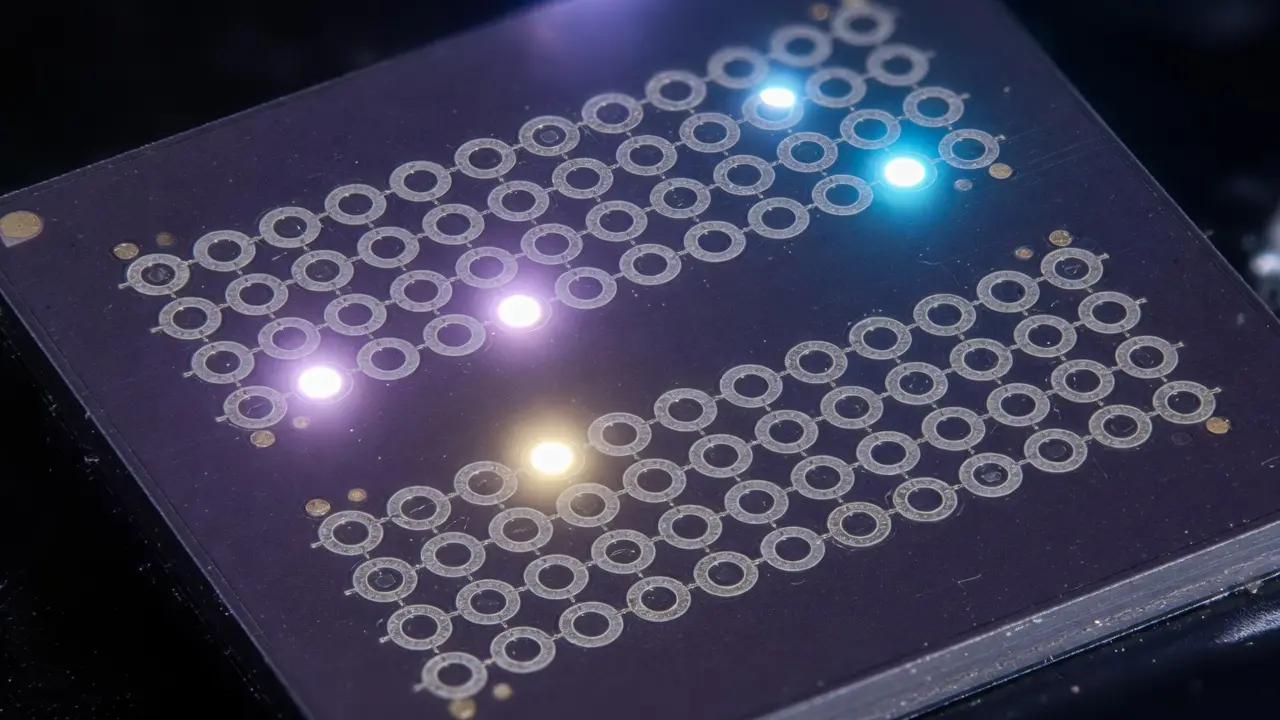
Researchers at Delft University of Technology have determined that the optimal method for moving multi-spin qubits depends on the distance they travel. The work analyzes how decoherence and leakage affect logical qubits, encoded using two, three, or four spins, during shuttling, finding that parallel shuttling best protects qubits over short distances, while sequential shuttling excels at long-range transport. This distinction arises from correlated noise affecting pairs of shuttled spins, and the team provides explicit expressions for predicting qubit performance based on independently measured factors. These results offer guidance for building noise-resilient, scalable semiconductor quantum processors.
Multi-Spin Qubit Encodings for Decoherence Resilience
The ability to accurately predict multi-spin qubit performance relies on understanding a few independently measured parameters, according to new work analyzing decoherence during qubit shuttling. This simplification stems from the observation that describing logical qubit evolution requires only a small two-dimensional subspace of the larger Hilbert space, reducing the need to know all dephasing factors.
While different multi-spin encodings offer advantages like efficient readout and resilience to noise, the emergence of qubit shuttling as a path to scalable quantum architectures introduces new challenges to maintaining qubit coherence. The analysis reveals that parallel shuttling best protects against decoherence over short distances, whereas sequential shuttling proves more effective for long-range transport, though the precise distance at which one method surpasses another is dependent on specific device parameters.
This distance-dependent behavior is explained by the dephasing factors of pairs of shuttled spins, allowing for explicit expressions for fidelities and leakage to be derived. Experimentalists can now predict performance of the multi-spin qubits from several independently measured pairwise dephasing factors.
Singlet-Triplet Qubit Shuttling Performance Analysis
This contrasts with the assumption that a single shuttling strategy would universally minimize decoherence, highlighting a critical interplay between trajectory and qubit fidelity. The study extends beyond singlet-triplet qubits, examining exchange-only and singlet-only encodings with various shuttling strategies, and numerically calculated average fidelity and leakage across a broad range of experimental parameters. This simplification is a significant advantage, as it reduces the complexity of characterizing multi-spin qubits and accelerates the development of scalable quantum processors.
The team’s approach allows for the prediction of qubit performance based on a limited set of independently measured parameters, streamlining the experimental process and reducing the resources required for optimization. “Besides its theoretical value, such a representation provides guidance for planning and analyzing experiments,” the researchers state, emphasizing the practical implications of their work.
By understanding how different shuttling protocols interact with noise, researchers can design architectures that minimize decoherence and maximize qubit fidelity. The team’s findings offer valuable guidance for experimentalists seeking to optimize the performance of multi-spin qubits in future quantum devices.
Exchange-Only Qubit Shuttling Strategies Investigated
The fidelity of three-spin exchange-only qubits during shuttling is demonstrably affected by the chosen transport protocol, with sequential shuttling maintaining higher performance over longer distances than parallel approaches. This distinction arises from the way correlated noise impacts the collective spin states, a nuance revealed through detailed analysis of dephasing factors. Analysis of singlet-triplet qubits showed that parallel shuttling offered the best protection against decoherence when the distance between shuttling channels was short. But this advantage diminished as the separation increased.
Singlet-Only Qubit Shuttling and Fidelity Limits
This detailed relationship challenges the assumption of a universally optimal shuttling method, demonstrating that the ideal approach is dependent on the scale of qubit movement. This parameter directly impacts the overall fidelity, with the calculations providing a quantifiable connection between phase differences and performance degradation.
Extending this analysis to singlet-only qubits, the study identified two additional parameters, and , representing spin-pair errors between next-nearest neighbors for sequential and parallel protocols, respectively. These parameters become increasingly important when assessing the fidelity of singlet-only qubits, and their inclusion simplifies the analysis of four-spin encodings, allowing for a unified description across all three qubit encoding schemes examined.
Parallel Shuttling Optimizes Short-Distance Fidelity
Parallel shuttling consistently outperforms other methods when moving multi-spin qubits over short distances, a finding that refines understanding of decoherence during quantum computation. Analysis reveals that sequential shuttling, conversely, maintains higher fidelity during long-range qubit transport, demonstrating that a single shuttling protocol is not universally optimal. The precise boundary between short and long range, however, depends on specific device parameters, requiring careful calibration for each architecture.
This differing performance stems from how each method handles the dephasing of paired spins during movement. Sequential shuttling, while exhibiting a smaller cross-covariance, sustains it for a longer duration, proving more effective over greater distances.
The analysis considered two-, three- and four-spin encodings, revealing that the general trend, parallel for short distances and sequential for long, holds across these different qubit architectures. Results show that for inter-channel distances of 0.4, 0.6, and 0.8, parallel shuttling consistently minimizes fidelity loss at shorter ranges, while sequential shuttling excels at longer ranges.
The ability to predict performance based on independently measured parameters represents a practical advancement, enabling experimentalists to refine their designs and mitigate the effects of decoherence. A detailed understanding of decoherence mechanisms is essential for building robust and scalable quantum computing systems.
Sequential Shuttling Excels at Long-Range Transport
Analyses of two-, three-, and four-spin encodings reveal that parallel shuttling excels at minimizing decoherence for short-range qubit movement, while sequential shuttling maintains higher fidelity and lower leakage when qubits travel further. These differing performances stem from how each protocol interacts with spatio-temporally correlated 1/f noise, a common source of decoherence in semiconductor qubits.
The research demonstrates a clear relationship between shuttling trajectory and the accumulation of errors, allowing for noticeable reductions in decoherence through careful protocol selection. Specifically, the rate at which errors accrue differs between parallel and sequential shuttling; errors from sequentially shuttled spins grow slowly but are larger at small shuttling lengths, while parallel shuttling exhibits smaller initial errors that increase more rapidly.
This explains why sequential shuttling becomes more beneficial as the distance increases, maintaining qubit integrity over extended transport. “Decoherence strongly depends on the trajectories of the shuttled spins and can be reduced by selecting suitable shuttling protocols,” the study notes, highlighting the importance of tailored approaches. The analysis reveals that decoherence of two spins shuttled through parallel channels differs markedly from that of spins moved sequentially along the same channel.
👉 More information
🗞 Trajectory-Dependent Decoherence and Leakage During Shuttling of Multi-Spin Qubits
✍️ Yu-Ning Zhang, Aleksandr S. Mokeev, Maximilian Rimbach-Russ, David P. DiVincenzo and Viatcheslav V. Dobrovitski (QuTech and Kavli Institute of Nanoscience, Delft University of Technology, PO Box 5046, 2600 GA Delft, The Netherlands)
🧠 ArXiv: https://arxiv.org/abs/2611.09873v1

See today’s quantum computing news on Quantum Zeitgeist for the latest breakthroughs in qubits, hardware, algorithms, and industry deals.