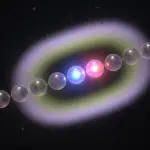
The researchers used intrinsic ^(14)N nuclear spins within nitrogen-vacancy centers in levitated diamond as sensing qubits, encoding rotation into a geometric phase. This advance overcomes limitations of existing near-resonant operation by employing a counter-diabatic protocol derived from the Kato gauge potential, establishing a path toward high-performance, solid-state quantum gyroscopes for inertial navigation and fundamental physics experiments.
Berry Phase Encoding for 3D Rotation Sensing
Intrinsic ^(14)N nuclear spins within levitated diamond crystals are used as sensing qubits in a new approach to building compact, solid-state quantum gyroscopes. This method encodes three-dimensional rotation into a geometric, or Berry, phase, offering a distinct advantage over conventional gyroscope designs that rely on accumulating dynamical phase. This builds on recent advances in mechanically rotated nitrogen-vacancy (NV) diamond systems, using the Barnett effect to create an effective magnetic field proportional to the rotation rate.
A key challenge in NV-based gyroscope development is the weakness of the rotation-induced signal, particularly when operating in a near-resonant regime designed to amplify the response. Near-resonant operation, while increasing sensitivity, can trigger nonadiabatic transitions that degrade the accumulated geometric phase and reduce readout fidelity. This protocol enables robust geometric-phase accumulation, improving sensitivity by four orders of magnitude compared to traditional detuned protocols.
The work details the Hamiltonian of the ^(14)N nuclear spin under three-dimensional mechanical rotation, analyzing the resulting spin dynamics to optimize the sensing scheme. Section II of the paper establishes this model, while Section III derives the counter-diabatic driving field.
The researchers evaluated the achievable sensitivity and identified dominant experimental limitations, including decoherence and the overhead associated with the counter-diabatic protocol, to establish a realistic path toward high-performance quantum gyroscopes. “Geometric-phase-based sensing in mechanically rotated NV-diamond systems has recently emerged as a promising direction,” the paper notes, highlighting the potential of this approach for future navigation and sensing technologies.
Counter-Diabatic Protocol Suppresses Nonadiabatic Leakage
A near-resonant regime amplifies the geometric-phase response for rotation sensing, but also introduces a vulnerability to nonadiabatic transitions that degrade signal fidelity. Researchers addressed this challenge with a counter-diabatic protocol, a technique rooted in the Kato gauge potential, to stabilize the process and maintain signal clarity. This intervention enables robust geometric-phase accumulation, a key step toward realizing practical quantum gyroscopes. Analysis indicates that an ensemble of one million NV centers could achieve a shot-noise-limited sensitivity of approximately 0.6 at the optimal operating point.
This sensitivity improvement, a factor of four orders of magnitude, stems from suppressing nonadiabatic leakage, the unwanted loss of quantum information, while simultaneously benefiting from the enhanced phase response. “To overcome this limitation, we introduce transitionless counter-diabatic control formulated in terms of the Kato gauge potential, which suppresses nonadiabatic leakage while preserving the near-resonant enhancement,” the researchers write.
Sensitivity Analysis of NV Centers in Levitated Diamonds
Achieving a shot-noise-limited sensitivity of 0.6 requires careful consideration of experimental factors. The study uses intrinsic ^(14)N nuclear spins associated with nitrogen-vacancy centers as sensing qubits, capitalizing on the long spin coherence times and room-temperature optical initialization and readout inherent to these diamond-based systems. Researchers evaluated achievable sensitivity under realistic conditions, factoring in decoherence and protocol overhead, critical considerations for practical implementation, within the established framework of quantum sensing.
Stable high-speed rotation has already been demonstrated for both levitated micro- and nanoparticles in vacuum, and levitated diamonds hosting NV centers have been coherently controlled in both optical and electrodynamic traps. The team’s approach encodes rotation within a geometric, or Berry, phase, identifying a near-resonant regime that strongly enhances phase response, but necessitates the counter-diabatic protocol to maintain signal fidelity.
👉 More information
🗞 Quantum gyroscope based on a Berry phase induced by three-dimensional rotation
✍️ Huaijin Zhang and Zhang-Qi Yin
🧠 DOI: http://link.aps.org/doi/10.1103/z6h7-y4cp




See today’s quantum computing news on Quantum Zeitgeist for the latest breakthroughs in qubits, hardware, algorithms, and industry deals.