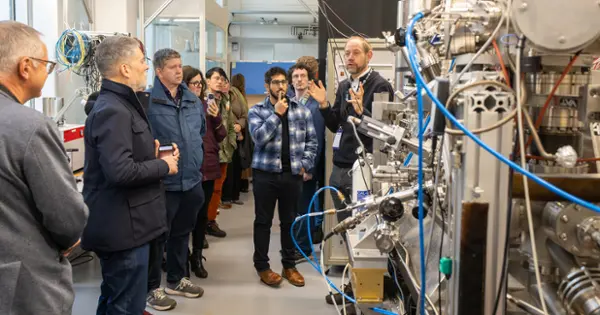
Julia Cramer contributed to the strategy on behalf of Leiden University and wrote the foreword. Journalists from regional, national, and international media recently toured quantum technology sites across Zuid-Holland, culminating at Leiden University’s Quantum Hub within the Bio Science Park.
This park uniquely houses both fundamental research and startup ventures, as well as corporate partnerships, as Cramer explains: “We have startups and collaborations with different companies at the Bio Science Park.” The concerted tour aimed to demonstrate Zuid-Holland’s position as a leading region for quantum innovation.
Zuid-Holland’s Quantum Ecosystem: Science, Startups, and Bio Science Park
The Bio Science Park in Leiden hosts a uniquely comprehensive quantum ecosystem, encompassing research spanning fundamental physics to software development and commercial ventures. The coordinated visit aimed to demonstrate the region’s position as a central hub for quantum innovation and practical application across sectors including communication, healthcare and energy.
The government’s plan, presented in early October, outlines a goal for the Netherlands to become a leader in quantum technology by 2035, prioritizing reduced reliance on non-EU applications and enhanced security. Cramer, also coordinator of the Quantum and Space theme, emphasized the breadth of expertise available within Leiden, stating, “All aspects of quantum are represented here: fundamental, applied, experimental and software.” This comprehensive approach, she argues, is a key strength of the Bio Science Park.
The park’s ability to integrate diverse perspectives further enhances its potential, according to Cramer. “Take ethics, law or society, for example,” she explained, noting close collaborations with other university faculties and increasing partnerships with the nearby Space Campus. This interdisciplinary approach, combined with the Bio Science Park’s location, creates a fertile ground for future opportunities. Cramer believes broad societal understanding of quantum technology is important, and hopes the recent press tour will facilitate connections between journalists and Leiden’s quantum experts.
The tour itself presented the link between foundational research and practical application within Leiden’s facilities. Scientific Director Jan van der Molen of the Leiden Institute of Physics led journalists through the Faculty of Science, highlighting the Ehrenfest Signature Wall bearing the autographs of Albert Einstein and Niels Bohr. The group then explored vibration-free halls housing advanced equipment, including the Low-Energy Electron Microscope (LEEM).
This instrument uses energy-efficient electrons to scan ultra-thin quantum materials, bridging the gap between fundamental physics and software development through both existing instruments and the creation of new ones. Measurements taken within these facilities are a critical link between theoretical physics and the development of practical software solutions. The Quantum Hub hosted presentations from Leiden research groups, covering topics ranging from quantum and society to the impact of quantum innovation on citizens and space exploration.
Evert van Nieuwenburg presented on the role of machine learning in society, while Cramer discussed the importance of effective communication about quantum technology, asking, “Who are we trying to reach? How should we reach them, and why?” She also explored the portrayal of quantum physics in the media and its effect on public perception.
Cramer believes the press tour will be successful if “everyone comes away with an understanding of the complexity of the quantum field in Leiden.” Accessible and clear information, she argues, is essential for encouraging public knowledge about quantum technology. The press can help disseminate the work of Leiden researchers.
All aspects of quantum are represented here: fundamental, applied, experimental and software. We have startups and collaborations with various companies at the Bio Science Park.

See today’s quantum computing news on Quantum Zeitgeist for the latest breakthroughs in qubits, hardware, algorithms, and industry deals.