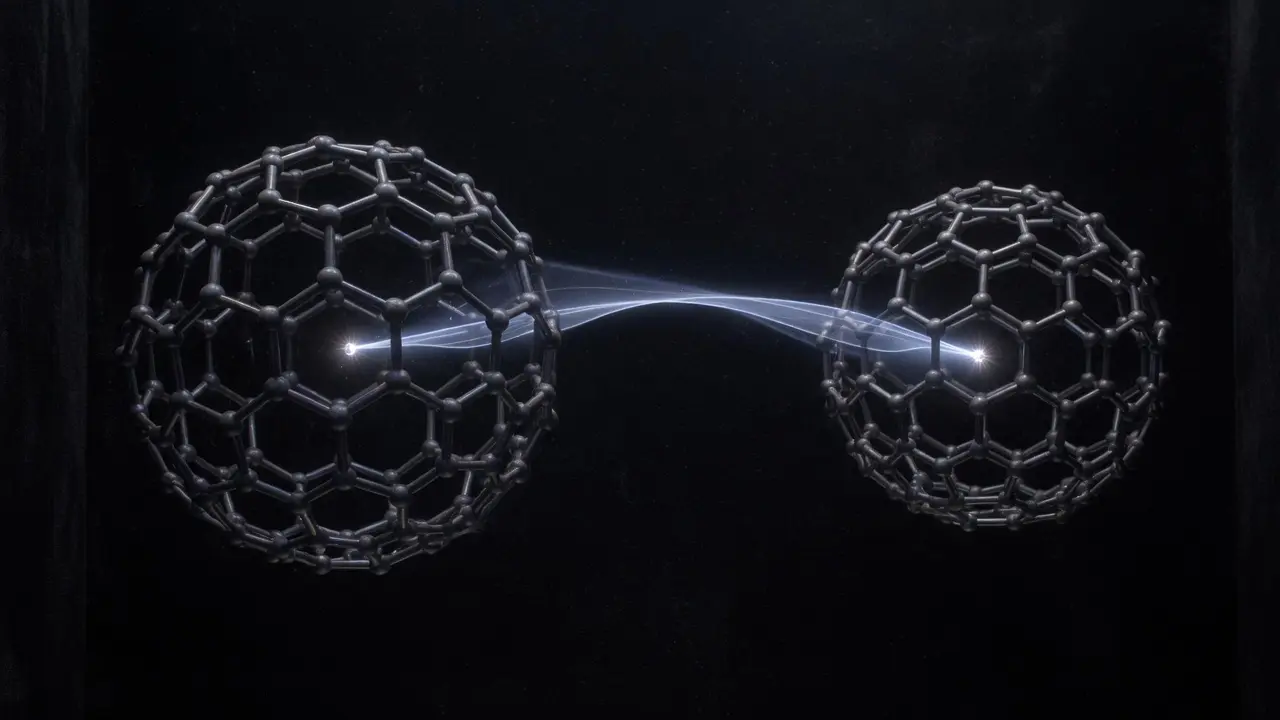
Quantum annealing accurately calculates molecular ground-state energies. Applying reverse quantum annealing within a Quantum Annealing Eigensolver framework sharply improves these calculations for alkaline-earth monofluoride molecules by minimising errors from initial attempts at solving the problem. The method allows computation of electronic structures with sub-milliHartree chemical accuracy; a level of precision vital for understanding bonding, stability and other key properties.
A technique for calculating molecular energy levels with quantum annealers has been refined, improving accuracy to within one thousandth of a Hartree, a standard unit in chemistry. This advancement minimizes errors that typically occur when solving these complex problems on current quantum hardware. Reverse quantum annealing refines initial calculations, achieving sub-milliHartree chemical accuracy which is key for understanding how molecules bond and behave.
The team at Centre for Quantum Engineering, Research and Education (CQuERE) demonstrated a strong improvement in calculating molecular energy levels with quantum annealers; achieving accuracy within one thousandth of a Hartree, a standard unit used by chemists. RQA works like proofreading an initial draft: it systematically undoes some computational steps to identify and correct mistakes.
This process applies the broader framework of the Quantum Annealing Eigensolver, which first translates the problem into mathematical representations known as QUBOs, akin to converting English instructions into machine code, so a computer can understand them, before optimisation begins. But how reliably does this refinement scale with increasingly intricate molecular structures.
Reverse Quantum Annealing Achieves Sub-MilliHartree Accuracy For Alkaline-Earth Monofluorides
Residual errors in ground-state energy calculations for alkaline-earth monofluoride molecules have been dramatically reduced using a new approach: reverse quantum annealing (RQA). RQA eliminated between 82.3% and 98.1% of those stemming from initial forward annealing attempts, surpassing previous limitations. Achieving sub-milliHartree chemical accuracy, a level previously unattainable with standard methods, was made possible by optimised RQA schedules refined at the Centre for Quantum Engineering. These schedules systematically minimised configuration errors within partitioned Dirac, Coulomb Hamiltonians to unlock this enhanced molecular electronic structure calculation capability.
BeF, MgF, CaF, SrF, and BaF serve as benchmarks in precision relativistic chemistry and tests of fundamental physics; these improvements are particularly important for open-shell diatomic molecules like them. Calculations extended across both (3e, 8o) and (7e, 14o) active spaces, demonstrating scalability within the Quantum Annealing Eigensolver algorithm. Exact Full Configuration Interaction (FCI) diagonalization provided an absolute reference point to validate results with these benchmark molecules, strontium fluoride has also utilised it in laser cooling experiments.
Precision with Alkaline Earth Monofluorides Indicates Potential Yet Unproven Broad Applicability
This work demonstrates a pathway to highly accurate molecular calculations using quantum annealers, reaching precision previously unattainable with standard methods; however, its immediate impact remains constrained by scope. The Centre for Quantum Engineering successfully refined their approach on alkaline-earth monofluoride molecules, but it’s unclear whether these gains will translate seamlessly to more complex chemical systems or different mathematical representations of those systems. This limitation isn’t merely about computational cost, it concerns fundamental adaptability: can reverse quantum annealing consistently correct errors arising from diverse electronic structures and Hamiltonian formulations?
The team at the Centre for Quantum Engineering has demonstrated that quantum annealers can achieve precise results when calculating molecular energies despite this current limitation to relatively simple molecules. Carefully controlling information flow during calculations using ‘reverse annealing,’ a process systematically minimising residual configuration errors as they arise within the system, refined their technique. They also developed a method involving partitioning the Dirac, Coulomb electronic Hamiltonian into sub-QUBOs and restoring connections between components after an initial attempt with hardware featuring Pegasus graph connectivity while employing both small and larger representations of electron interactions.
This research successfully calculated ground-state energies of alkaline-earth monofluoride molecules with accuracy approaching sub-milliHartree levels. This work establishes a method for improving molecular electronic structure calculations using quantum annealers. The authors suggest this approach may enable more precise energy estimations within that computational paradigm.
👉 More information
🗞 Reverse Quantum Annealing for Ground-State Energy Calculation in Molecule
✍️ Pradyot Pritam Sahoo (Affiliation: Centre for Quantum Engineering)
🧠 ArXiv: https://arxiv.org/abs/2610.39129




See today’s quantum computing news on Quantum Zeitgeist for the latest breakthroughs in qubits, hardware, algorithms, and industry deals.