
Researchers at the Information Engineering University in Zhengzhou, China have proposed a new Hybrid Turing Machine (HTM) model to address critical challenges in building cohesive classical-quantum computing systems. By unifying state sets and transition functions, HTM clarifies control logic and introduces a method for calculating computational complexity based on entanglement and superposition, supporting automated resource allocation. The HTM ultimately aims to fill a theoretical gap and accelerate the joint development of computing models and hardware.
HTM Model Addresses Gaps in Hybrid Computation
All six authors, Guoqiang Shu, Zongjiang Yi, Jinyang Yao, Haomiao Dong, Zhihang Li, Fudong Liu and Zheng Shan, are affiliated with that single institution, a concentration notable within a field typically characterized by international collaboration. The HTM introduces a control-sharing mechanism built on unified state sets and transition function representations, clarifying the logic governing how instructions are dispatched to both classical and quantum computing components.
This unified approach aims to resolve inconsistencies present in existing hybrid integration devices, offering a standardized theoretical description to guide future engineering efforts. Beyond clarifying control logic, the HTM incorporates a complexity calculation method rooted in the principles of entanglement and superposition, enabling a more detailed approach to computation task partitioning and resource scheduling. The development of HTM, as detailed in the research, seeks to fill a theoretical gap in the classical-quantum hybrid computation area and facilitate the joint advancement of both computing models and the hardware that implements them.
Unified State and Transition Functions in HTM
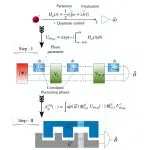
The Hybrid Turing Machine (HTM) model standardizes control logic through unified state sets and transition functions, resolving inconsistencies found in current integration devices. The model’s architecture, state space, transition mechanism, and control-sharing principle are systematically detailed, revealing the deep integration between classical and quantum computation under a single controller. HTM’s complexity calculation method, rooted in quantum state transformation and entanglement, supports fine-grained resource scheduling. The unified controller manages concurrency between the classical and quantum read/write heads; when the quantum head executes transformations, the classical head halts, resuming after measurement via an interrupt signal.
This scheduling strategy allows for exponential acceleration through classical-quantum collaboration, as the classical control portion remains polynomial in all cases. The HTM’s design allows for Boolean functions on the classical track, recognizing these as special, deterministic transitions that do not violate unitarity.
The model directly addresses practical challenges, notably non-standardized engineering architecture design and ambiguous task partitioning criteria. “HTM effectively alleviates the critical bottleneck of insufficient theoretical support in existing hybrid computing systems,” the research states, emphasizing the model’s role in filling a theoretical gap.
HTM Control-Sharing Mechanism for Classical-Quantum Tasks
The absence of a standardized approach to building classical-quantum systems currently relies on empirical engineering practices, potentially leading to inefficient resource allocation. This method moves beyond manual programming of hybrid systems by providing a means to determine how to best divide computational workloads between classical and quantum resources. The model’s creators propose that this approach supports fine-grained, reliable scheduling, maximizing the use of both computing paradigms.
The HTM model’s control-sharing mechanism is central to its function, defining how operations are delegated between the classical and quantum components. “Consequently, task partitioning between classical and quantum resources is currently guided by empirical engineering practices rather than rigorous theoretical principles,” the paper states, emphasizing the need for a more formalized approach to hybrid computation.
A comprehensive complexity calculation method based on entanglement and superposition was proposed, supporting computation task partitioning and resource scheduling. The analysis considers both the initial and target states to determine the computational cost of achieving a given transformation.
IBM Qiskit, Cirq, and Sinan Enable Hybrid Platforms
Representative frameworks like Sinan are actively enabling the reuse of quantum algorithms across different platforms, an important step toward building functional hybrid computational systems. These tools not only support algorithm development for Noisy Intermediate-Scale Quantum (NISQ) devices but also facilitate the construction of GPU-QPU collaborative architectures, effectively linking quantum software with underlying hardware. Global supercomputing centers are already integrating quantum and classical computation platforms, using classical systems for data preprocessing, error correction, and analysis while assigning computationally intensive tasks like combinatorial optimization and quantum simulation to quantum devices.
The newly proposed Hybrid Turing Machine (HTM) model builds upon this existing infrastructure, aiming to formalize the execution of hybrid algorithms within a unified framework. The HTM’s design incorporates a control-sharing mechanism, allowing for precise scheduling of operational transformations and complexity analysis, and is intended to support the joint development of both computing models and hardware.
Turing & Church-Turing Thesis Foundations of Computation
The foundations of modern computation rest on equivalencies established nearly a century ago; in 1936, Alonzo Church formalized computability with the λ-definability model, demonstrating its equivalence to recursive functions and, importantly, to the Turing machine proposed by A.M. Turing that same year. This convergence, later solidified by Stephen Kleene’s work on recursive function theory, established the Church-Turing Thesis, defining the boundaries of what is considered “computable” and providing a theoretical bedrock for all subsequent computer science. The thesis asserts that any mechanical computation can, in principle, be performed by a Turing machine, a concept that continues to shape the design and analysis of algorithms.
Building upon this groundwork, the mid-20th century saw refinements in abstract models and the emergence of automata theory. Emil Post’s 1936 POST machine, Turing-equivalent in its capabilities, laid the foundation for understanding finite automata, while Andrey Markov Jr.’s 1947 Markov algorithm advanced language theory by formalizing unsolvable problems. These early explorations established the concept of a benchmark for computational power still used to evaluate new computing paradigms.
From the 1970s onward, research shifted towards defining complexity boundaries between different computational models; Stephen A. Cook et al.’s 1973 time-bounded RAM model provided a framework for comparing the efficiency of algorithms across various architectures.
Quantum Turing Machine Extends Classical Model
The foundation for modern computing received a novel extension with the introduction of a hybrid classical-quantum computation model, the Hybrid Turing Machine (HTM), which integrates both classical and quantum processing onto a shared computational tape. Building upon Alan Turing’s foundational 1936 work, the HTM incorporates two independent read/write heads, one classical, one quantum, managed by a single unified controller. This architecture departs from previous approaches by aiming for cohesive control rather than simply linking existing classical and quantum systems.
The model’s unified controller, denoted as , schedules operations for both heads, enabling a shared resource across the classical and quantum tracks of the tape. The HTM’s structure, with its dual heads and unified control, is intended to streamline the process of assigning computational tasks.
The research proposes a hybrid classical-quantum computation model (HTM) by constructing unified state sets and transition function representations, clarifying hybrid control logic and implementing a control-sharing mechanism. The HTM’s architecture is not merely theoretical. It directly addresses practical concerns in building cohesive quantum-classical systems, moving beyond the question of if these systems can work together to how they can be constructed efficiently.
The model’s creators envision a future where the boundaries between classical and quantum computation become increasingly blurred, enabling more powerful and versatile computing systems. The HTM’s unified control and shared tape represent a step towards realizing that vision, offering a new pathway for exploring the intersection of classical and quantum information processing.
HTM Supports Fine-Grained Resource Scheduling
The Hybrid Turing Machine model directly addresses a critical need for standardized theoretical guidance in hybrid computing, moving the field beyond reliance on empirical engineering practices. This approach resolves inconsistencies often found in current integration devices and establishes a foundation for more cohesive system design. A core innovation within HTM is a complexity analysis method based on quantum state transformation, providing a means to quantify, decompose, and verify computational complexity. This analysis doesn’t simply measure cost. It actively guides the scheduling and allocation of both classical and quantum micro-operations, optimizing resource use for specific tasks.
The method employs Dirac notation, tracking system states at discrete time steps to assess the operational foundations of complexity within the hybrid system. “State transformation lays an operational foundation for the quantification, decomposition, and verification of HTM complexity,” the research states, highlighting the method’s central role. The HTM’s architecture, featuring dual read-write heads and unified control, is designed to achieve a strong working relationship and optimal resource allocation.
This focus on engineering practicality is evident in the model’s ability to support fine-grained, highly reliable scheduling of hybrid resources, a capability absent in many earlier designs. The HTM’s complexity description supports task partitioning, enabling a more informed decision-making process for dividing computations between classical and quantum processors. The research team proposes future work will focus on optimizing the model architecture, control protocols and interaction interfaces in conjunction with hardware devices, and exploring adaptive task partitioning strategies based on detailed complexity analysis.
👉 More information
🗞 HTM: A Hybrid Classical-Quantum Computation Model
✍️ Zongjiang Yi, Jinyang Yao, Haomiao Dong, Zhihang Li, Fudong Liu and Zheng Shan (Information Engineering University, Zhengzhou, 450001, China); Guoqiang Shu
🧠 ArXiv: https://arxiv.org/abs/2610.37249



See today’s quantum computing news on Quantum Zeitgeist for the latest breakthroughs in qubits, hardware, algorithms, and industry deals.