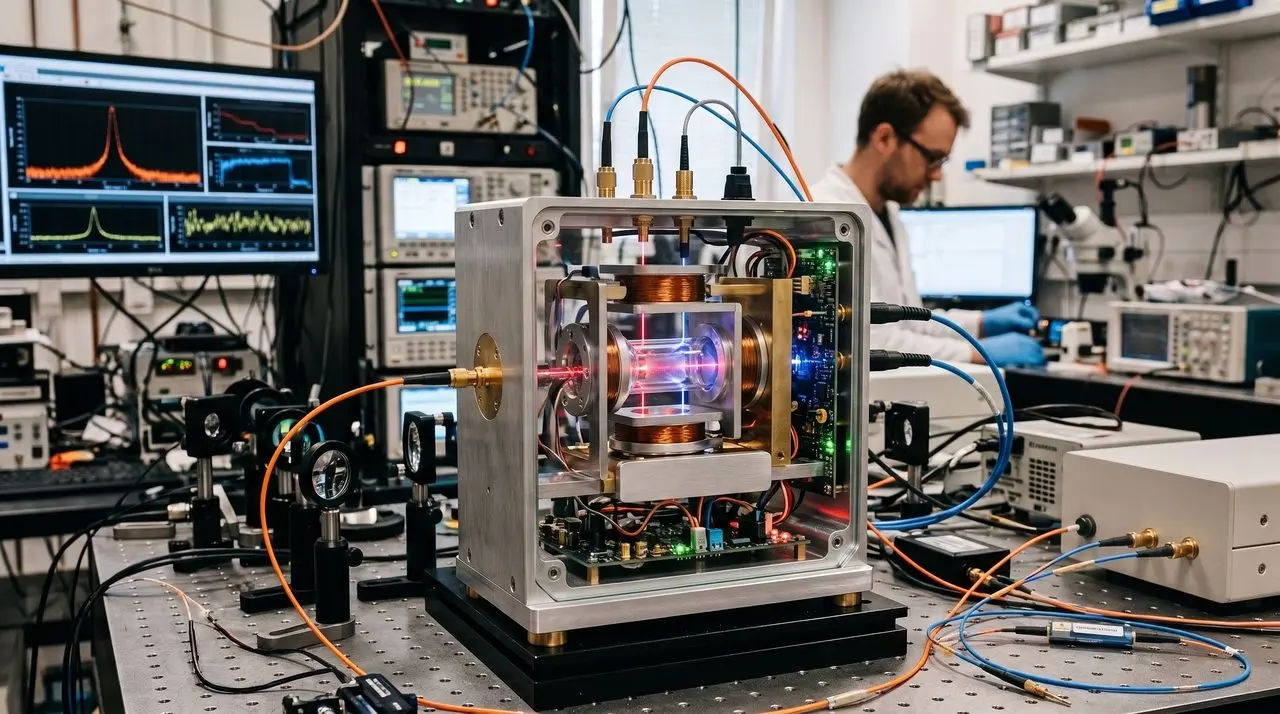
Zachary Bogorad and Roni Harnik of Fermi National Accelerator Laboratory have identified a fundamental constraint on detector sensitivity, revealing that the strength of coherent enhancement, a technique for improving detection, is quantitatively limited by entanglement. Their work demonstrates that as detectors grow in size, the amount of entanglement within them dictates how much sensitivity can be gained, establishing bounds on how effectively coherent effects can scale.
The researchers prove these limits apply to both parameter estimation and scattering processes, linking the single-mode entanglement entropy of a detector to its performance. These findings offer a unified view of coherent enhancement and suggest new avenues for generating entangled detector states.
Entanglement Bounds Coherent Enhancement in Detectors
This constraint applies whether the detector is used for precise parameter estimation or for observing scattering events, providing a unified framework for understanding coherent enhancement across diverse experimental setups. The research establishes bounds on the quantum Fisher information of many-body states, which directly translate into limits on parameter sensitivity via the quantum Cramér-Rao bound. This means the theoretical quantum property of Fisher information, a measure of how much information a measurement can yield, is capped by the detector’s entanglement, ultimately defining the precision with which a parameter can be measured.
The team’s calculations show that detectors with intermediate levels of entanglement will exhibit intermediate scaling, placing universal limits on the coherence that can be extracted from partially entangled systems. This is a departure from the expectation that simply increasing detector size would always lead to improved performance.
The findings also predict how minimum detectable interaction strengths scale with target size, offering insight into the limits of scattering experiments. Specifically, the work suggests there is a fundamental limit to how small a signal a detector can pick up as the target gets larger, a constraint on the scattering cross sections observed in these experiments. “We derive general bounds on collective responses generated by sums of local operators, demonstrating that the coherent contribution is controlled by the correlations present in the underlying many-body state,” the authors write.
This implies that even with a larger target, the ability to detect weak interactions is ultimately governed by the entanglement present within the detector itself. For pure quantum states, the bounds on coherent enhancement can be expressed in terms of the average single-subsystem von Neumann entropy, providing a simple way to understand the relationship between entanglement and detector performance.
The team found that these states exhibit a scaling between incoherent O(N) performance and maximally coherent O(N^2) performance, where N represents the system size. Mixed states, however, admit similar bounds through an entanglement of formation-type quantity, allowing for a more detailed understanding of entanglement in complex systems. These results are largely model-independent, relying only on the structure of the detector’s Hilbert space and the entanglement properties of its quantum state.
The implications extend beyond fundamental limits, offering practical guidance for the design and interpretation of experiments that rely on coherent enhancement. From atomic sensors to particle detectors, understanding these constraints is important for optimizing performance and accurately interpreting results. The analysis clarifies the entanglement resources required to surpass incoherent scaling, suggesting that simply building larger detectors is not always the answer. Instead, the focus should be on maximizing entanglement within the detector itself.
The team’s approach frames coherent enhancement as a direct product of entanglement, motivating the development of new techniques for generating and employing entanglement to improve measurements across a wide range of applications. This suggests a shift in focus from simply increasing detector size to actively engineering entanglement within the detector material. The work also provides a unified information-theoretic framework for understanding the limits of coherent enhancement across quantum sensing, metrology, and scattering experiments.
This framework allows researchers to compare and contrast different experimental setups, identifying the key factors that limit performance and guiding the development of new strategies for overcoming these limitations. The researchers emphasize that their analysis applies to scenarios where the final states are disjoint from the initial state, allowing for detectable but not coherently enhanced processes.
Conversely, large momentum uncertainties can lead to overlapping initial and final states, potentially enhancing the cross section but reducing the effectiveness of the initial state. The study demonstrates that coherent enhancement is quantitatively limited by entanglement, a fundamental constraint that must be considered when designing and interpreting experiments.
“In this work, we have derived general bounds on coherent enhancement in many-body detectors and targets, showing that superlinear scaling with system size is quantitatively constrained by entanglement,” the authors conclude. This finding has significant implications for the future of detector technology, suggesting that the pursuit of ever-increasing sensitivity will require a deeper understanding and control of quantum entanglement.
Single-Mode Entanglement Entropy Limits Scaling with System Size
This connection, detailed in recent work, establishes that the scaling of coherent effects is not limitless, but rather constrained by the degree of entanglement present within the detector’s quantum state. The analysis reveals that detectors with intermediate entanglement exhibit intermediate scaling, a finding that refines the relationship between multipartite entanglement and enhanced quantum Fisher information. The research demonstrates that achieving fully coherent improvement, reducing error to a level proportional to one over the system size, requires a non-zero, system-size-independent density of entanglement entropy.
This means that simply adding more components to a detector will not indefinitely improve its sensitivity if entanglement is not actively engineered and maintained. The work extends the familiar distinction between standard and Heisenberg-limited scaling to a broader class of states, providing a more subtle understanding of the limits of quantum enhancement. The implications extend beyond quantum metrology, impacting the design of scattering experiments as well.
The analysis yields bounds on coherent contributions to inelastic transition probabilities, ultimately limiting how detectable interaction strengths can scale with target size. This is particularly relevant for particle physics experiments that use coherent scattering to amplify signals from weakly coupled probes, but the framework itself is applicable to any physical realization. This allows for a direct comparison of different experimental setups, identifying the key entanglement resources needed to surpass incoherent scaling.
The analysis also clarifies how entanglement is distributed across the system, revealing that partially entangled states exhibit intermediate behavior between fully incoherent and maximally coherent scaling. This understanding is important for designing detectors that maximize sensitivity within the constraints imposed by entanglement.
Conversely, a lack of entanglement between subspaces prevents any covariance between distinct parts of the system, limiting the total variance to a linear scaling with system size. The findings demonstrate that coherent enhancement, the constructive addition of amplitudes from many detector constituents, is a quantifiable one tied directly to entanglement, not a limitless resource.
Quantum Fisher Information Constrains Parameter Sensitivity
Researchers there have established that this information, and therefore parameter sensitivity, is fundamentally constrained by the degree of entanglement within a detector system. The distribution of entanglement is critical. The team’s analysis reveals that the maximum achievable quantum Fisher information is limited by the entanglement present in the detector, effectively establishing a trade-off between system size and entanglement quality.
A detector’s ability to surpass incoherent scaling, where sensitivity improves only with the square root of the detector size, depends entirely on the entanglement entropy of its constituent parts. Specifically, the research demonstrates that coherent contributions to inelastic transition probabilities, and thus the ability to detect faint signals, are similarly constrained by entanglement.
The research clarifies that detectors prepared in a not-quite-polar Dicke state, a specific quantum state of N spin-1/2 particles, exhibit intermediate scaling behavior, falling between the fully incoherent and fully coherent regimes. This intermediate behavior highlights that partial entanglement is sufficient to achieve some enhancement, but not the maximum possible sensitivity. This is especially true when systems are highly inhomogeneous, with entanglement localized between only a few subsystems rather than widely distributed.
The analysis in Appendix B.1 of the paper details this effect, showing how localized entanglement weakens the overall signal. The team’s approach provides a unified perspective on seemingly disparate phenomena, linking enhanced quantum Fisher information in metrology with coherent contributions to scattering cross sections. This unification stems from the central role of entanglement in both processes, revealing that the distribution of entanglement dictates the achievable scaling behavior.
The implications of this work extend beyond simply identifying limits on detector sensitivity. This means future detector designs should prioritize maximizing entanglement entropy, rather than simply adding more components. The bounds established by the team are not absolute, and they acknowledge that improving upon them remains an open question.
“We leave proving or disproving such an improved bound to future work,” the authors concede. However, their current results provide a fundamental benchmark against which to evaluate new detector designs and entanglement generation strategies, offering a clear path toward maximizing sensitivity within the constraints imposed by quantum mechanics.
Coherent vs Incoherent Scaling in Target Momentum Distributions
The strength of coherent enhancement in detectors, the ability to amplify signals by constructively combining responses from many components, is fundamentally limited by the entanglement within the detector itself, according to recent analysis. The work establishes that the entanglement entropy of a detector quantitatively constrains how strongly coherent effects can scale with system size, moving beyond the previously understood linear and quadratic scaling regimes to reveal intermediate behaviors.
This connection between a theoretical quantum property and a practical limit on measurement precision is a key outcome of the study, offering a new way to assess detector performance. Consider a target composed of numerous spin-1/2 particles initially prepared in a coherent state; an incident particle can scatter by transferring spin to any target particle.
The researchers demonstrate that the scaling of detectable signals in such a scenario is not simply linear with the number of particles, nor is it always the fully coherent quadratic scaling often sought after. This behavior is exemplified by a scenario where the initial momentum distributions of target particles are neither fully independent nor perfectly correlated, resulting in a detectable but not optimally enhanced signal.
This has implications for scattering experiments, where the ability to detect weak signals is important. The findings illustrate that incoherent detectors can be easily detectable, while coherent detectors can be poorly detectable, and the key lies in finding an intermediate state that balances both. They found that this configuration exhibits intermediate scaling behavior, falling between the incoherent O(N) scaling and the fully coherent O(N^2) scaling, though it does not saturate the derived bound.
This demonstrates that even with partially entangled states, improvements over purely incoherent detectors are possible, but are ultimately constrained by the entanglement present.
👉 More information
🗞 Entanglement requirements for coherent enhancement in detectors
✍️ Zachary Bogorad and Roni Harnik
🧠 DOI: http://link.aps.org/doi/10.1103/w1ks-wdjp




See today’s quantum computing news on Quantum Zeitgeist for the latest breakthroughs in qubits, hardware, algorithms, and industry deals.