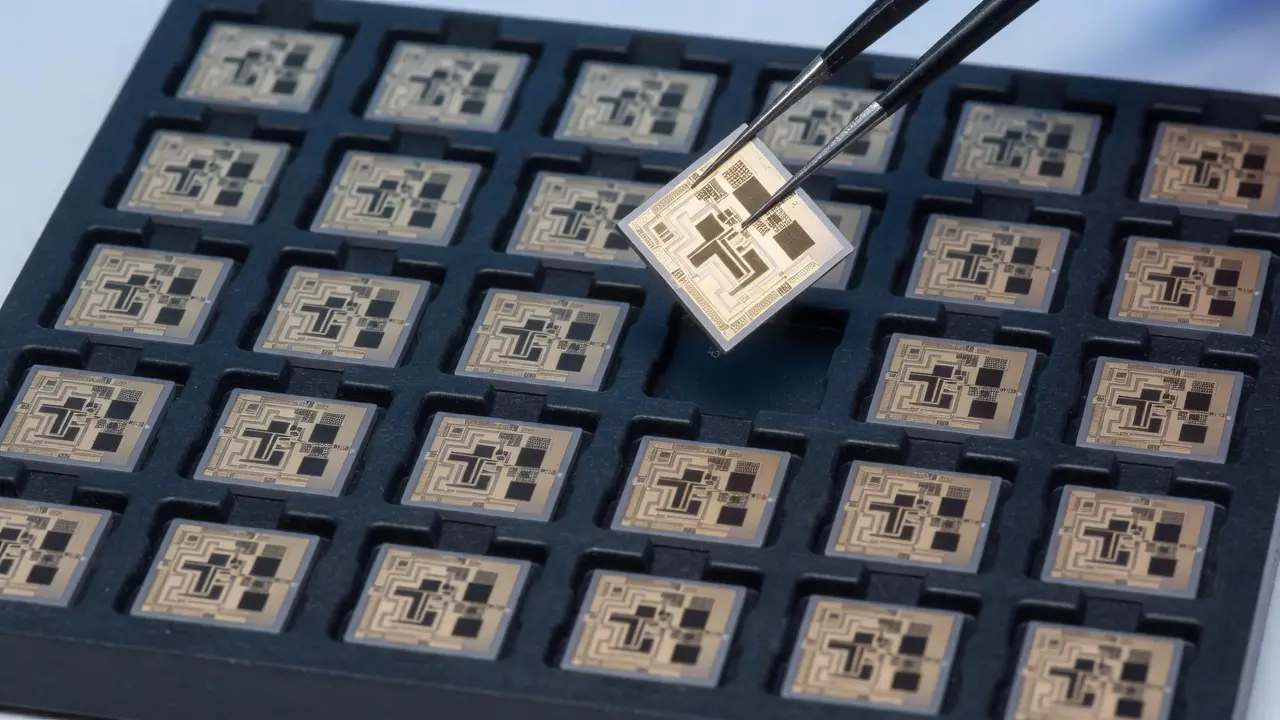
LYNX is a trapped-ion quantum information processor boasting up to thirty-one qubits and full connectivity between them. Characterisation revealed average one-qubit error rates of eight times ten to the minus five and two-qubit gate errors of approximately three thousandths. The new trapped-ion processor, LYNX, controls up to thirty-one qubits and directly connects any pair together.
Tests reveal very low error rates: less than one ten thousandth for single qubit operations and around three thousandths for paired qubit interactions. Alpine Quantum Technologies unveiled LYNX, a flexible trapped-ion quantum computer capable of controlling up to thirty-one qubits; key to its design is that every qubit can directly communicate with any other, a feature known as all-to-all connectivity. This architecture avoids delays caused by physically moving ions during calculations.
To assess performance, the team employed thorough tests including ‘stress testing’ and randomized benchmarking, alongside measures of how well multiple entangled qubits hold together and an overall “score” called quantum volume (QV). LYNX achieved a QV of two to the power of fifteen using fifteen qubits, demonstrating both a substantial number of qubits *and* strong reliability in their operation; single-qubit errors were less than one ten thousandth while paired qubit interactions had error rates around three thousandths. But can this level of control be scaled up further without sacrificing stability.
LYNX Processor Achieves Record Quantum Volume with High Fidelity Qubit Control
Alpine Quantum Technologies’ LYNX trapped-ion processor achieved a quantum volume (QV) of 2 15, marking a significant advance beyond previous demonstrations limited by lower qubit counts. Previous systems struggled to maintain sufficient fidelity as the number of qubits increased, hindering meaningful tests at this scale.
The device utilizes up to thirty-one qubits featuring all-to-all connectivity and demonstrates average single-qubit error rates of 8 ±5times 10-5 alongside two-qubit gate errors reaching 2.84 ±0.08times 10-3. Rigorous testing, including randomized benchmarking and GHZ state analysis, confirms both high performance *and* genuine multiparticle entanglement across the register, paving the way for more complex quantum computations.
An average single-qubit gate error rate of 8 ±5times 10-5 was measured when tested across twenty-four qubits using randomized benchmarking within a larger thirty-one qubit register. Two-qubit gates achieved an average error of 2.84 ±0.08times 10-3, assessed over all two hundred and seventy-six ion pairs in the twenty-four qubit system; median values also confirmed consistent performance. A fidelity exceeding 0.5 was yielded by a complex entangled state, a 31-qubit GHZ state, demonstrating genuine multiparticle entanglement throughout the entire processor.
Up to thirty-one qubits are utilised by the LYNX processor, exhibiting all-to-all connectivity while maintaining overall system performance evaluation. Extending control from well-characterised few qubits to larger architectures proves more challenging than achieving high fidelity in smaller systems. Consistent performance across all thirty-one qubits remains a challenge; however, current benchmarks focusing on smaller registers validate their approach and offer valuable insights into scaling fidelity beyond easily controlled qubit numbers.
The Alpine Quantum Technologies team has demonstrated LYNX capable of maintaining high fidelity across multiple qubits featuring full connectivity, meaning any qubit can directly interact with another without needing complex rearrangement procedures. Achieving a quantum volume of 2 15 confirms substantial progress towards building more powerful systems than previously possible, validating their approach to scaling up these processors using calcium ions while retaining precise control over individual qubit states and interactions between them.
The researchers successfully built and tested LYNX, a quantum information processor utilizing up to 31 trapped Calcium-40 ions connected in an all-to-all configuration.
This system achieved average one-qubit gate errors of 8 times 10-5 and two-qubit gate errors of 2.84 times 10-3 within a register of 24 qubits, demonstrating high fidelity operations. The device also passed quantum volume tests with up to 15 qubits, reaching a quantum volume of QV=2 15, and generated a complex entangled state involving all 31 qubits; these results indicate the potential for performing more intricate quantum computations.
👉 More information
🗞 LYNX – A trapped-ion quantum information processor
✍️ Alexander Erhard, Georg Jacob, Max Hettrich, Philip C. Holz, Juris Ulmanis and Thomas Feldker (Affiliation: Alpine Quantum Technologies (AQT) GmbH)
🧠 ArXiv: https://arxiv.org/abs/2610.32518


See today’s quantum computing news on Quantum Zeitgeist for the latest breakthroughs in qubits, hardware, algorithms, and industry deals.