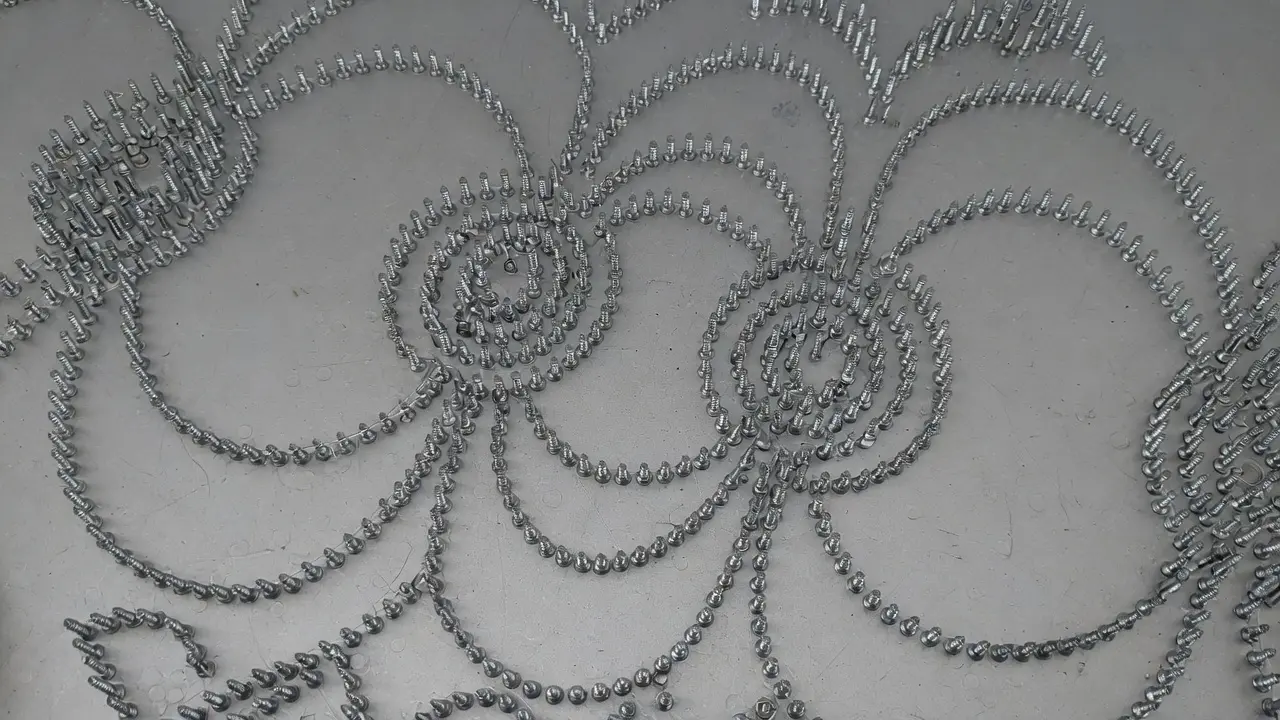
Miguel Gonçalves of Princeton Center for Theoretical Science and colleagues demonstrate that chiral superconductivity can be achieved by introducing holes into a Chern ferromagnet. Their calculations reveal a surprising pairing mechanism: a Cooper pair formed by a magnon bound to two holes, exhibiting chiral f-wave symmetry and a noncoplanar skyrmionic spin texture. The researchers found that increasing Ising spin-orbit coupling shifts interactions between these skyrmion Cooper pairs from repulsive to attractive, potentially explaining the recent observation of superconductivity in the MoTe2 moiré superlattice.
Kane-Mele-Hubbard Model Reveals Skyrmion-Bipolaron Pairing
A unique pairing mechanism involving spin-flip excitations, known as magnons, bound to two holes stabilizes a novel Cooper pair under specific interaction strengths and spin-orbit coupling. Calculations using the repulsive Kane-Mele-Hubbard model demonstrate this pairing occurs at hole doping relative to a filling of one electron per unit cell, potentially leading to chiral superconductivity. This pairing exhibits finite spin chirality, a signal of a noncoplanar skyrmionic spin texture, alongside chiral f-wave symmetry, with both characteristics directly linked to the Chern number of the originating Chern ferromagnet.
Researchers emphasize that this pairing is a binding of spin flips, creating a distinct pathway to superconductivity. Detailed analysis using density-matrix-renormalization-group calculations reveals a critical value of Ising spin-orbit coupling, below which interactions between these skyrmion-bipolarons are repulsive, and above which they become attractive.
This transition occurs at approximately 0.23 for a system with U = 100, defining a narrow region where chiral superconductivity can emerge. The team found that for U = 100, the repulsive-to-attractive transition occurs between = 0.222 and = 0.23, establishing a parameter space where dilute concentrations of the 2h1s bosons can condense.
While acknowledging the small size of this intermediate-SOC regime, the researchers note its existence even within the Kane-Mele-Hubbard model suggests its potential robustness. They state, “The aim of this work is not to make an exhaustive parameter model scan of when this regime can be stabilized, but instead to establish that it can be energetically favored even in the paradigmatic Kane-Mele-Hubbard model.” These findings provide a novel microscopic mechanism for chiral superconductivity and may be relevant for the recent observation of superconductivity in the MoTe₂ moiré superlattice.
The ability to model and understand the interactions within this system provides a potential explanation for the superconductivity seen in this material, opening avenues for further experimental verification and exploration of similar materials. “Chiral skyrmionic superconductivity from doping a Chern Ferromagnet,” the team concludes, is achievable through these specific quantum interactions.
Ising Spin-Orbit Coupling Drives Chiral Superconductivity
Calculations reveal a composite Cooper pair, bound from two holes and a single magnon, exhibits both finite spin chirality and chiral f-wave symmetry, a key step toward understanding unconventional superconductivity. This pairing, stabilized by sufficiently strong interactions and Ising spin-orbit coupling, arises within a doped Chern ferromagnet, and its spin chirality directly reflects the polarization of the material’s initial state.
The work demonstrates that the resulting Cooper pair’s characteristics are intrinsically linked to the topological properties of the parent Chern ferromagnet, offering a new avenue for designing superconducting materials. Unlike previously proposed mechanisms for magnonic superconductivity, this system achieves spontaneous spin polarization without requiring an external magnetic field, simplifying potential experimental realization.
This contrasts with earlier proposals requiring a finite Zeeman field to stabilize spin polarons, as the current model generates them intrinsically. The mechanism diverges from recent work on chiral superconductivity achieved through doping a Chern band, which does not involve spinful excitations. Initially repulsive, these interactions transition to attractive within a specific, intermediate range of SOC values, creating conditions where the condensation of hole-skyrmion Cooper pairs can drive chiral superconductivity.
This shift is critical, as it reveals a parameter space where these pairs can coalesce and form a superconducting state. “We further show that the interaction between these hole-magnon pairs evolves from repulsive to attractive as the Ising spin–orbit coupling increases, identifying an intermediate SOC regime in which their condensation can realize chiral superconductivity,” the researchers state.
Chern Ferromagnet Doping Stabilizes Hole-Magnon Cooper Pairs
Composite Cooper pairs, distinct from conventional electron-based pairings, can emerge when a Chern ferromagnet is doped with holes, according to new calculations. These pairs bind two holes to a single spin-flip excitation, a magnon, creating a charge-2e and spin = ∓ 2 composite particle. This pairing mechanism diverges from previous proposals requiring external magnetic fields to stabilize spin polarons, as these skyrmion-bipolarons form spontaneously at zero field.
The research demonstrates a pathway to chiral superconductivity through the condensation of these hole-magnon pairs, offering a new understanding of how superconductivity can arise from unconventional pairings. This detailed relationship suggests a specific sweet spot for inducing superconductivity, a departure from simpler models where stronger interactions always favor pairing.
The pairing symmetry and spin chirality are directly determined by the polarization and Chern number of the initial Chern ferromagnet, linking the macroscopic superconducting properties to the microscopic details of the parent material. Previous work established the possibility of magnonic superconductivity, but required a topologically trivial ferromagnet, resulting in a trivial spin texture. In contrast, this new approach induces a non-coplanar spin texture only upon doping.
Numerical Methods: Exact Diagonalization and DMRG Calculations
Exact diagonalization and density-matrix-renormalization-group calculations were essential to characterizing the unusual pairing mechanism revealed by this work, allowing researchers to probe the behavior of the repulsive Kane-Mele-Hubbard model at specific doping levels. This technique, as detailed in a referenced prior publication, enabled analysis on a 12-unit-cell lattice with up to four particles in the highest band, providing a balance between accuracy and computational feasibility. Density-matrix-renormalization-group calculations employed a quasi-one-dimensional geometry with up to 24 sites, using open boundary conditions in the longitudinal direction and periodic conditions across six transverse sites.
Conservation of both particle number and total was maintained throughout these DMRG simulations, a critical step in accurately modeling the system’s quantum properties. The convergence criteria involved monitoring the relative error in average entanglement entropy, average density and average energy, halting calculations when these values fell below a predetermined threshold or the number of sweeps exceeded 250. The computational methods also addressed the challenge of spin polaron pinning at boundaries, a potential artifact of the quasi-1D geometry.
A pinning field was applied to the boundary sites, preventing artificial localization of these spin excitations and ensuring that the calculated results accurately reflected the bulk behavior of the material. This boundary condition, differing for the two parent Chern ferromagnet states, demonstrates a careful consideration of potential systematic errors in the simulations.
The use of the ITensor and DiagHam libraries facilitated these complex calculations, providing the necessary tools for analyzing the many-body quantum system. The team’s focus on the repulsive Kane-Mele-Hubbard model, while computationally demanding, proved important for observing the formation of the hole-magnon Cooper pair.
While characterizing higher-spin bipolarons presented a greater computational challenge due to the expanded Hilbert space, the researchers anticipate these will share the same fundamental characteristics identified in the current study. The ability to explore these interactions, and the careful validation of the numerical methods, provides a strong foundation for understanding the emergence of chiral superconductivity in this system.
MoTe₂ Moiré Superlattice Relevance and Pairing Symmetry
Interactions between Cooper pairs, specifically, skyrmion Cooper pairs, shift from repulsive to attractive as Ising spin-orbit coupling (SOC) increases, creating a pathway for chiral superconductivity within a specific range of SOC values. The pairing symmetry of the resulting superconducting state is characterized by f-wave symmetry.
The energy dispersion of the 2h1s Cooper pair, analyzed in the Brillouin zone, shows substantial dispersion away from the minimum at the Γ point, even as the interaction strength (U) approaches infinity, supporting the condensation of the Cooper pair in the dilute density limit. The work does not aim for an exhaustive parameter scan to pinpoint when this regime is stabilized, but rather to demonstrate its potential for energetic favorability within the Kane-Mele-Hubbard model, and to elucidate the underlying mechanism driving superconductivity.
The ability to model the transition from repulsive to attractive interactions between skyrmion Cooper pairs, and the identification of an intermediate-SOC region conducive to chiral superconductivity, offer a specific framework for exploring similar phenomena in other materials and systems. This research builds on the understanding of unconventional superconductivity arising from repulsive electronic interactions, a long-standing challenge in condensed matter physics, and adds to the growing interest in moiré materials where topology and magnetism are closely intertwined.
👉 More information
🗞 Chiral skyrmionic superconductivity from doping a Chern Ferromagnet
✍️ Miguel Gonçalves, Kun Yang and Shi-Zeng Lin
🧠 DOI: http://link.aps.org/doi/10.1103/gd1k-s125

See today’s quantum computing news on Quantum Zeitgeist for the latest breakthroughs in qubits, hardware, algorithms, and industry deals.