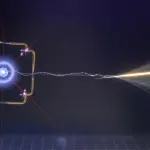
Researchers led by José Carlos Egues Paulo and Yugui Yao of the Beijing Institute of Technology detail a method in Physical Review B Letters to read qubit states without causing the typical collapse seen in conventional quantum measurement. The team proposes using Andreev qubits, which produce an oscillating electric supercurrent through their own quantum dynamics, potentially acting as a macroscopic indicator of the qubit’s state.
According to Egues, “In the conventional formulation of quantum mechanics, a projective measurement causes the system to assume one of the states associated with the measured quantity.” This approach could eliminate the need for “ancillas”, auxiliary qubits currently required in non-destructive quantum readout techniques.
Andreev Qubit Dynamics Enable Non-Destructive Readout
The oscillating electric supercurrent intrinsic to Andreev qubits offers a novel pathway for reconstructing a qubit’s state with minimal disturbance, potentially circumventing a major hurdle in quantum computing. The study was published in the journal Physical Review B Letters and was led by José Carlos Egues, a full professor at the São Carlos Institute of Physics at the University of São Paulo (IFSC-USP) in Brazil, and Yugui Yao of the School of Physics at the Beijing Institute of Technology in China. This approach focuses on the supercurrent’s fluctuating component, which carries information about the qubit’s superposition of states, allowing for inference of its initial condition.
José Carlos Egues explains that the supercurrent’s characteristics reveal key aspects of the qubit’s state. “Our study showed that this information is encoded in the supercurrent itself, while the supercurrent has a constant component and a fluctuating component.
The value of the constant component and the amplitude of the oscillation reveal the proportion of each state (0 and 1) in the superposition, and the moment when that oscillation begins reveals the phase relationship between them. Thus, by measuring how the current varies over time, it’s possible to reconstruct the initial state of the qubit.” The team incorporated the Andreev qubit into a closed superconducting circuit, allowing the supercurrent to circulate and be measured.
The potential to remove “ancillas”, auxiliary qubits traditionally required for non-destructive readout, represents a significant simplification of quantum circuit architecture. “Our method doesn’t eliminate the fundamental problem of quantum measurement, but it can approach the limit of a non-destructive readout and, at the same time, avoid the use of auxiliary qubits – the ancillas – employed in other non-destructive quantum measurement protocols,” Egues notes.
This streamlining is made possible by the unique properties of the Andreev qubit itself, specifically the formation of states within a nanoscale structure in indium arsenide connected to superconducting materials. The researchers emphasize the system’s ability to track qubit dynamics over time, as measurements do not necessitate a reset to the initial state.
This continuous monitoring capability stems from the supercurrent’s behavior, which manifests as an alternating current without voltage. It’s the very evolution of the qubit’s state that produces that oscillation,” says Egues. The team’s calculations used parameters from existing systems, suggesting the proposed geometry and setup are realistically achievable. The researchers believe their approach offers a pathway towards a simpler, more efficient architecture for reading Andreev qubits.
“All the numbers we used are realistic. In principle, this can be achieved. What doesn’t yet exist is that geometry, that setup that we proposed,” Egues concludes, highlighting the need for experimental verification of their theoretical findings.
In the conventional formulation of quantum mechanics, a projective measurement causes the system to assume one of the states associated with the measured quantity. Thus, if a qubit has been prepared in a certain superposition of 0 and 1, its direct measurement tends to destroy that superposition and, consequently, the information it contained.
José Carlos Egues, full professor at the São Carlos Institute of Physics at the University of São Paulo (IFSC-USP)
Supercurrent Oscillation Encodes Qubit State Information
The ability to discern a qubit’s state without collapsing its superposition relies on a naturally occurring oscillation within the qubit itself, according to a new theoretical proposal. Any qubit state is geometrically represented on the Bloch sphere, defined by two angles indicating the proportion and phase relationship of the states 0 and 1. Reconstructing these parameters allows for inference of the qubit’s initial state. The oscillating supercurrent arises not from an applied voltage, as seen in the AC Josephson effect, but from the qubit’s evolution.
This intrinsic oscillation is then detected by a superconducting quantum interference device (SQUID), an instrument sensitive to weak magnetic fields. The supercurrent’s magnetic field variations, sensed by the SQUID, provide the data needed to reconstruct the qubit’s state. “We can think of the qubit as one compass and the SQUID as another compass. The current in the circuit produces a magnetic field, and the SQUID ‘senses’ that field.
Since the coupling between the two is very weak, the effect of the measuring instrument on the qubit tends to be very small,” Egues adds. This strategy differs from conventional methods by extracting information directly from the qubit’s inherent properties. “Our strategy is different.
Instead of transferring the information to an auxiliary qubit, we seek to obtain it from a signal produced by the qubit under study itself,” the researcher points out. The researchers envision the Andreev qubit integrated into a closed superconducting circuit, with the SQUID positioned to detect the magnetic field generated by the oscillating supercurrent.
Our study showed that this information is encoded in the supercurrent itself. The supercurrent has a constant component and a fluctuating component. The value of the constant component and the amplitude of the oscillation reveal the proportion of each state (0 and 1) in the superposition, and the moment when that oscillation begins reveals the phase relationship between them. Thus, by measuring how the current varies over time, it’s possible to reconstruct the initial state of the qubit.
Bloch Sphere Representation & Supercurrent Signal Analysis
The ability to map a qubit’s state onto the Bloch sphere, a geometrical representation defining proportions and phase relationships, is central to the new readout method detailed by researchers. Unlike traditional methods requiring external voltage to induce oscillations in supercurrent, the Andreev qubit generates a naturally oscillating electric supercurrent through its own quantum dynamics, a phenomenon that is key to extracting information without direct measurement.
This oscillation isn’t random; the amplitude of the fluctuation and the timing of its onset directly correlate to the qubit’s initial state as defined by its position on the Bloch sphere, allowing for inference of the angles defining that state.
The sensitivity of the SQUID is paramount. It must discern subtle variations in the magnetic field to accurately map the supercurrent’s behavior and, consequently, the qubit’s state. “All the numbers we used are realistic. The system’s ability to generate a supercurrent that oscillates without external voltage is a key distinction from conventional methods relying on the AC Josephson effect. This intrinsic oscillation, driven by quantum interference, is the very signal used to infer the qubit’s state.
Our method doesn’t eliminate the fundamental problem of quantum measurement. But it can approach the limit of a non-destructive readout and, at the same time, avoid the use of auxiliary qubits – the ancillas – employed in other non-destructive quantum measurement protocols.
José Carlos Egues, full professor at the São Carlos Institute of Physics at the University of São Paulo (IFSC-USP)
Source: https://agencia.fapesp.br/59422


See today’s quantum computing news on Quantum Zeitgeist for the latest breakthroughs in qubits, hardware, algorithms, and industry deals.