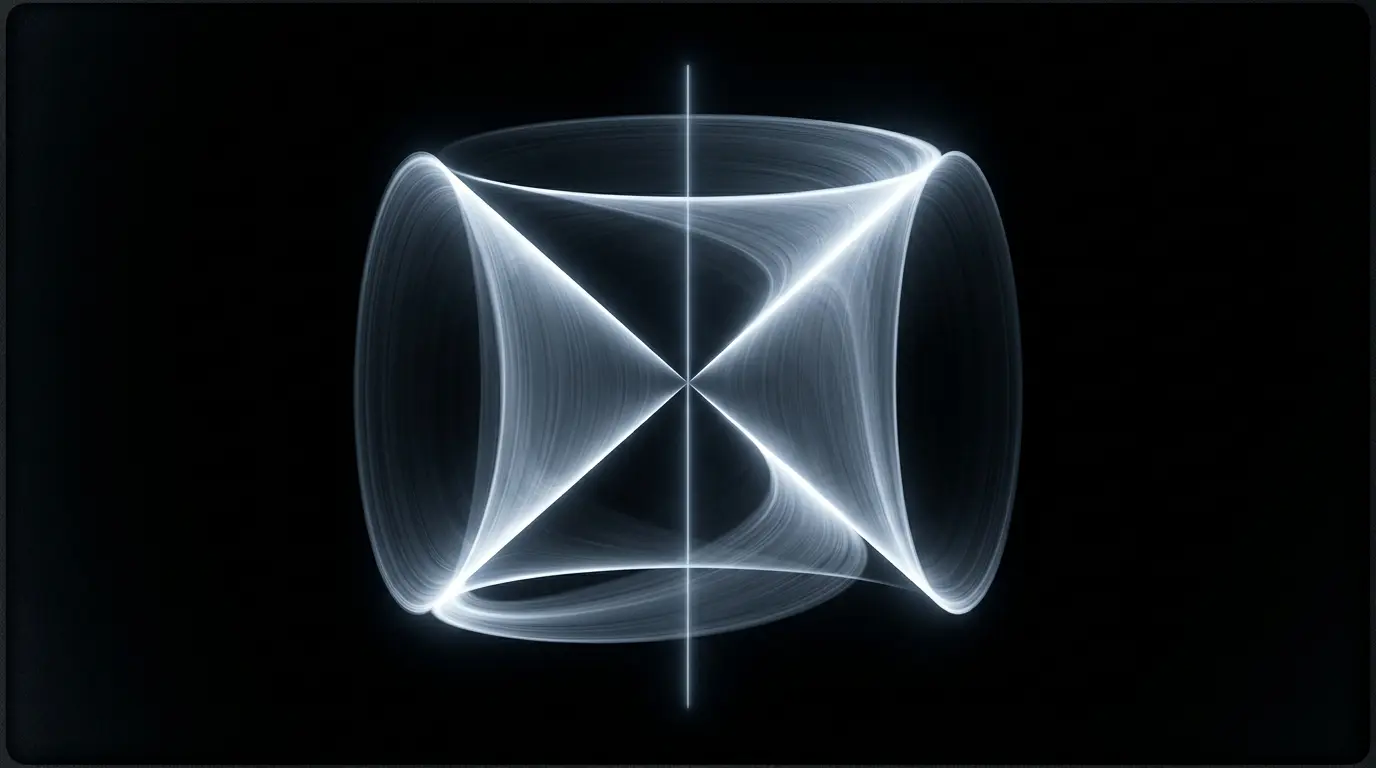
Venkatesa Chandrasekaran of the Leinweber Institute for Theoretical Physics at Stanford University has developed a new approach to quantizing gravity that begins with data from intersecting light cones. The work proposes a background independent quantization of general relativity, yielding a finite closed-form expression for graviton pair creation and annihilation on a null cone, a result achieved despite standard expansions in GN producing a logarithmic divergence.
This method also demonstrates that a macroscopic causal diamond with a defined maximum size possesses a finite dimensional Hilbert space, a surprising finding for theories of quantum gravity. From this framework, the Bekenstein-Hawking entropy for large Schwarzschild black holes was calculated, matching a coefficient previously derived using Euclidean methods.
Algebraic Quantization of Gravity from Null Cones
This result, achieved through algebraic quantization, suggests the method circumvents a common obstacle in quantum gravity calculations where perturbative approaches often fail to converge. The approach uses intersecting null cones within a bulk subregion to define a reduced phase space at finite GN, effectively sidestepping reliance on a fixed background spacetime. The restriction to a finite number of states could simplify calculations and offer new insights into the nature of spacetime.
This correspondence between Lorentzian and Euclidean approaches to black hole entropy provides a consistency check for the new quantization scheme. The method relies on solving gravitational constraints on intersecting null cones, and then promoting the canonical Poisson brackets of the reduced phase space to commutation relations, forming an algebra of observables. As stated in the paper, highlighting the mathematical framework underpinning the calculations.
First Order Gravity and Reduced Phase Space
Calculations within this framework reveal that a state prepared on a connected slice of spacetime can also be represented as an entangled superposition on two disconnected spatial components, a result aligning with the ER = EPR correspondence proposed by Maldacena and Susskind. This demonstrates a potential link between entanglement and the geometry of spacetime, a long-sought connection in theoretical physics. The method’s success extends to recovering the semiclassical Einstein equations through one loop for coherent initial states, validating its consistency with established physics.
A key step involved examining the terms arising from variations in the divergence operator at order , which vanish due to the background field equations and their linearization, ensuring a conserved quadratic source. This conservation maintains the mathematical consistency of the quantization process.
The resulting retarded solution for the metric perturbation, Δ g, is expressed as Δ g = Δ – ⟨ + O(ℏ^2), where represents the retarded Green’s function on the reduced phase space. The work establishes that even a causal diamond of bounded width admits infinitely many orthogonal states with identical clock probabilities, while its observables generate a type I∞ factor. This finding challenges conventional expectations in quantum gravity, where Hilbert spaces are often assumed to be infinite-dimensional.
Canonical Poisson Brackets to Commutation Relations
Promoting canonical Poisson brackets to commutation relations is a key step in constructing a nonperturbative Hilbert space, allowing for the definition of an algebra of observables that generates a type I factor. This algebraic structure is built using deformations of a reduced action, enabling the creation of a framework where calculations are not limited by traditional perturbative expansions. The surface charge, dependent on radiative canonical variables, allows the reduced Hamiltonian to generate time evolution through its Poisson brackets; integrating a specific term by parts separates the bulk symplectic potential from the Hamiltonian itself.
This separation is key, as it reduces the Hamiltonian to a pure boundary term, simplifying calculations and providing a clear definition of the system’s dynamics. The method establishes a means of fixing the ordering of insertions when two sources act on opposite sides of a defined surface, and promoting Poisson brackets to commutators. This approach allows for the definition of the algebra of observables independent of the chosen Hilbert space representation, offering a level of flexibility not typically found in other quantization schemes.
Nonperturbative Hilbert Space via Gaussian Wavefunctions
The resulting Hilbert space is built using Gaussian wavefunctions applied to pairs of canonical coordinates, allowing for the calculation of overlaps between states prepared on null cones at finite GN. By composing amplitudes between states prepared on null cones, a Lorentzian path integral is obtained in which each sum over intermediate states converges absolutely.
Lorentzian Path Integral Convergence via Amplitudes
This approach yields the Bekenstein-Hawking term at finite GN, a component in understanding black hole entropy, and allows for a logarithmic correction to the entropy of large Schwarzschild black holes. The one-loop calculation of this logarithmic correction matches a coefficient previously derived through Euclidean methods, demonstrating a connection between traditionally separate approaches to black hole entropy calculations.
“We will evaluate this correction at one loop from the Lorentzian trace and, at fixed mass with angular momenta summed, recover the result Sen obtained from the Euclidean path integral,” the paper states, highlighting the consistency of the findings.
Graviton Pair Creation and Finite Expression
The team’s approach instead achieves a finite result through non-perturbative summation, effectively sidestepping the divergent behavior. The finite dimensionality arises from the specific constraints imposed by the path integral and the geometry of the causal diamond, limiting the number of independent quantum states. The sum over graviton pairs of arbitrarily short wavelength defines a finite amplitude, even though expanding in GN yields a logarithmic divergence.
The team determined the Poisson brackets of radiative and corner data, and how to match this data on the overlap of two subregions. The resulting Lorentzian path integral converges absolutely at finite GN, meaning each sum over intermediate states yields a finite value.
Bekenstein-Hawking Entropy from Lorentzian Trace
This non-perturbative result suggests a novel approach to handling infinities that often plague attempts to reconcile general relativity with quantum mechanics. The team’s work demonstrates a path toward finite results without relying on traditional regularization techniques. The dimensionality is not infinite, but rather constrained by the geometry and the imposed path integral conditions.
Diffeomorphism Invariance and Finite Hilbert Space
Calculations revealed a finite dimensionality to the Hilbert space of a macroscopic causal diamond, a result stemming from the diffeomorphism invariance of the path integral, a surprising constraint given expectations of infinite-dimensional spaces in quantum gravity. The team used Gaussian wavefunctions of canonical pairs to construct a nonperturbative Hilbert space representation, generating a type I factor, a mathematical structure ensuring a consistent quantum theory.
Semiclassical Einstein Equations as Low-Energy Limit
Recovering the Einstein equations, even with quantum corrections, required matching solutions across overlapping regions of spacetime, a process dictated by the framework’s treatment of geometry within causal diamonds. The work demonstrates that metrics reconstructed in neighboring diamonds must align where they intersect, ensuring a consistent spacetime description between boundaries. This alignment is achieved by measuring metrics relative to the local Lorentz frame of each diamond’s boundary, a technique that enforces agreement on shared areas. This builds upon a state sharply defined by smooth initial data.
👉 More information
🗞 An algebraic quantization of gravity from the null cone
✍️ Venkatesa Chandrasekaran (Leinweber Institute for Theoretical Physics, Stanford University, Stanford, CA, USA)
🧠 ArXiv: https://arxiv.org/html/2611.34924v1


See today’s quantum computing news on Quantum Zeitgeist for the latest breakthroughs in qubits, hardware, algorithms, and industry deals.