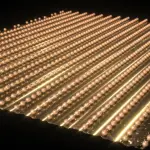
Researchers at Columbia University have, for the first time, observed trapped electron waves within a metal, a phenomenon predicted by quantum mechanics but previously unseen. “Quantum mechanics predicts that an electron wave can, theoretically, remain trapped even when there are infinitely many paths for it to escape,” said Raquel Queiroz, a theoretical physicist, suggesting new avenues for manipulating quantum states in metallic materials. The findings reveal that electrons in experience “frustration” due to the arrangement of its atoms, leading to their unexpected immobilization.
Metal Enables Trapped Electron Waves
, a metallic compound synthesized in Xavier Roy’s lab, exhibits an unusual property: it can be exfoliated into atomically thin, two-dimensional layers while retaining electrical conductivity. This characteristic initially prompted researchers to investigate electron behavior within the material, revealing unexpectedly slow electron movement that signaled a more complex phenomenon. The observation of trapped electron waves represents a first for electrons within a metallic structure, despite being a long-predicted outcome of quantum mechanics.
This trapping occurs through a process called the formation of bound states in the continuum, or BICs, where destructive interference cancels out electron wave propagation, effectively confining the electrons to specific locations. The team’s spectroscopic imaging confirmed these bound states around atomic defects within the lattice. While BICs have been previously observed with light, achieving them with electrons in a metal proved more difficult.
Electrons are typically free to move throughout a metal’s structure, but the unique, “frustrated” crystal lattice of allows for the necessary conditions to arise. “Bound electrons shouldn’t occur in a metal, but they do in. What we have observed is the first clear evidence of quantum interference trapping a state in a metal,” said Queiroz. This frustration arises from the arrangement of atoms within the material, creating a specific environment where quantum interference can effectively bind electrons.
The ability to trap electrons has significant implications for manipulating their behavior; if you trap a particle, you can manipulate it, the researchers suggest, opening possibilities for novel electronic devices and quantum technologies. The team believes that other metals with similar frustrated lattice structures may also exhibit this behavior, providing a new avenue for materials discovery.
Their work establishes a quantum mechanical recipe for identifying materials capable of hosting these electronic BICs, potentially leading to a new class of materials with tailored electronic properties. The findings, published in Science, demonstrate a fundamental shift in understanding electron behavior and offer a pathway toward controlling electron waves within metallic systems.
Bound electrons shouldn’t occur in a metal, but they do in Pd 5 AlI 2.
Queiroz, who developed the models that now explain the team’s physical observations
Frustrated Electron Hopping Creates Bound States in the Continuum
Spectroscopic imaging revealed bound electron waves localized around atomic defects in the two-dimensional metal, marking the first observation of a bound state in the continuum within a metallic structure. The Columbia University team, using scanning and spectroscopy instruments with atom-scale accuracy, initially detected unexpected patterns during material scans that ultimately indicated these trapped electron waves. These observations build on previous work detailing frustrated electron hopping, providing a physical basis for the team’s current models.
The phenomenon relies on destructive quantum interference, where electron wave paths cancel each other out, effectively immobilizing them despite the conductive nature of the metal. Sufficient interference can entirely prevent an electron wave from propagating, binding it within a sea of otherwise free-moving electrons.
This trapping mechanism, known as a bound state in the continuum or BIC, has been previously demonstrated with light, where researchers etched materials to create patterns that confine photons. The team’s success hinges on the frustrated crystal lattice structure of, a characteristic that localizes electrons through interference rather than relying on methods used in semiconductors like doping.
The discovery establishes a new pathway for electron localization in metals, distinct from the mechanisms governing semiconductors and insulators. In semiconductors, bound states are linked to doping processes essential for controlling current flow in computing chips; in contrast, BICs in metals arise solely from the material’s inherent structural properties.
The team’s findings, detailed in Quantum Materials & Nanoscience, provide a foundation for exploring materials with tailored electronic properties and controlling electron movement at the nanoscale, offering a new approach to understanding and harnessing the quantum properties of electrons within metallic systems.
Quantum mechanics predicts that an electron wave can, theoretically, remain trapped even when there are infinitely many paths for it to escape. This effect is known from light waves, but it has never been seen before for electrons.
Raquel Queiroz, a theoretical physicist at Columbia



See today’s quantum computing news on Quantum Zeitgeist for the latest breakthroughs in qubits, hardware, algorithms, and industry deals.