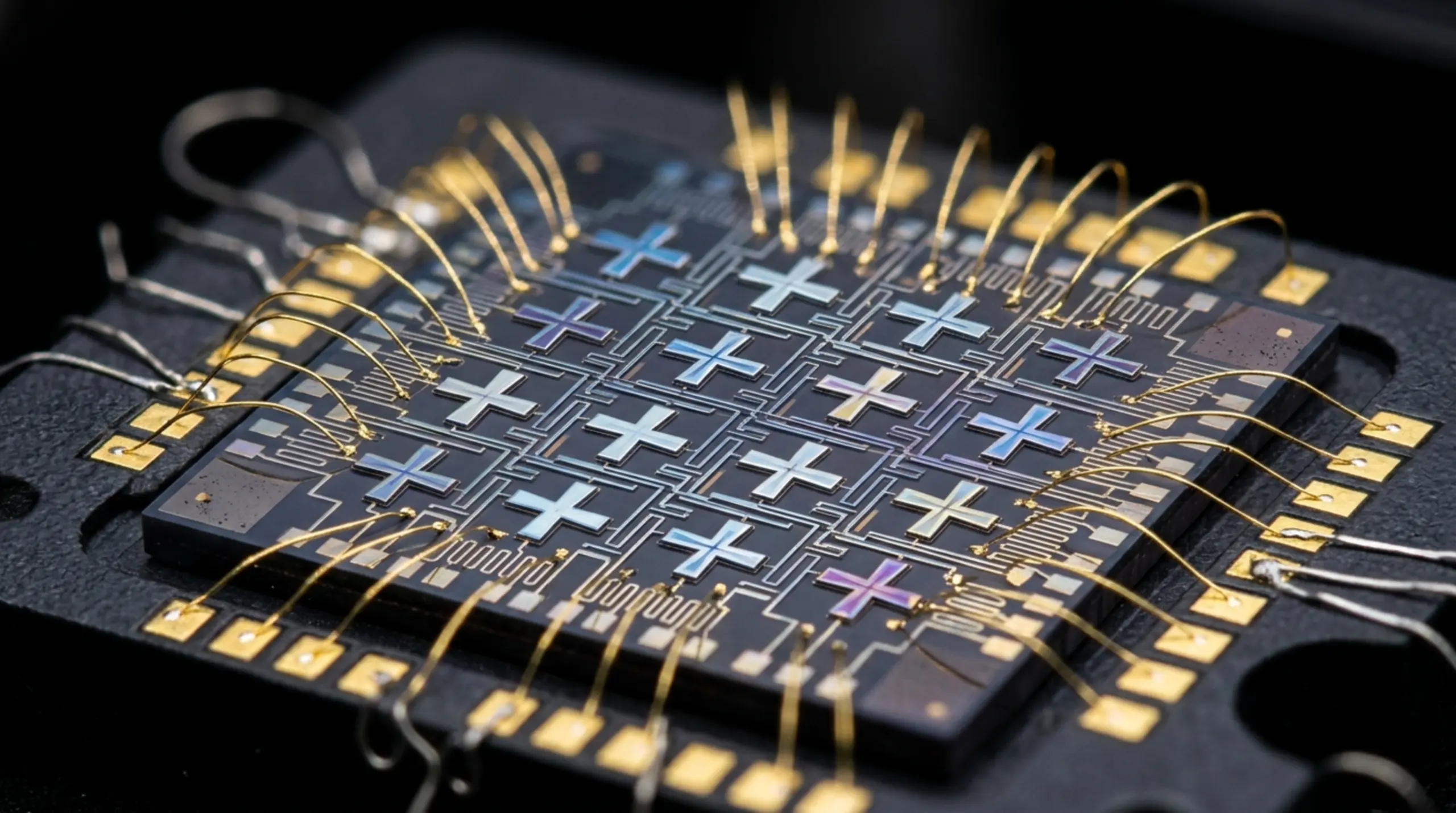
This work proposes a detection scheme to verify the entanglement, indicating progress beyond creation toward proving quantum connection. The results suggest applications in exploring macroscopic quantum mechanics and testing decoherence theories.
Two-Tone Driving Entangles Magnon Modes in YIG Spheres
Gen Li and Jie Li, both affiliated with Zhejiang Key Laboratory of Micro-Nano Quantum Chips and Quantum Control and School of Physics at Zhejiang University, detailed a scheme using a superconducting qubit driven by a two-tone field to achieve this connection between the spheres’ magnon modes. This approach builds on recent demonstrations of cavity-mediated coupling between magnons in YIG spheres and superconducting qubits, establishing a platform for preparing macroscopic quantum states.
The proposed entanglement relies on an effective magnonic two-mode squeezing interaction induced by precise control of qubit frequencies and the strengths of the applied driving fields. By adiabatically eliminating the microwave cavity mediating the interaction, researchers predict strong entanglement can be realized with parameters currently within experimental reach. This differs from previous approaches by directly addressing the creation of entanglement, rather than simply demonstrating the potential for coupling between magnons and qubits.
The team’s calculations indicate that the system’s parameters allow for the realization of this entanglement, opening avenues for exploring fundamental quantum phenomena. Verification of this entanglement is also addressed within the proposal, with the researchers outlining a detection scheme based on measuring the frequency shift of the qubit. This shift is induced by the qubit-magnon dispersive interaction, and the dispersive shifts caused by the two magnon modes are expected to be distinguishable.
Specifically, the method involves switching off the two-tone driving field and applying resonant microwave fields to each magnon mode to implement a displacement operation, followed by tuning the qubit frequency to a far-detuned point. The potential applications of this work extend to fundamental studies in macroscopic quantum mechanics and the testing of unconventional decoherence theories. Simulations, presented with parameters including a cavity linewidth of κ/2π = 0.5 MHz and 2 MHz, demonstrate the feasibility of the proposed scheme.
The ability to create and verify entanglement at this scale could provide new insights into the boundary between the quantum and classical worlds, and challenge existing understandings of how quantum systems lose coherence. The researchers conclude that their scheme offers an experimentally feasible path toward generating macroscopic entanglement.
Cavity-Mediated Coupling of Magnons and Superconducting Qubits
An entanglement detection scheme relies on performing Wigner-function tomography of the two magnon modes, exploiting their dispersive coupling to the superconducting qubit, a method offering high feasibility for creating entanglement. This approach contrasts with protocols dependent on nonlinear magnomechanical or optomagnonic interaction, or the magnon Kerr effect, where achieving sufficient nonlinearity remains a challenge. The proposed method uses the qubit’s capacity to provide the necessary strong nonlinearity for entanglement generation, which is a key advantage over alternative techniques.
The system’s architecture places the qubit and two yttrium-iron-garnet spheres within a common three-dimensional microwave cavity, facilitating effective coupling between the qubit and both magnon modes. This cavity operates in a regime far-detuned from both the magnon modes and the qubit, ensuring virtual excitation and establishing an effective coupling not only between the magnon and qubit, but also between the two magnon modes themselves.
This indirect coupling, mediated by the cavity, is central to the entanglement process, enabling interaction without direct physical connection. The proposed entanglement scheme uses a two-tone driving field applied to the superconducting qubit, carefully selecting frequencies and strengths to induce the desired quantum state. This precise control over the driving fields is essential for manipulating the qubit and, consequently, the entangled magnon modes. The researchers demonstrate that strong entanglement can be achieved with parameters readily attainable with current technology, suggesting the experimental realization of macroscopic entanglement is within reach.
The ability to entangle two magnon modes opens avenues for exploring fundamental quantum phenomena and advancing quantum technologies. The system’s parameters, including the cavity’s virtual excitation regime, are designed to maximize the efficiency of the entanglement process and ensure its feasibility. The researchers at Zhejiang University suggest this approach offers a viable path toward generating macroscopic entanglement, a significant step toward harnessing quantum mechanics at larger scales.
Magnon-Qubit Interaction via Microwave Cavity
The resulting Hamiltonian describes a system where the qubit mediates a beam-splitter coupling, influencing the relationship between the two magnon modes. Adiabatic elimination of the cavity mode yields modified effective frequencies for both the qubit and the magnon modes, shifting them from their original values. These shifts are quantified by the effective coupling strengths, denoted as , which govern the interaction between the qubit and each magnon mode, and , which defines the direct coupling between the two magnons.
The strength of this magnon-magnon coupling is dependent on the cavity parameters and the detuning from the magnon frequencies, allowing for tunable entanglement. The researchers detail that the effective Hamiltonian of the magnon-qubit system incorporates these modified frequencies and coupling strengths, enabling precise control over the entanglement process.
The two YIG spheres are positioned within a uniform bias magnetic field, with each sphere also experiencing a localized magnetic field generated by a small coil. The driving fields, characterized by Rabi frequencies and applied at frequencies , manipulate the qubit’s state and, consequently, the entanglement between the magnon modes. The equations governing the system reveal that the effective coupling strengths, and , are directly influenced by the detuning parameters and the cavity coupling, allowing for optimization of the entanglement process.
The resulting effective Hamiltonian, , incorporates these interactions, providing a framework for understanding and controlling the entanglement dynamics. The system’s design, with its emphasis on virtual excitation and precise frequency control, maximizes the efficiency of the magnon-qubit coupling and facilitates the creation of entangled magnon modes. The ability to manipulate these parameters offers a degree of freedom for optimizing the entanglement process and exploring the boundaries of macroscopic quantum mechanics.
Numerical Simulation Demonstrates Achievable Entanglement
Numerical simulation confirms considerable entanglement is achievable within this system using parameters readily available in current experiments. The simulations demonstrate that the system’s design effectively facilitates strong quantum correlations between the two millimeter-sized yttrium-iron-garnet spheres. One field induces a strong magnon-qubit coupling, while the frequency and strength of the second are carefully chosen to derive an effective magnonic two-mode squeezing interaction.
Researchers also developed a method to verify this entanglement experimentally, proposing a quantum state tomography of the two magnon modes through measurement of their joint Wigner function. This detection scheme involves measuring the expectation value of the joint magnon-number parity operator following independent displacements of the two magnon modes.
Analysis of the system’s sensitivity to dissipation reveals specific limitations. A driving field that is too strong weakens the validity of the adiabatic elimination process, reducing the maximum achievable entanglement. Simulations also show that increasing temperature reduces both the maximum entanglement and the time required to establish it.
The initial state of the system, assumed to be a qubit in its ground state and magnons in a thermal state, influences the entanglement process, with higher temperatures diminishing the strength and speed of entanglement formation. The ability to predict and mitigate these effects through careful parameter selection highlights the system’s potential for realizing and controlling macroscopic quantum entanglement.
Entanglement Detection Using Wigner-Function Tomography
This approach moves beyond simply creating entanglement to addressing the challenge of verifying its existence, a critical step toward realizing macroscopic quantum systems. The impact of temperature on entanglement fidelity is also detailed, showing relatively mild effects for temperatures below 100 millikelvin. However, temperatures exceeding this threshold significantly reduce the degree of entanglement, highlighting the need for cryogenic control. The detection scheme is nontrivial, given the system’s complexity involving two magnon modes and a single qubit, and the typical readout of magnon states via the qubit itself.
The researchers’ analysis indicates that quantum entanglement between macroscopic objects, YIG spheres ranging from 0.5 to 1 millimeter in diameter, is promising in the near future, positioning the cavity-magnon-qubit system as an ideal platform for preparing various macroscopic quantum states. The work suggests that this system is not only capable of generating entanglement but also of providing the tools to confirm its presence, an important advancement for exploring the boundaries of quantum mechanics at larger scales.
👉 More information
🗞 Macroscopic entanglement between two magnon modes via two-tone driving of a superconducting qubit
✍️ Rong-Can Yang, Gang Liu, Gen Li and Jie Li
🧠 DOI: http://link.aps.org/doi/10.1103/jtyx-xsgc



See today’s quantum computing news on Quantum Zeitgeist for the latest breakthroughs in qubits, hardware, algorithms, and industry deals.