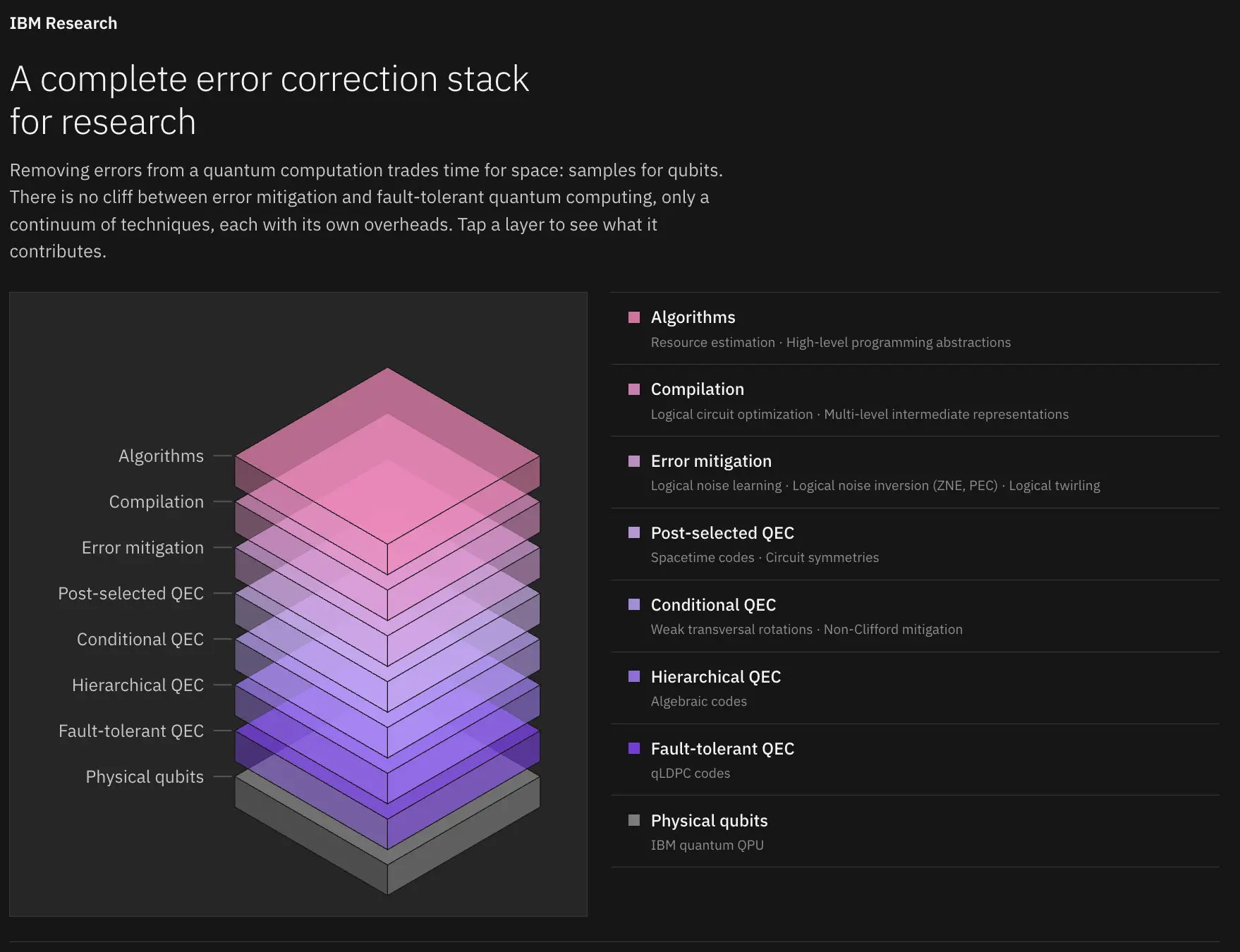
IBM researchers are charting a course from reducing quantum errors to fully correcting them, recognizing that the most effective approach isn’t simply about minimizing mistakes, but how those mistakes are addressed. The team reports that optimizing across a spectrum of error-correcting techniques, from mitigation to correction, is key to scaling quantum computation, measured not by logical qubits, but by “the size of the circuit you can run with the available error-correcting tools.” While full quantum error correction demands hardware beyond current capabilities, lower error rates, long-range connections, and real-time decoders, techniques like probabilistic error cancellation are already enabling computations on systems that surpass classical verification. This continuous path, combining mitigation, detection, and correction, helps achieve useful quantum computation.
Error Mitigation Techniques Bridge to Fault Tolerance
The interplay between computation time and qubit resources defines progress in quantum error handling; quantum error correction, while the most time-efficient approach, demands substantial qubit overhead, a constraint researchers are actively addressing with hybrid methods. IBM scientists are exploring layered techniques, combining post-selected quantum error correction with probabilistic error cancellation (PEC) to extend the reach of advantage experiments toward practical applications before achieving full fault tolerance.
This strategy acknowledges that conventional quantum error correction, encoding information into multiple qubits, currently strains hardware limitations. This layered approach isn’t simply a stopgap, but a means of optimizing performance across the entire spectrum of error-handling techniques, allowing for a more nuanced trade-off between qubit count and computational runtime.
This is particularly relevant given that even the most advanced error-correcting codes have limitations, removing errors only up to a point determined by the code distance and the underlying hardware noise. The NTU-IBM Quantum Hub, founded in January 2019 with science ministry funding, gives National Taiwan University staff and students access to IBM quantum systems, and partners with the Institute for Information Industry and ITRI, fostering a collaborative environment for quantum research and development.
The annual Qiskit Hackathon Taiwan, whose 2026 edition was sponsored by Foxconn’s quantum computing research centre, exemplifies this commitment to expanding quantum skills and innovation within the region. This access is not merely academic; the university’s licensing contract with IBM, effective since 2019, provides a 20-qubit system for hands-on experimentation and refinement of these error mitigation strategies.
While PEC and post-selection offer immediate gains, the ultimate goal remains full fault tolerance, a benchmark IBM continues to pursue with its IBM Quantum Starling project. However, even in a fault-tolerant future, the researchers anticipate that error mitigation and post-selection will continue to contribute, working in conjunction with quantum low-density parity-check (qLDPC) error correction to enhance logical performance with existing hardware.
“From error mitigation to error correction, there is a spectrum of techniques that are ripe for exploration to advance useful quantum computation before fault tolerance,” IBM states, emphasizing the importance of optimizing across this spectrum. The recently released IBM Quantum Nighthawk r2 is a platform for exploring these combined approaches, integrating quantum error correction with tools from Qiskit and the IBM Quantum Compute Service.
This platform allows researchers to refine the balance between qubit requirements and sampling efficiency, ultimately pushing the boundaries of what’s computationally possible with near-term quantum devices. The team emphasizes the focus is not solely on building more qubits, but on maximizing the complexity and reliability of computations achievable with the available resources, measured by the circuits that can be successfully run.
Probabilistic Error Cancellation Enables Quantum Advantage
Probabilistic error cancellation (PEC) is now enabling quantum computations exceeding the capabilities of classical verification, marking a shift toward achieving quantum advantage through what researchers term This advancement isn’t simply about reducing errors, but about strategically balancing the trade-offs between computational time and qubit resources, a distinction crucial for scaling quantum systems. Error mitigation techniques like PEC offer a pathway to run larger circuits on current hardware, even if full fault tolerance remains a future goal. This fundamental constraint highlights that the challenge isn’t solely about minimizing errors, but about how those errors are addressed, and the associated costs in terms of both time and qubit requirements.
Researchers are layering post-selected quantum error correction with PEC to explore hybrid approaches, potentially bridging the gap to practical applications before complete fault tolerance is realized. The directed execution model, released as a beta service in late 2024, allows for configurable error mitigation on the client side, facilitating experimentation with advanced capabilities.
Beyond configurable mitigation, new tools are streamlining tasks like debugging and noise learning while maintaining efficient circuit execution on large systems. When integrated with packages such as qiskit-noise-learning and qiskit-mitigation, this model empowers quantum information scientists to design customized noise learning protocols and implement modular error mitigation strategies.
This capability unlocks new research avenues in quantum error correction and device characterization, allowing researchers to move beyond binary measurement outcomes and incorporate confidence information into decoding and state verification. The availability of richer measurement data is particularly significant because quantum error-correcting codes only remove errors up to a certain point, dependent on code distance and hardware noise. Researchers can now refine decoding processes, verify states more effectively, and analyze leakage, ultimately leading to more sophisticated methods for understanding and improving quantum systems.
This reframing of progress is reflected in the metric used to measure success: not the number of logical qubits, but the size of the circuits that can be reliably executed. As Abhinav Kandala, Ali Javadi-Abhari, and Jay Gambetta state, the goal is to demonstrate quantum advantage through trusted quantum computation, a feat now within reach thanks to advancements in error mitigation and correction techniques.
Spacetime Codes Improve Logical Qubit Density
Spacetime codes now distribute error checks across both the spatial layout and temporal sequence of a quantum circuit, a design choice enabling implementation on existing quantum hardware. This approach encodes computation within a distinct vector space using ancilla qubits, creating a logical circuit separate from the raw physical qubits, and flagging runs with errors for discard.
The resulting method reduces error with a sampling overhead that improves on previous post-selection error correction (PEC) by a factor of four, allowing for more complex circuits to be run effectively. A recent demonstration encoded 64 logical qubits within spacetime codes using 76 physical qubits and 314 T gates, while also maintaining a fidelity lower bound of 0.349 with 95% confidence.
The interplay between Clifford and non-Clifford gate errors dictates the path toward more robust quantum computation; mitigating Clifford errors is relatively inexpensive, while non-Clifford operations, such as T gates, demand greater resources. Traditional fault-tolerant T gate implementations rely on magic state injection and distillation, techniques requiring hardware complexity unlikely to be available until the fully fault-tolerant era. Instead, conditional quantum error correction offers an intermediate step, applying codes provisionally based on real-time noise channel information.
While algebraic codes can become unwieldy for larger quantum systems, where quantum low-density parity-check (qLDPC) codes offer a more scalable alternative, they present benefits as outer codes in hierarchical quantum error correction (QEC) architectures. Concatenating algebraic codes with qLDPC codes extends the protection of the inner qLDPC codes without requiring larger modules.
This architecture uses the logical operations of the inner code to provide the long-range connectivity needed by the outer code, reducing the demand for additional hardware. Progress in hardware components, such as high-speed independent qubit reset and the Nighthawk r2 system, accelerates learning cycles for critical physical circuit elements closely tied to hardware codes. The demonstration of 64 logical qubits, and the associated improvements in gate fidelity, represent a step toward that goal, signaling that quantum computing has entered its logical circuit era.
Post-Selection & PEC Enhance Error Correction Performance
Spacetime codes offer a hardware-efficient approach to error correction by distributing low-weight Pauli checks across both space and time within a quantum circuit, making them suitable for implementation on current quantum hardware. This distribution allows for the creation of logical circuits using ancilla qubits that encode and perform computations in a vector space distinct from the raw qubits, a technique known as post-selected quantum error correction.
When a hardware run fails to satisfy all Pauli checks, indicating errors, the run is discarded, a process that enhances reliability without demanding excessive qubit resources. This highlights a fundamental constraint in quantum computing development: it’s not simply about reducing errors, but how you reduce them, and the associated costs.
The IBM Quantum Systems API, positioned as the programmatic boundary between real-time layers and the broader system architecture, is designed to facilitate timely feedback from syndrome measurements and integration between code layers. The development of such hardware is crucial, as it will unlock the full potential of these error-correcting techniques. The IBM Quantum Nighthawk r2 builds on earlier systems obtained through licensing and represents a step toward realizing the first fault-tolerant quantum computer, IBM Quantum Starling.
The team emphasizes the focus has shifted from simply increasing qubit counts to achieving increasingly complex and reliable computations. This reframes the challenge as achieving increasingly complex and reliable computations, regardless of the underlying qubit count. The team’s work demonstrates a continuous path from error mitigation to fault-tolerant quantum computing.
IBM’s Control Infrastructure Enables Pulse-Level Experimentation
Access to detailed control over quantum systems, extending beyond standard gate and measurement operations, is now available through the IBM Quantum Compute Service, allowing researchers to explore advanced error mitigation and correction techniques. This infrastructure provides a fine level of access, including control over pulse timing and customized calibrations for individual gates, as well as access to soft information derived from measurements beyond simple binary classifications.
Dynamical decoupling, a method for suppressing noise by applying pulse sequences to idle qubits, is among the capabilities now accessible to users, enabling cancellation of noise channels and extending qubit coherence. When combined with packages like qiskit-noise-learning, qiskit-mitigation, and Samplomatic, the directed execution model, released as a beta service in late 2024, offers a comprehensive toolkit for optimizing quantum computations. By using this detailed data, scientists can develop more sophisticated approaches to understanding and improving quantum systems, ultimately enhancing the reliability of computations.
The ability to conditionally apply quantum error-correcting codes based on noise channel information represents a stepping-stone toward full error correction. One research direction explores implementing encoded Clifford + T circuits by protecting Clifford gates with error correction while mitigating errors from noisy encoded T gates. This approach utilizes a quasiprobability method, simulating a noise-free quantum computer to produce accurate measurement observables. Because only T gates require error mitigation, the computational overhead is significantly reduced, potentially enabling early error-corrected machines to deliver useful quantum computations.
Another area of investigation focuses on relaxing the requirements for transversal gates, operations crucial for fault-tolerant quantum computing, to avoid the complexity of rotation synthesis, magic state factories, and teleportation routing. These advancements, coupled with the availability of pulse-level control, are enabling researchers to push the boundaries of what’s possible with near-term quantum hardware.



See today’s quantum computing news on Quantum Zeitgeist for the latest breakthroughs in qubits, hardware, algorithms, and industry deals.