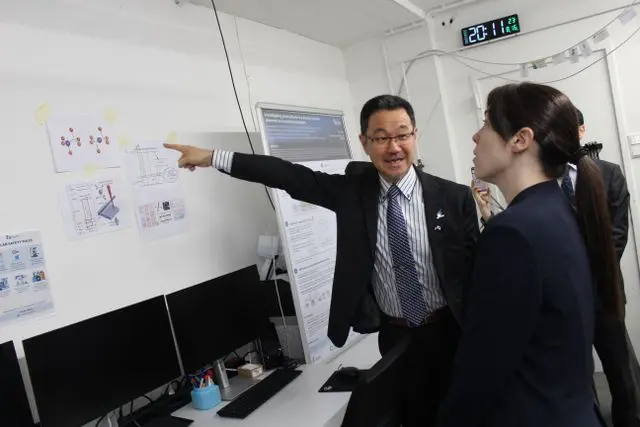
Japan’s Minister of Science and Technology, Ms. Kimi Onoda, focused her visit to Delft University of Technology (TU Delft) on the university’s quantum capabilities, beginning with a tour of the QuTech institute and the laboratory of Dr. Ryoichi Ishihara at TU Delft’s Quantum Integration Technology group. The delegation’s itinerary also included House of Quantum (HoQ), a national hub designed to connect quantum research with businesses and startups.
This focused exploration signals a particular interest in the Dutch model of fostering quantum innovation, as Bart van Arem of TU Delft shared that strengthening international partnerships is “crucial” for maintaining strategic autonomy in quantum technology.
Onoda’s Visit Highlights Dutch-Japanese Quantum Collaboration
Dr. Takuto Yamaguchi of Fujitsu detailed a prototype diamond-spin quantum computer during the visit, showcasing Japanese advancements in quantum hardware to the Dutch delegation and prompting discussion on differing qubit technologies. The focus on practical applications at HoQ signals a Dutch strategy of translating research into commercial ventures, an approach potentially of interest to the Japanese Ministry of Science and Technology.
Hester Bijl, Rector Magnificus of TU Delft, outlined the university’s commitment to addressing societal challenges through a combination of research, education, and innovation during her introduction of TU Delft to the visiting delegation, the company says. Bart van Arem, Pro Vice Rector for Doctoral Affairs, then highlighted the existing productive collaboration between TU Delft and Japanese institutions, emphasizing a history of shared academic pursuits. Program Manager Friso Lippmann followed by stressing the importance of Strategic Autonomy & Resilience, framing quantum technology as a key component of national technological independence.
The exchange of gifts and an official group photograph marked the formal welcome extended to the Japanese delegation, led by Minister Kimi Onoda, who initiated the visit with opening remarks. “The visit was very successful and provided a lot of opportunities for Japanese and Dutch quantum experts to engage in fruitful discussions on quantum technology, and to foster collaboration,” a statement released following the event confirmed, underscoring the potential for strengthened ties between the two nations in this rapidly evolving field. The visit’s success suggests a mutual interest in using complementary strengths to advance quantum capabilities.
Ishihara’s Quantum Integration Technology & Fujitsu Partnership
Kimi Onoda. This sustained relationship, centering on spin-based qubits in diamond, demonstrates a specific Japanese interest in Delft’s approach to quantum computing hardware. Ishihara’s work uses on-chip integration, converging electronic and photonic technologies to control and read out these qubits, a method potentially offering scalability advantages over other qubit modalities. QuTech, TU Delft’s quantum institute, co-founded with TNO in 2014, provides the foundational research environment for this integration effort, operating as a world-leading center for quantum innovation, according to the company.
The focus on Ishihara’s group is notable given TU Delft’s broader qubit research portfolio, which also includes superconducting and silicon-spin technologies. While the university actively pursues multiple qubit platforms, the Minister’s visit specifically targeted this diamond-spin work, suggesting a strategic alignment with Japanese priorities. This prototype builds on TU Delft’s expertise in characterizing qubits, recently demonstrated by the introduction of the QARPET chip architecture for parallel qubit analysis.
The partnership extends beyond basic research, as evidenced by Quantum Machines’ 2026-05-05 acquisition of QHarbour, a TU Delft spin-off, indicating a move towards commercializing quantum control systems. House of Quantum (HoQ), the Dutch national hub visited by the delegation, further underscores this emphasis on translating research into practical applications.
QuTech and House of Quantum Drive Quantum Development
QuTech’s role as a focal point for international quantum collaboration was underscored by the visit, as Ms. Lieven Vanderseypen, leading a prominent TU Delft research group in semiconductor spin-based quantum computing, then initiated a discussion on the direction of quantum research, highlighting the ongoing collaboration with Fujitsu. This exchange suggests a deepening of ties between Japanese industry and Delft’s foundational quantum research capabilities. The delegation’s focused attention on Dr. Ishihara’s work, combining electronic and photonic technologies for qubit control, aligns with a growing emphasis on scalable quantum systems.
TU Delft’s commitment to this area is reinforced by the 2026-06-26 introduction of the QARPET chip architecture, designed to characterize large numbers of qubits in parallel, and the 2025 release of the Tuna-5 spin-qubit processor on its Quantum Inspire cloud platform. Beyond research, the visit to House of Quantum (HoQ) demonstrates the Dutch strategy of fostering a robust quantum ecosystem.
HoQ is a national hub connecting researchers, businesses, and startups, a model potentially of interest to Japan as it develops its own quantum industry. Through partnerships with institutions like TNO, and the 2026-05-05 acquisition of QHarbour by Quantum Machines, TU Delft actively translates research into commercial applications and supports quantum technology leadership across Europe.
Source: https://www.tudelft.nl/en/2026/eemcs/japanese-minister-visits-tu-delft-to-explore-quantum-research