Researchers from Northwest University, University of Hyogo, and Kyushu Institute of Technology have performed quantum calculations predicting superconductivity exceeding 50 Kelvin in specifically engineered layered nickelates. The work demonstrates a method to introduce electrons into nickelate superconductors by intercalating insulating layers, such as LaAlO3, into La2NiO4, without creating disorder. This process releases carriers into the Ni-3d orbitals, positioning the material for superconductivity. The same approach also enables electron doping of La3Ni2O7, a superconductor currently receiving significant attention.
Heterostructuring Enables Electron Doping in Nickelates
Calculations predict superconductivity exceeding 50 Kelvin in specifically layered nickelate structures. Researchers from Northwest University, University of Hyogo, and Kyushu Institute of Technology have performed quantum calculations demonstrating a pathway to achieve this by precisely interleaving layers of different materials, a technique known as heterostructuring, to introduce electrons into the nickelate’s atomic structure. This targeted electron doping overcomes a longstanding challenge in realizing superconductivity within this class of materials, as previous attempts to achieve it through substituting elements proved unsuccessful.
The team demonstrated a method using first-principles calculations to achieve electron doping of Ruddlesden-Popper nickelates. Intercalating wide-band-gap insulating layers, specifically LaXO3 where X equals aluminum, gallium, or scandium, into La2NiO4 introduces extra (LaO)+ layers. These layers function as electron donors, releasing carriers into the Ni-3d orbitals, a crucial step for achieving superconductivity.
This process, unlike traditional chemical doping, avoids introducing defects that could disrupt the delicate quantum state necessary for superconductivity. The resulting La2NiO4:La2AlO4 heterostructure is predicted to exhibit superconductivity, a specific type of electron pairing crucial for high-temperature superconductivity. Many-body calculations identify a critical temperature exceeding 50 Kelvin. This finding is significant because it suggests a pathway to create nickelate superconductors, and the same heterostructuring concept successfully enables electron doping in La3Ni2O7, a nickelate superconductor currently receiving considerable attention within the field.
DFT band structure analysis reveals that nickel ions in the heterostructure adopt a valence state of 2+ (3d8), with fully occupied Ni-t2g and half-filled Ni-eg orbitals. The calculations confirm a transfer of charge from the LaXO3 layers into the NiO2 layers, driving the nickel towards a configuration favorable for superconductivity.
The team’s DFT, SCPH, and AIMD methods were carried out to assess the structural stability of La2NiO4:La2AlO4, even at 300 Kelvin. These results establish wide-band-gap intercalation as a promising strategy to access electron-doped nickelate superconductivity, and potentially extend to other materials like lanthanum manganites and cuprates.
Ruddlesden-Popper Nickelates as Platform for Intercalation
Achieving electron doping in nickelate superconductors has long hindered progress in the field, with previous attempts to substitute rare-earth cations proving unsuccessful. Researchers are now focusing on a novel approach: heterostructuring, the precise layering of different materials, to introduce electrons without creating the defects that plague traditional chemical doping methods. First-principles calculations reveal that intercalating wide-band-gap insulating layers, specifically lanthanum oxides like LaAlO3, into La2NiO4 creates an electron-rich environment around the nickel orbitals.
This process effectively adds electrons to the nickelate structure, a critical step toward realizing superconductivity. This intercalation method hinges on the unique properties of Ruddlesden-Popper (RP) nickelates, materials with a layered structure allowing for the insertion of additional atomic layers. This finding is particularly encouraging as it suggests the potential for nickelate superconductors that operate at more readily achievable temperatures, easing the practical challenges of implementation.
La₂NiO₄:La₂XO₄ Heterostructure Design and Mechanism
Chao Deng of Northwest University in Xi’an, China, and his collaborators are exploring a novel approach to induce superconductivity in nickelate materials, specifically through the precise layering of different compounds. Their work centers on overcoming a longstanding challenge: achieving reliable electron doping in these promising materials, a process crucial for unlocking their full superconducting potential. Unlike previous attempts that relied on substituting elements with different valences, this team demonstrates a route to electron doping via heterostructuring.
The researchers focused on creating layered structures of La₂NiO₄ interleaved with layers of La₂XO₄, where X represents aluminum, gallium, or scandium. These La₂XO₄ layers, acting as wide-band-gap insulators, introduce extra (LaO)+ layers into the structure. These additional layers function as electron donors, releasing carriers into the Ni-3d orbitals.
DFT and DMFT Calculations Confirm Charge Transfer
Quantum calculations have predicted that layering specific nickelate compounds could yield superconductivity at temperatures exceeding 50 Kelvin, a threshold that eases the practical challenges of widespread application compared to many existing superconductors. These predictions stem from detailed investigations into a novel method of introducing electrons into the material’s structure, a process confirmed by both density-functional theory (DFT) and dynamical mean-field theory (DMFT) calculations. This targeted electron doping is not merely theoretical; the DFT and DMFT calculations demonstrate a shift in valence, confirming the increase in electron density around the nickel atoms.
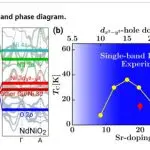
Crucially, the calculations indicate that this engineered material, La₂NiO₄:La₂AlO₄, naturally falls within the optimal doping range for superconductivity. The predicted critical temperature, exceeding 50 Kelvin, represents an advancement in the field, and the same principle extends to La₃Ni₂O₇, a currently prominent nickelate superconductor, demonstrating the versatility of this heterostructuring technique. The researchers state.
Superconductivity Predicted Above 50K
While hole doping, adding positive charge carriers, has proven relatively straightforward in these materials, introducing electrons has remained elusive, hindering a complete understanding of their potential. Researchers have demonstrated that intercalating wide-band-gap insulating layers into lanthanum nickelate structures offers a “disorder-free route to electron dope” the material, a departure from previous attempts. The predicted critical temperature represents an advancement, as many currently known superconductors require significantly lower temperatures to operate.
The calculations reveal a significant charge transfer when these wide-band-gap insulating layers are introduced. For La₂NiO₄:La₂AlO₄, DFT analysis showed an occupancy of 1.46 electrons in the Ni orbital and 0.56 electrons in the orbital, indicating a shift towards the desired electronic configuration for superconductivity. The team also employed more advanced many-body calculations to confirm the nature of the predicted superconductivity, further solidifying the findings.
Wide-Bandgap Insulators (LaXO₃) as Electron Donors
The ability to precisely control electron density in nickelate superconductors has long been a challenge, yet first-principles calculations demonstrate a pathway to achieve this through the strategic insertion of wide-bandgap insulating layers. This robustness is crucial for potential real-world applications, suggesting that these engineered nickelates could maintain their superconducting properties under practical operating conditions.
Computational Methods: DFT, DMFT, and Beyond
Computational methods played a central role in predicting the potential for superconductivity in a newly engineered class of nickelate materials. These calculations demonstrated an occupancy of 1 within the La₂NiO₄:La₂AlO₄ structure, indicating a shift in electron distribution. Beyond DFT, the team demonstrated a method using dynamical mean-field theory (DMFT) to account for strong electron correlations, a crucial step in understanding the behavior of these materials.
The application of DMFT, alongside other advanced techniques, allowed for a more accurate assessment of the material’s electronic properties and its potential for superconductivity. These analyses confirmed the material’s stability, a crucial factor for potential applications.
Structural Stability of RP-Phase Oxide Heterostructures
Computational modeling carried out by researchers from Northwest University, revealed the structural integrity of the proposed heterostructures is maintained even under ambient conditions, a critical factor for potential applications. First-principles calculations, including SCPH and AIMD simulations demonstrated that the La₂NiO₄:La₂AlO₄ structure remains dynamically and chemically stable up to 300 Kelvin. This stability addresses a key concern with layered materials, where interfacial strain or chemical mixing can degrade performance.
The team extended these calculations to assess variable compositions, constructing convex hulls to confirm the thermodynamic favorability of the heterostructure. Beyond simply confirming stability, the computational work delved into the electronic structure of the engineered materials. Density-functional theory (DFT) calculations showed a transfer of charge from the La₂XO₄ blocks into the NiO₂ layers, effectively doping the nickelate with electrons.
This targeted electron doping circumvents the difficulties encountered when attempting to achieve the same effect through traditional substitutional doping methods, which often introduce disorder. The predicted critical temperature exceeding 50 Kelvin is particularly noteworthy given the challenges in achieving high-temperature superconductivity in nickelate materials. To refine this prediction, the researchers employed dynamical mean-field theory (DMFT), accounting for strong electron correlations that are crucial in these materials.
👉 More information
🗞 Heterostructuring as Gateway to Electron Doping of Nickelate Superconductors
✍️ Chao Deng et al.
🧠 DOI: http://link.aps.org/doi/10.1103/qp4p-x6g3


See today’s quantum computing news on Quantum Zeitgeist for the latest breakthroughs in qubits, hardware, algorithms, and industry deals.