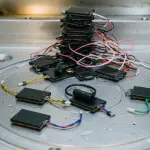
A $19.9 million National Science Foundation grant will fund a four-year project beginning August 1, pairing SUNY Poly with Rice University and the University of Texas at Austin to accelerate materials discovery using artificial intelligence. The “Revolutionizing AI-Driven Autonomous Experimentation for Next-Generation Semiconductor Synthesis” (READINESS) initiative will see identical autonomous physical vapor deposition and chemical vapor deposition systems installed at both SUNY Poly and Rice University, scaling research capacity and collaborative training.
“This award reflects the growing recognition of SUNY Poly as a national leader in semiconductor innovation, advanced manufacturing, and applied artificial intelligence,” said SUNY Poly President Dr. Michael Carpenter, Vice President for Research, will co-lead development of an autonomous PVD system focused on oxide thin film synthesis.
SUNY Poly Develops Autonomous PVD and CVD Systems for Materials Synthesis
Dr. SUNY Poly will also contribute to workforce development by creating short courses and credentials in semiconductor manufacturing, laboratory automation, and AI-enabled materials research, extending the project’s impact beyond immediate research outcomes. The READINESS platform’s design allows researchers to simulate experiments and conduct them remotely, with artificial intelligence continuously refining testing parameters for improved results.
This award reflects the growing recognition of SUNY Poly as a national leader in semiconductor innovation, advanced manufacturing, and applied artificial intelligence.
SUNY Poly President Dr.


See today’s quantum computing news on Quantum Zeitgeist for the latest breakthroughs in qubits, hardware, algorithms, and industry deals.