DIII-D Tokamak Instabilities Drive Predictive AI Development
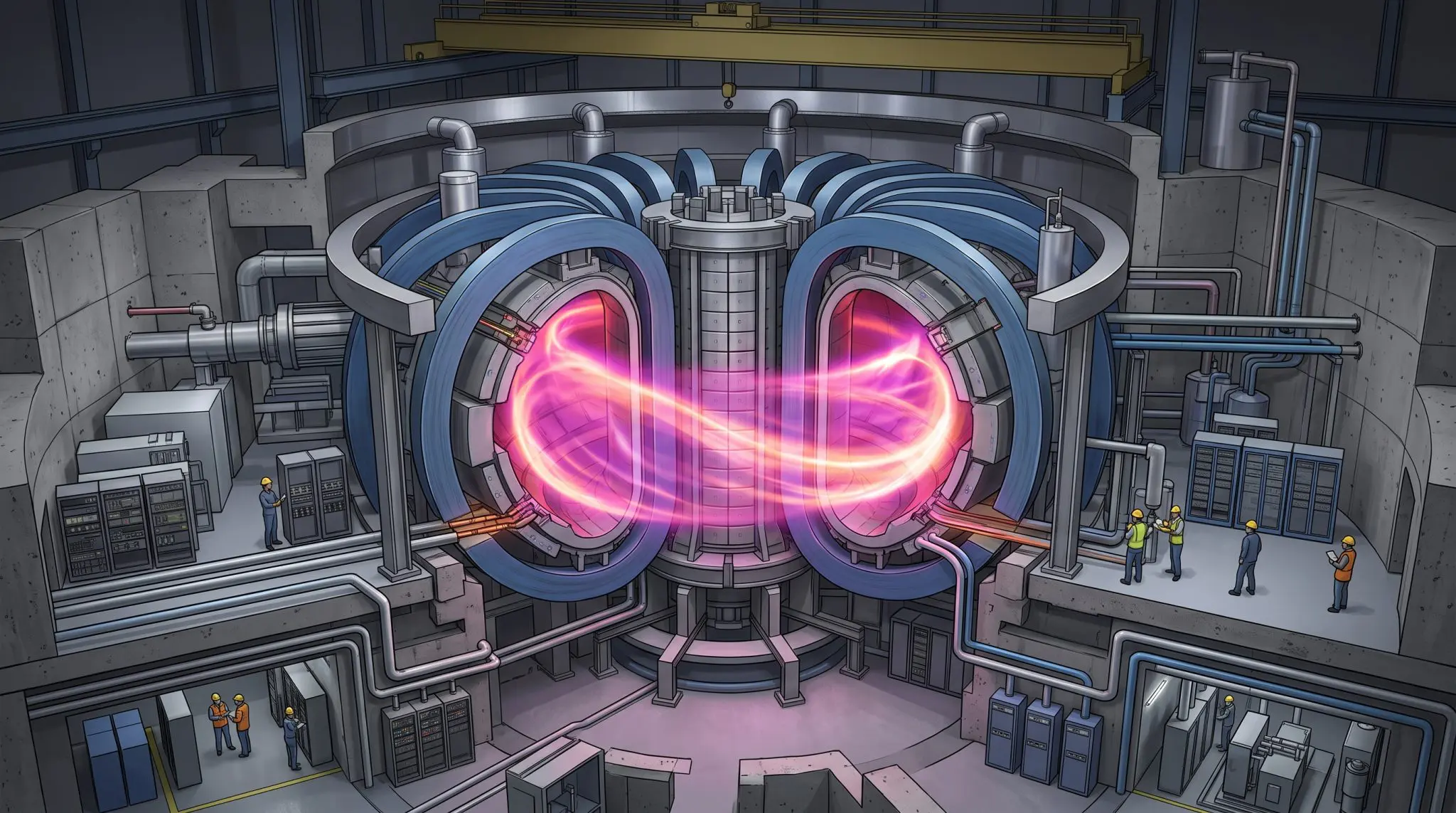
The DIII-D National Fusion Facility contends with plasma temperatures exceeding those found at the sun’s core, creating a challenging environment for sustained experimentation. Maintaining stable operations within this extreme setting requires constant monitoring of the tokamak’s physical integrity, as even subtle distortions can significantly impact fusion reactions. Data scientists at the U.S. Department of Energy’s Thomas Jefferson National Accelerator Facility, collaborating with researchers from General Atomics, the University of Houston, and Pacific Northwest National Laboratory, responded by developing a machine learning framework designed to predict hardware changes before they disrupt experiments. This innovative approach centers on a digital twin of the DIII-D’s toroidal field coil system, a ring of large magnets crucial for confining plasma. These coils, though rigidly engineered, are susceptible to minute shifts as plasma stability fluctuates between experimental “shots” which occur roughly every ten minutes. Recognizing the potential for small issues to escalate, the team aimed to forecast coil movement during these brief downtimes, allowing for proactive diagnosis and maintenance. The resulting system employs deep neural networks trained through online learning, adapting continuously to incoming data and addressing a gap in applying such techniques to the non-stationary data streams common in fusion science. The framework’s core innovation lies in its ensemble of models, each trained on slightly different time series to accommodate various drift patterns in the data. Some models focus on abrupt shifts, others on gradual changes, and still others on intermediate trends. Crucially, each prediction incorporates a reliable assessment of uncertainty, providing operators with a clear indication of confidence levels. “We combine the predictions such that we inversely weight them based on the uncertainty quantification, or the width of the error envelope,” Rajput said. “We weight the models with the narrower envelopes higher, and that’s where the guidance comes in for the ensemble.” Testing revealed this online learning approach reduced prediction error by 80 percent compared to static models, with the uncertainty-guided ensemble further improving accuracy by approximately 10 percent. “From all the aspects we consider—the uncertainty quantification, the adaptive mechanism to make sure the drifts are accommodated, the constraint with respect to time—this all indicates that it’s usable in actual operations,” Rajput stated, highlighting the system’s readiness for deployment and potential adaptability to other fusion devices.From all the aspects we consider – the uncertainty quantification, the adaptive mechanism to make sure the drifts are accommodated, the constraint with respect to time – this all indicates that it’s usable in actual operations. Kishan Rajput, a data scientist at Jefferson Lab
Online Ensemble of DNNs Adapts to Drifting Fusion Data
Rajput and his colleagues are not stopping at current performance. They plan to expand the system’s training data to encompass years of historical shots, capturing less common events and refining uncertainty quantification. “Though we’re able to adapt each shot, it’s important to show explicitly what the trend is from the machine learning model perspective,” he said. “We want to show how the model is evolving as opposed to how the data is evolving and what part of the models are capturing that trend.” This focus on model evolution and explainability, Rajput notes, is key to building trust in AI-driven diagnostics within the fusion community. The framework is now ready for deployment on DIII-D and can be adapted for use in other fusion facilities.The technique that we have developed would help fusion researchers find issues before they actually happen on the physical machine. Kishan Rajput, a data scientist at Jefferson Lab and the lead author on the study
Source: https://www.jlab.org/news/stories/blending-fusion-science-ai-predict-diii-d-tokamak-behavior
More like this

Artificial IntelligenceAIA Sports’ ‘Cyber-Purge’ uses quantum tech to prevent rogue robot threats
Artificial IntelligenceCalifornia State University asks students and staff how they use AI
Artificial IntelligenceBerkeley Law report finds AI use affects rights in law, media, schools
Artificial IntelligenceNVIDIA’s platform monitors AI agents continuously within hardware
Stay current
See today’s quantum computing news on Quantum Zeitgeist for the latest breakthroughs in qubits, hardware, algorithms, and industry deals.