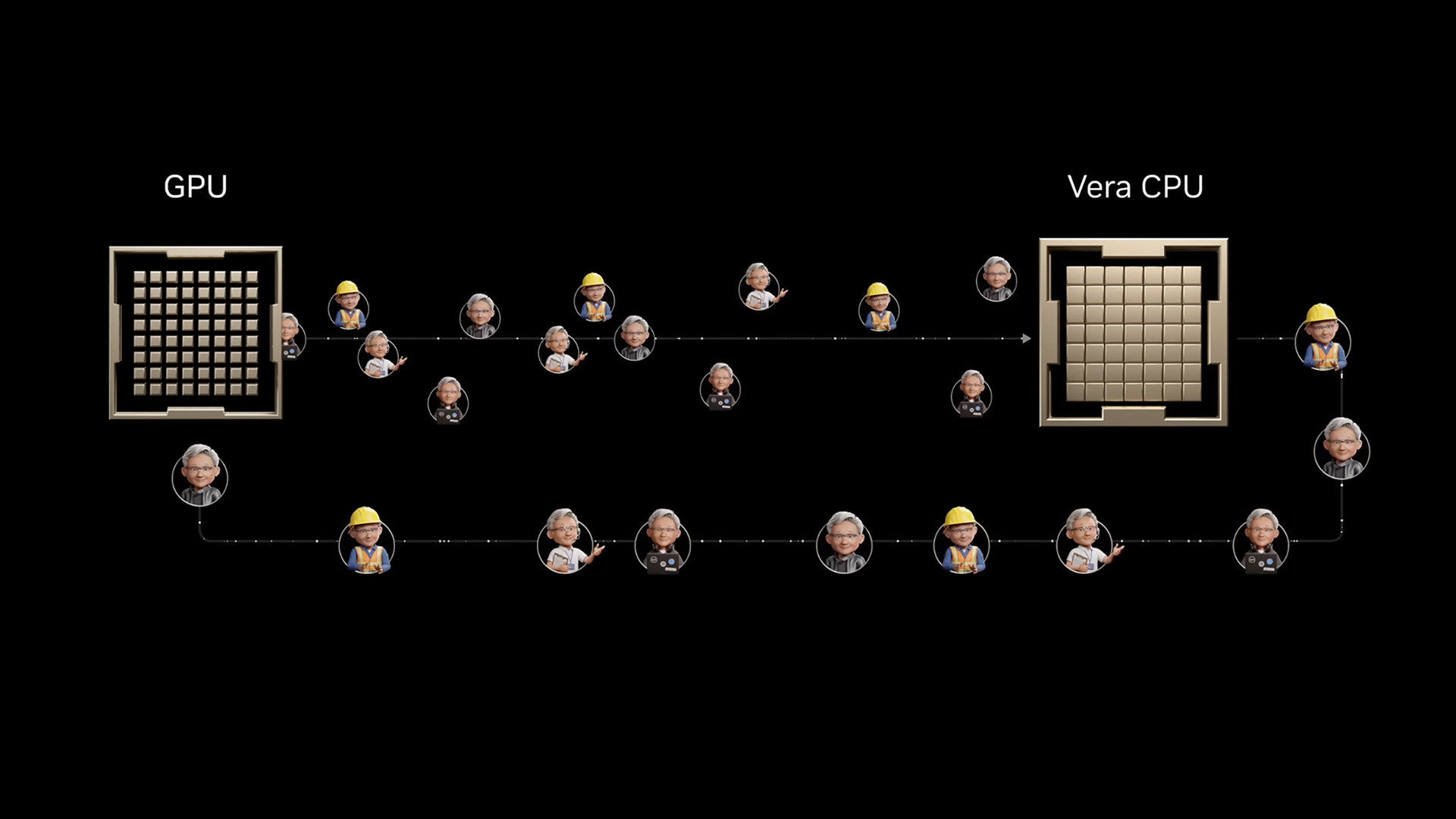
NVIDIA is challenging a core tenet of modern data center design with Vera, a new CPU built to maximize single-threaded performance at scale, and AI innovator Perplexity is among the first to adopt it. While data center CPUs have increasingly prioritized higher core counts and cost reduction, NVIDIA argues this approach has come at the expense of speed, a critical factor for the emerging era of agentic AI. “The faster the CPU can run the tool, the faster the agent can perform the task at hand,” explains the company, highlighting the need for rapid processing within AI “factories” where GPU utilization drives revenue. NVIDIA Vera exemplifies a new class of CPU designed to deliver strong performance per core under load, with enough memory bandwidth and predictable latency to keep agents operating efficiently; the article was published on July 7, 2026.
NVIDIA Vera: Architecture for Agentic AI Workloads
NVIDIA Vera delivers 1.8 times the sustained per-core performance of x86 in agentic workloads, marking a significant departure from recent data center CPU design priorities. The newly unveiled NVIDIA Vera CPU is specifically architected to address the demands of agentic AI, a field where maximizing single-threaded performance is paramount, a focus that contrasts with the industry trend towards higher core counts at the expense of individual core speed. NVIDIA asserts that contemporary data center CPUs have evolved to prioritize cost-effectiveness and rentable core numbers, inadvertently hindering the rapid execution crucial for AI agents. This shift, driven by the cloud computing model, has resulted in CPUs where silicon area is diverted from enhancing per-core performance, including high-performance memory fabrics and faster instruction processing.
The design philosophy behind Vera centers on maintaining speed even under heavy load. “Every core completes the agent task at full performance without other cores slowing it down,” explains NVIDIA, highlighting the importance of predictable latency and sustained throughput. This is achieved through a monolithic compute die providing 3.4 terabytes per second of core-to-core bandwidth, three times greater than any other data center CPU, ensuring active cores receive uninterrupted data flow. Vera pairs its custom Olympus CPU core, which delivers 50 percent higher instructions per cycle than NVIDIA Grace, with up to 1.2 terabytes per second of LPDDR5X memory bandwidth while maintaining a power consumption of less than 40 watts. This combination is intended to accelerate the agentic loop: the iterative process of reasoning, tool use, data processing, and result analysis. Early adoption by AI innovators like Perplexity demonstrates confidence in this approach.
Perplexity tested Vera on real-world coding workflows, achieving a 1.5 times speed increase in cloning repositories and running test suites, and Perplexity started concurrent sandboxes up to 1.9 times faster. According to the company, “Running a real coding workflow — cloning a repository and running its test suite in sandboxes — Vera completed the job about 1.5 times faster than x86.” Beyond coding, Vera also demonstrates significant improvements in data-intensive tasks, with partners reporting three times faster large-scale SQL analytics with Starburst and up to six times lower latency on real-time streaming with Redpanda, both against leading x86 server CPUs. NVIDIA’s CPU roadmap continues with the forthcoming Rosa CPU and its Rigel core, promising further gains in per-core performance while maintaining a similar silicon footprint.
At the core of Vera is Olympus, NVIDIA’s custom CPU core, which delivers 50% higher instructions per cycle than NVIDIA Grace.
Olympus Core Delivers Enhanced Single-Threaded Performance
The demand for increasingly parallel processing has largely defined data center CPU design in recent years, but a shift is occurring as artificial intelligence workloads mature. Contemporary data center CPUs have been evolving away from single-threaded performance, prioritizing core counts and cost optimization over raw speed. This trend contrasts with the design philosophy behind NVIDIA Vera, which prioritizes maximizing performance for individual CPU cores, a strategy geared toward the emerging needs of agentic AI systems. The focus on single-threaded performance stems from the nature of agentic workflows, where sequential tasks depend on the rapid completion of each step before the next can begin. Faster cores, therefore, accelerate the entire agent loop.
NVIDIA has paired these faster cores with up to 1.2 terabytes per second of LPDDR5X memory bandwidth at less than 40 watts of memory power, plus a monolithic compute die that helps active cores stay fed and keeps data movement predictable with 3.4 terabytes per second of core-to-core bandwidth, three times greater than any other data center CPU. This architecture ensures that all cores have full access to memory performance, avoiding bottlenecks that could slow down individual cores. NVIDIA asserts that this results in a substantial performance gain; in loaded CPU workloads representing agentic execution, Vera delivers 1.8 times the sustained per-core performance of x86. These gains are not merely theoretical, as demonstrated by Perplexity, an AI innovator adopting the Vera CPU. This versatility allows a single Vera processor to handle the diverse demands of an AI agent, from tool execution to data processing and model training, streamlining the entire AI factory infrastructure.
Perplexity Validates 1.5-1.9x Speedup with Vera
Perplexity, a company actively developing agentic systems, is among the first to adopt the NVIDIA Vera CPU, signaling a significant endorsement of the new architecture’s capabilities. This move highlights a growing industry need for processors specifically designed to accelerate the workflows underpinning increasingly sophisticated AI agents, rather than simply maximizing core counts for traditional cloud computing tasks. The article was published on July 7, 2026, positioning Vera as a solution to bottlenecks encountered when CPUs struggle to keep pace with the demands of AI-driven tasks like tool calling, code execution, and data processing. NVIDIA asserts that current data center CPUs have shifted focus toward cost optimization and higher core density, often at the expense of single-threaded performance. This trend, while beneficial for certain workloads, creates a challenge for agentic AI where rapid, sequential processing is paramount.
Vera directly addresses this issue with its Olympus core, delivering 50 percent higher instructions per cycle than NVIDIA’s Grace CPU, a crucial metric for accelerating those sequential agent steps. According to their internal benchmarks, Vera completed the task approximately 1.5 times faster than x86 processors, and started concurrent sandboxes up to 1.9 times more quickly. Perplexity is now planning to integrate Vera into its upcoming production systems, demonstrating confidence in its ability to enhance agent performance and overall system efficiency.
Running a real coding workflow – cloning a repository and running its test suite in sandboxes – Vera completed the job about 1.5x faster than x86, and started concurrent sandboxes up to 1.9x faster.
Perplexity
Vera’s Unified Design Maximizes AI Factory Revenue
The economic implications of NVIDIA’s Vera CPU extend beyond raw processing speed, directly impacting the revenue potential of AI factories. Unlike conventional data center CPUs optimized for cost per core, Vera prioritizes maximizing single-threaded performance, a design choice that addresses a critical bottleneck in agentic AI workflows. The company acknowledges a shift in priorities away from individual core performance in favor of higher core counts and reduced expenses. This admission underscores the unique positioning of Vera, which aims to accelerate each step within an agent’s operational loop. Vera’s architecture is geared towards persistent, parallel processing, a departure from the intermittent, user-driven workloads traditional CPUs handle. Agentic systems, characterized by “swarms of agents running continuously,” demand a CPU capable of swiftly completing each task in a chain of dependent operations.
While increasing core counts can handle more concurrent tasks, it doesn’t inherently reduce the time required for each individual step. NVIDIA emphasizes that “more cores can’t make any one task run faster,” highlighting the importance of per-core speed in driving overall efficiency. The design extends beyond core performance to encompass memory bandwidth and data access. Vera incorporates up to 1.2 terabytes per second of LPDDR5X memory bandwidth at under 40 watts, coupled with a monolithic compute die providing 3.4 terabytes per second of core-to-core bandwidth, three times greater than any other data center CPU. This infrastructure ensures active cores remain consistently supplied with data, preventing bottlenecks and maintaining predictable latency, ultimately helping every GPU spend more time generating revenue and less time waiting.




See today’s quantum computing news on Quantum Zeitgeist for the latest breakthroughs in qubits, hardware, algorithms, and industry deals.