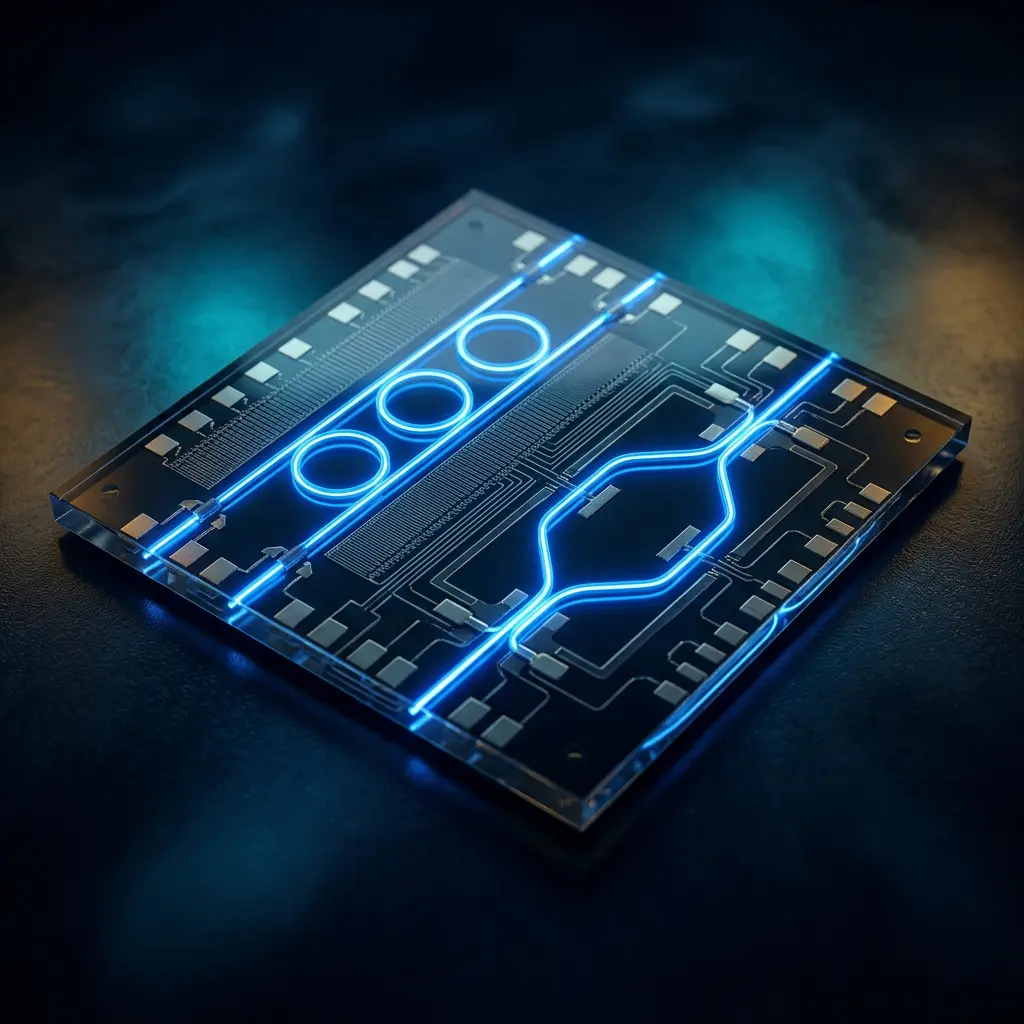
Delft researchers have demonstrated a quantum repeater architecture employing a system that dynamically assigns quantum chips in every end-to-end communication cycle, a strategy designed to boost fidelity in practical quantum networks. Unlike systems with static chip allocation, the new approach leverages each chip’s dual functionality, an optically addressable communication qubit alongside a dedicated memory qubit for entanglement storage, to optimize performance. The team focused on a challenging parameter regime where, on average, less than one entangled link is generated per end-to-end communication cycle, acknowledging the current limitations of generating stable quantum connections. This dynamic multiplexing policy, they report, can significantly improve fidelity over fixed assignment methods, even with a more complex router, making it especially relevant for the development of near-term quantum networks.
Each quantum repeater developed by researchers at QuTech integrates both a communication qubit for entanglement exchange and a dedicated memory qubit for storage. This dual-qubit architecture, detailed in their recent publication, moves beyond simpler designs by enabling more sophisticated entanglement manipulation within the repeater itself. The team has constructed a system where multiplexing, boosting entanglement rates, is achieved through optical integration of numerous quantum chips. Their analysis reveals that this dynamic multiplexing policy can significantly improve fidelity, the accuracy of the entangled state, over a fixed assignment strategy, while also offering a slight improvement in the entanglement generation rate.
Quantum repeater technology is rapidly evolving from theoretical designs to demonstrable systems, though practical limitations currently constrain performance. Researchers are now focusing on optimizing entanglement distribution within these repeaters, particularly through advanced multiplexing strategies. A team at QuTech, Delft, has developed a quantum repeater architecture distinguished by its dual-qubit design; each quantum chip hosts an optically addressable communication qubit and a separate memory qubit, enabling both entanglement generation and storage within the repeater itself. Simulations reveal substantial improvements using this dynamic system. Even though the dynamic multiplexing policy requires a deeper, and therefore more lossy, router than the fixed policy, it can still achieve higher secret key rates in the parameter regime studied. This resilience, the researchers claim, offers a pathway to practical, secure communication despite hardware limitations.
QuTech researchers are developing a dynamic approach to entanglement distribution within quantum repeaters, moving beyond static assignments of quantum resources. This architecture, unlike previous designs, utilizes a reconfigurable router to dynamically allocate chips to either of the two end nodes in every end-to-end communication cycle. The team’s innovation centers on a policy where, after an entangled link has been established with one of the end nodes, all remaining quantum chips are assigned to the opposite end node. This contrasts with fixed assignment strategies and addresses a critical challenge in current quantum networks: achieving entanglement even when link generation is infrequent. The results demonstrate a significant advantage for the dynamic approach.
The pursuit of secure, long-distance quantum communication is increasingly focused on overcoming the limitations of current entanglement distribution methods, and a novel approach to quantum repeater architecture is yielding promising results. This contrasts with simpler architectures and suggests a deliberate strategy for enhancing network performance. The system can adapt rapidly to changing conditions, a significant departure from static allocation methods. This focus on realistic limitations is key; the researchers aren’t modeling ideal scenarios, but rather optimizing for the constraints of near-term technology. They demonstrate that this dynamic policy can significantly improve fidelity, particularly with smaller entanglement generation probabilities and shorter memory coherence times. The authors report that “dynamic multiplexing can significantly improve the fidelity of end-to-end links generated by a quantum repeater in steady-state, especially for parameter values relevant to near-term quantum networks.”
The prevailing image of quantum repeaters often centers on complex chains of nodes, yet a critical component enabling their functionality, the reconfigurable router, receives less attention. Researchers at QuTech, Delft, are challenging conventional designs with a system that dynamically allocates quantum resources within the repeater itself. This architecture isn’t simply about increasing qubit count; it’s about intelligent management. This is particularly crucial given the current limitations of quantum networks, where establishing even a single entangled link remains a significant hurdle. Simulations demonstrate that this dynamic policy yields substantial improvements in fidelity, especially with limited hardware.
A novel approach to quantum repeater design leverages dynamic resource allocation to dramatically improve entanglement fidelity, even with imperfect hardware. Simulations reveal that this dynamic approach yields substantial improvements in fidelity. Importantly, the system remains effective even with realistic losses; dynamic multiplexing still achieves positive secret key rates where fixed multiplexing fails.
Quantum repeaters are rapidly evolving from theoretical concepts to demonstrable hardware, yet current systems face a fundamental challenge: generating entangled links reliably enough to overcome signal loss over long distances. Researchers are now refining strategies to maximize the efficiency of these repeaters, and a recent advance focuses on how quantum chips within the device are allocated during communication. Simulations demonstrate substantial gains.
Researchers at QuTech, Delft University of Technology, are refining strategies for building practical quantum networks, focusing on maximizing performance within current technological constraints. This architecture moves beyond theoretical ideals to address the realities of near-term hardware. This makes dynamic multiplexing a viable option for improved performance with limited resources.
Researchers employed Markov chain analysis, a mathematical framework for modeling probabilistic transitions, to rigorously evaluate a dynamic multiplexing policy for entanglement distribution. This wasn’t merely theoretical; the team validated their analytical findings using NetSquid, a widely-used open-source simulator for quantum networks. This pragmatic approach allowed them to pinpoint scenarios where their dynamic system truly excels. This, combined with allowing dynamic chip assignment in every end-to-end communication cycle, creates a highly adaptable system.
Source: https://arxiv.org/abs/2607.07539


See today’s quantum computing news on Quantum Zeitgeist for the latest breakthroughs in qubits, hardware, algorithms, and industry deals.