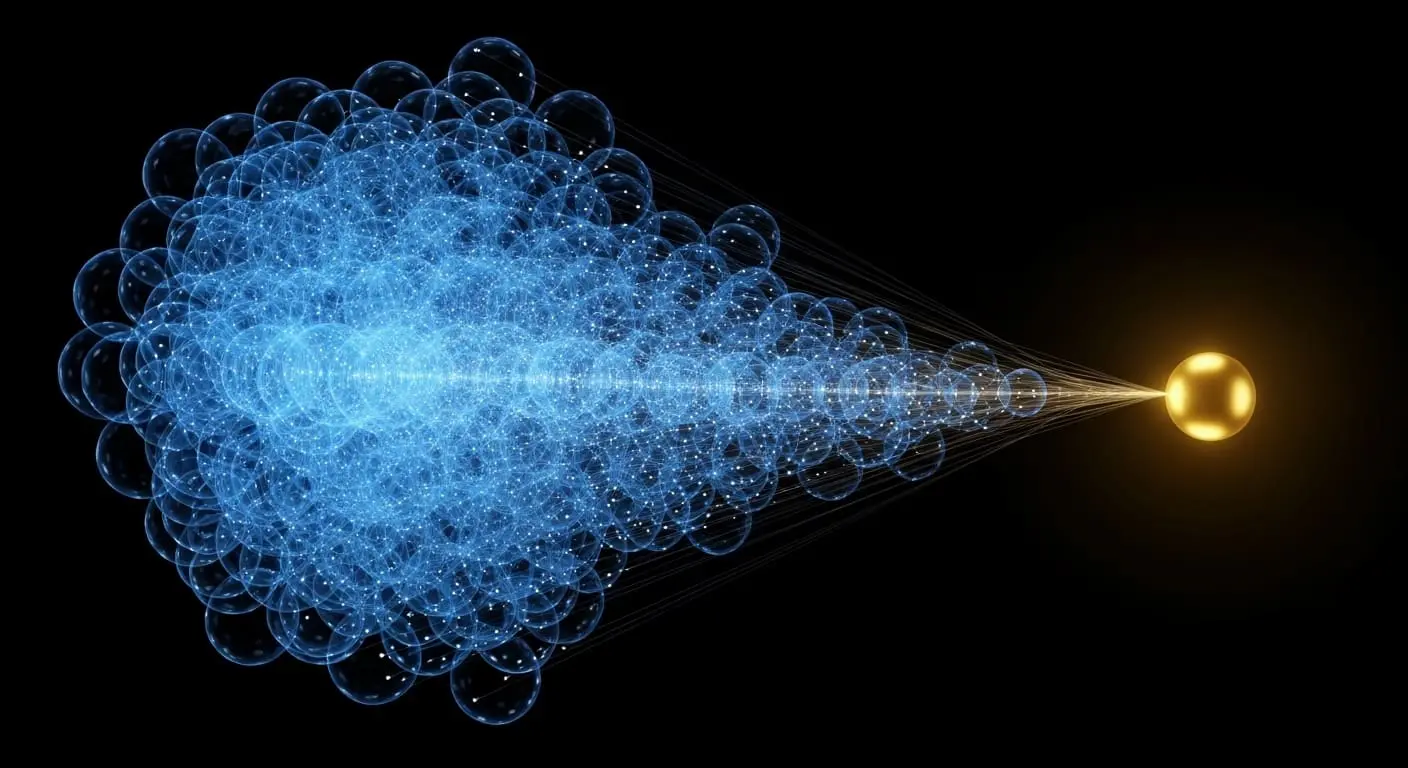
Researchers at Shanxi University report achieving 99% readout fidelity in neutral atom arrays despite histogram overlaps of 61%, a level of accuracy previously unattainable with standard threshold-based methods. The team’s advance centers on a neural-network-assisted Bayesian inference method for fluorescence readout, addressing a key challenge in scalable atomic quantum processors where distinguishing qubit states becomes increasingly difficult at the single-photon level. A “weakly anchored Bayesian scheme” simplifies calibration by requiring measurement of only one state, solving a common problem of asymmetric calibration found across all quantum platforms. Acceleration via a permutation-invariant neural network delivers a 100-fold speedup, compressing Bayesian inference into a single forward pass and enabling reliable extraction of Rabi oscillations and Ramsey interference.
To address this, Yaoting Zhou and colleagues developed a system that moves beyond simple thresholding, instead employing probabilistic reasoning to improve accuracy. This streamlined approach significantly reduces the time and resources needed to prepare a quantum processor for operation. The resulting system boosts fidelity to 98% with 72% histogram overlap and enables reliable extraction of crucial quantum signals like Rabi oscillations and Ramsey interference, as published in Physical Review Letters.
Weakly Anchored Calibration Improves Single-Photon Fidelity
Achieving reliable qubit readout remains a central challenge in scaling neutral atom quantum processors, particularly as researchers push towards the single-photon regime where distinguishing quantum states becomes increasingly difficult. Conventional threshold-based discrimination methods falter when state distributions significantly overlap, introducing errors that limit the fidelity of quantum operations; existing systems struggle with asymmetric calibration requirements across different quantum platforms. To overcome these limitations, Yaoting Zhou and colleagues at Shanxi University have developed a novel approach leveraging Bayesian inference and neural networks.



See today’s quantum computing news on Quantum Zeitgeist for the latest breakthroughs in qubits, hardware, algorithms, and industry deals.