

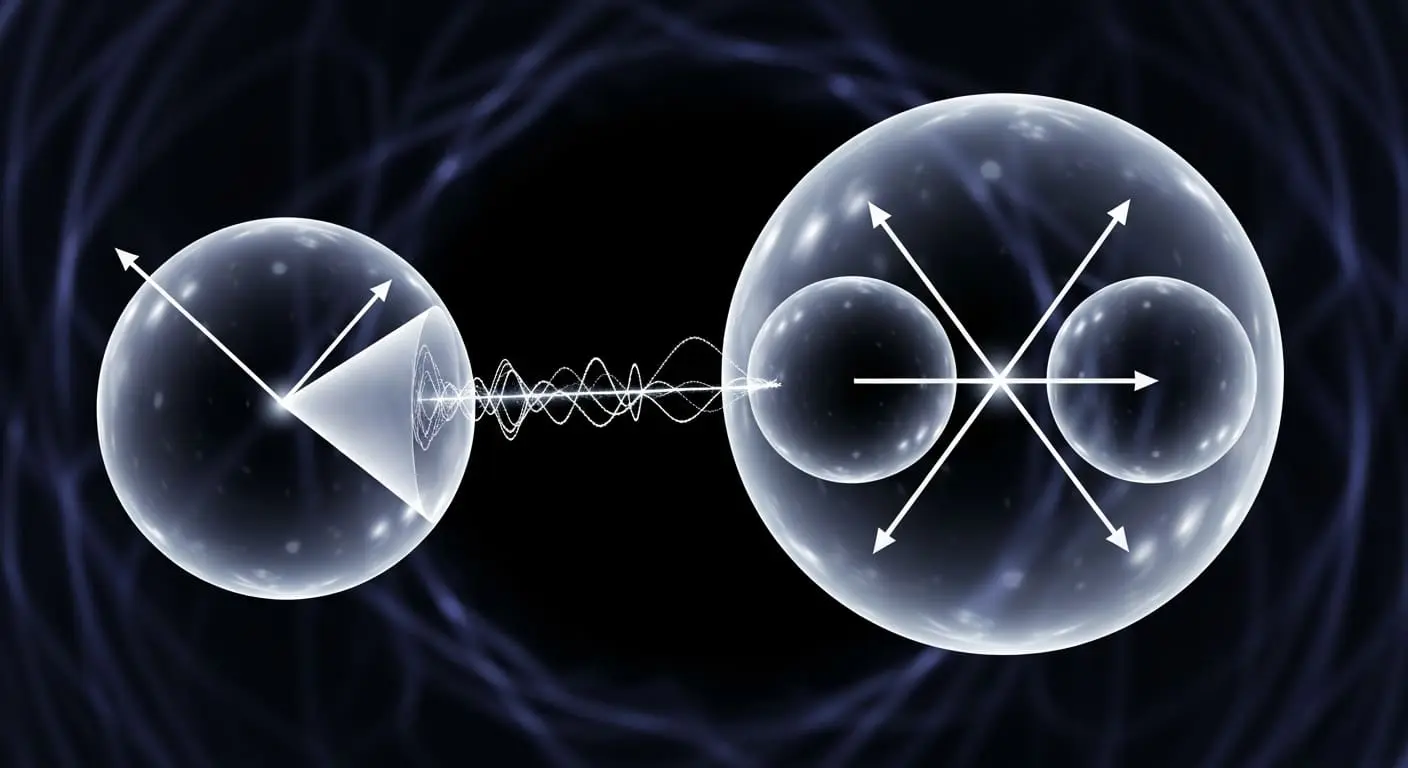
Scientists have, for the first time, created a two-mode magnonic cat state, a complex form of quantum entanglement. Yttrium-iron-garnet spheres and a superconducting qubit linked by a microwave cavity were used by the team from Zhejiang University to achieve this. This breakthrough extends cat state generation beyond single modes to multimode systems, previously a missing step in the field; it demonstrates a protocol for generating these states, opening new avenues for quantum technologies.
Researchers have successfully generated a two-mode magnonic cat state, a complex quantum connection, utilising yttrium-iron-garnet spheres and a superconducting qubit linked by a microwave cavity. A cat state is created by combining two opposing quantum states; this work extends its creation beyond single components to systems with multiple interacting parts. This achievement demonstrates a new method for producing these states and advances the field of quantum magnonics, potentially aiding the development of more advanced quantum information processing.
Scientists at Zhejiang University have demonstrated a new method for creating a complex quantum state known as a two-mode magnonic cat state, utilising yttrium-iron-garnet spheres and a superconducting qubit linked by a microwave cavity. A cat state, in this context, is a superposition of two distinct quantum states; imagine Schrödinger’s cat being both alive and dead simultaneously, but instead realised using magnons, quantum excitations within a material. The team achieved this by carefully controlling the interaction between the qubit and the magnons, effectively creating a situation where the magnons behave as a single, unified quantum entity, much like two swings linked together so that pushing one also affects the other. This breakthrough extends the creation of these states beyond single components to systems with multiple interacting parts, paving the way for more advanced quantum technologies; however, practical limitations such as dissipation and dephasing must be considered.
Multimode entanglement realised via controlled magnon interactions in a hybrid system
Zhejiang University researchers have now achieved a two-mode magnonic cat state exceeding previously attainable levels in multimode systems. A reliable protocol for creating entanglement across multiple magnonic modes was previously lacking, hindering the generation of cat states beyond single modes. The experimental setup involves two yttrium-iron-garnet spheres and a superconducting qubit coupled to a microwave cavity, effectively creating a platform for intricate control over quantum excitations known as magnons. Yttrium-iron-garnet, or YIG, is particularly well-suited for this purpose due to its low magnetic damping, allowing magnons to propagate with minimal energy loss. The microwave cavity serves as a crucial intermediary, mediating the interaction between the magnons in the YIG spheres and the superconducting qubit, which acts as a control element.
Precise manipulation of magnons is now possible, paving the way for more complex quantum networks, although scaling to larger systems remains a significant challenge. The system comprises two yttrium-iron-garnet spheres and a superconducting qubit coupled to a microwave cavity, as demonstrated by the Zhejiang University team, and benefits the two-mode magnonic cat state. Adiabatic elimination, a mathematical process effectively removing the cavity’s influence from the system’s dynamics, enabled an effective interaction where the qubit conditionally displaces the magnons, quantum excitations within the YIG spheres. This displacement is achieved by carefully tuning the qubit’s frequency and applying resonant driving fields. Performing this manipulation under strong-coupling conditions, where magnons and the qubit strongly influence each other, prepared one magnon mode in a cat state while leaving the other undisturbed, creating the desired two-mode state. The resulting state exhibits strong non-classicality and non-Gaussian entanglement, indicating a strong quantum effect, but is currently limited by feasible, yet idealised, parameters. The non-Gaussian nature of the entanglement is particularly important, as it allows for quantum information processing tasks that are impossible with classical or Gaussian states.
Magnonic cat states and the challenges of maintaining quantum coherence
Scientists at Zhejiang University have engineered a pathway towards more complex quantum networks by creating a two-mode magnonic cat state, a peculiar form of quantum entanglement where a quantum excitation exists in a superposition of states. This achievement builds upon recent advances in linking magnons, quantum vibrations within materials, with superconducting qubits and microwave cavities, offering a promising platform for manipulating quantum information. Magnons, as quasi-particles representing collective spin excitations, offer advantages in terms of coherence and potential for long-range interactions compared to other quantum systems. Calculations, however, reveal that maintaining this delicate quantum state is vulnerable to environmental noise, specifically energy dissipation and dephasing, which degrade the signal over time. Dissipation refers to the loss of energy from the system to the environment, while dephasing refers to the loss of the phase relationship between the quantum states.
This work extends the generation of these unusual states beyond single quantum components to systems with multiple interacting parts, potentially improving the performance of quantum devices. A direct interaction was established through careful elimination of mathematical complexities related to the microwave cavity linking the components, enabling precise control over the magnons’ behaviour. The ability to generate and control multimode magnonic cat states opens up possibilities for implementing advanced quantum algorithms and protocols, such as quantum teleportation and quantum key distribution. Despite susceptibility to energy loss and signal degradation, creating such a state represents a key step towards building more sophisticated quantum networks and understanding the limits of quantum coherence in these hybrid systems. Future research will focus on mitigating the effects of dissipation and dephasing through improved materials, device design, and quantum error correction techniques, ultimately aiming to create more robust and scalable quantum technologies. The team’s work represents a significant advancement in the field of quantum magnonics, bringing us closer to realising the potential of magnons as a platform for quantum information processing.
The creation of a two-mode magnonic cat state, involving the precise orchestration of magnons and a superconducting qubit, demonstrates a significant step towards harnessing the power of quantum entanglement for practical applications. The 2 YIG spheres, acting as reservoirs of magnons, are crucial for sustaining the quantum state, while the superconducting qubit provides the necessary control and readout capabilities. The microwave cavity, carefully designed to enhance the interaction between these components, plays a vital role in mediating the quantum exchange. Further investigation into optimising these parameters and mitigating environmental noise will be essential for realising the full potential of this innovative platform for quantum technologies.
The researchers successfully prepared a two-mode magnonic cat state using yttrium-iron-garnet spheres and a superconducting qubit coupled via a microwave cavity. This achievement demonstrates the creation of strong non-Gaussian entanglement within a hybrid quantum system, moving beyond single quantum components. The resulting state offers a pathway towards more complex quantum systems and protocols, such as quantum teleportation and key distribution. The authors intend to focus on reducing energy loss and signal degradation to improve the robustness of these states.
👉 More information
🗞 Preparing two-mode magnonic Schrödinger cat states in a cavity-magnon-qubit system
✍️ Gen Li, Gang Liu, Rong-Can Yang and Jie Li
🧠 ArXiv: https://arxiv.org/abs/2606.25511



See today’s quantum computing news on Quantum Zeitgeist for the latest breakthroughs in qubits, hardware, algorithms, and industry deals.



