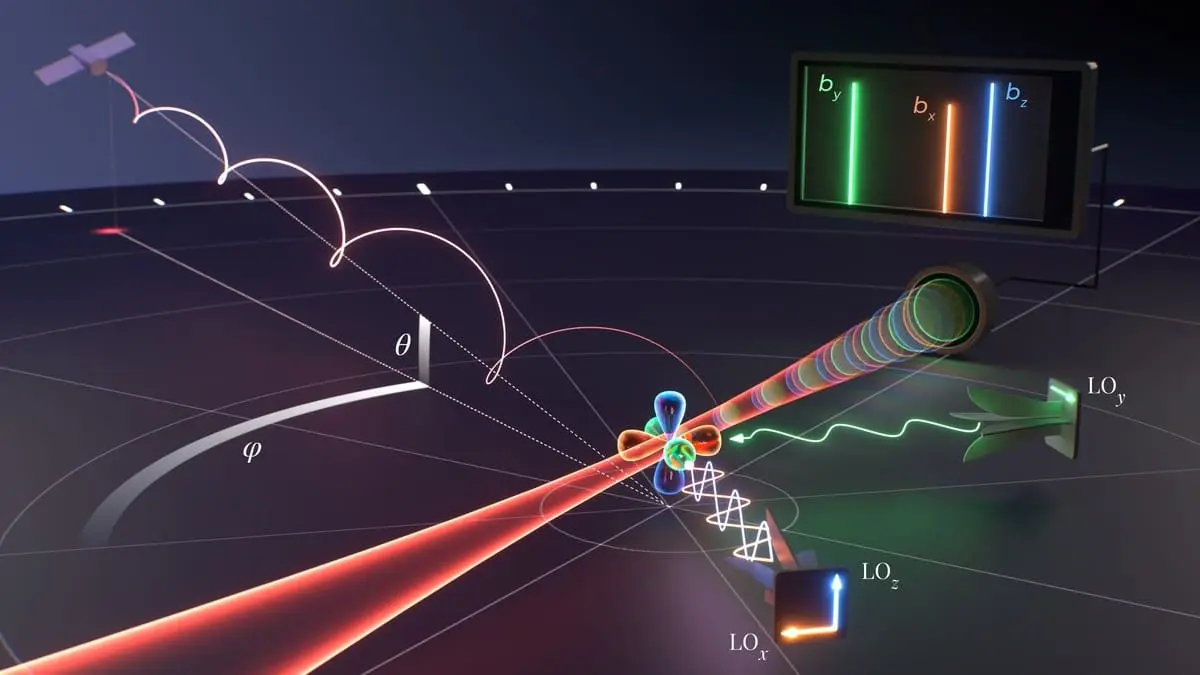
Scientists at the U. S. Army Combat Capabilities Development Command, DEVCOM Army Research Laboratory, have achieved a first: measuring the full 3D direction of radio-frequency electromagnetic fields with a quantum sensor. This breakthrough moves battlefield signal detection beyond traditional methods, which can only assess field strength in one direction at a time; the new sensor provides a complete three-dimensional picture of signal origin and motion. At the core of the device is a glass cell containing rubidium atoms, excited by lasers to highly sensitive Rydberg states, allowing for precise detection across the entire radio frequency spectrum. “This research opens the door to detecting and pinpointing signals over a broad frequency range in a single sensing package, even in the most challenging environments,” said David Meyer, ARL research physicist, suggesting a potential transformation in situational awareness and secure communications for Soldiers.
Rydberg Atoms Enable 3D Radio-Frequency Field Measurement
The ability to fully map the direction of radio-frequency electromagnetic fields represents a significant leap forward in signal detection, recently achieved by scientists at the U. S. Army Research Laboratory. This innovation relies on the unique properties of Rydberg atoms, excited to highly sensitive states using laser technology within a rubidium vapor cell. Researchers detailed their findings in Physical Review Applied, demonstrating the sensor’s capacity to determine not only field strength but also the 3D polarization orientation and propagation direction, referred to as the k-vector. This is a departure from conventional antennas, which often require sizes comparable to the wavelengths they detect and operate within restricted frequency ranges; the ARL sensor, measuring just centimeters across, functions across the entire radio frequency spectrum. The sensor achieves directional accuracy of approximately two degrees, offering a flexible platform for signal intelligence.
The implications for modern warfare are substantial, particularly given the increasing complexity of the radio frequency environment with the proliferation of autonomous systems. This advance builds upon previous ARL work with Rydberg electrometers, demonstrating the lab’s long-standing commitment to quantum research and its designation as an Army Quantum Information Science Research Center.
Rubidium Vapor Cell Design for Quantum Sensing
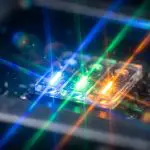
The pursuit of enhanced battlefield awareness has led to innovations in radio-frequency signal detection, moving beyond traditional methods limited by size and bandwidth. Scientists at the U. S. Army Research Laboratory developed a new capability relying on a meticulously designed rubidium vapor cell, central to the Rydberg quantum sensor’s functionality, which allows for precise detection across a broad spectrum. This allows the sensor to pinpoint the origin and movement of signals with an accuracy of approximately two degrees, a level of directional precision previously unavailable. This advancement builds upon earlier ARL research into Rydberg electrometers, including work demonstrating the sensor’s ability to measure radio-frequency field polarization and decode encoded information. The ability to correct for systematic effects, such as internal reflections within the vapor cell, has been crucial in achieving these increasingly precise measurements.
This is the first time such a measurement has been achieved using a quantum sensor.
ARL’s Quantum Research & Spectrum Awareness Applications
David Meyer, a research physicist at the U. S. Army Combat Capabilities Development Command, Army Research Laboratory, is leading efforts to redefine battlefield signal detection through advancements in quantum sensing. Unlike conventional sensors limited to single-direction measurements, this new device provides a complete 3D picture of signal propagation, offering a significant advantage in complex radio frequency environments. This broadband capability, extensively explored by ARL scientists, contrasts sharply with traditional antennas which are often limited to narrow frequency ranges and must be comparable in size to the signals they detect.
Having a single sensor platform that covers the entire radio-frequency spectrum and can measure the 3D direction of those fields represents a potentially transformative capability, especially in spectrum awareness.


See today’s quantum computing news on Quantum Zeitgeist for the latest breakthroughs in qubits, hardware, algorithms, and industry deals.