
1. Superposition is a linear combination of quantum states. If a quantum system can be in state |A⟩ or state |B⟩, the rules of quantum mechanics also allow it to be in any state α|A⟩ + β|B⟩ with complex amplitudes α and β satisfying |α|² + |β|² = 1.
2. Superposition is not classical uncertainty. A coin spinning in the air is in a classical mix of heads and tails, not a quantum superposition. The fundamental difference is interference: amplitudes can add or cancel, which classical probabilities never do.
3. Measurement collapses the superposition to a single outcome. Reading the state in a basis yields a single basis state with probability given by the Born rule (|α|² for outcome A, |β|² for outcome B); after measurement the system is in the observed state.
4. The double-slit experiment proves single photons interfere with themselves. Sending photons (or electrons, atoms, or even buckyballs) through two slits one at a time still produces an interference pattern, the experimental signature that each particle is in superposition of the two paths.
5. Schrodinger’s cat is the most famous superposition thought experiment. Erwin Schrodinger’s 1935 thought experiment scales quantum superposition to a macroscopic system to highlight the strangeness of the measurement problem, the still-debated philosophical question of when and why superposition breaks down. The Stanford Encyclopedia of Philosophy: what is superposition in quantum mechanics covers what is superposition philosophically in depth.
6. Decoherence is what destroys superposition in practice. A quantum system interacting with its environment becomes entangled with all the environmental degrees of freedom, and the superposition becomes effectively impossible to recover; T2 dephasing times are the most-quoted measure of how long a qubit’s superposition survives.
7. Superposition powers every quantum algorithm. Shor’s factoring, Grover’s search, variational chemistry, and quantum machine learning all run on registers of qubits in superposition; quantum interference between amplitudes is the architectural primitive that lets quantum algorithms outperform classical ones on specific tasks.
Superposition without the maths
The shortest answer to what is superposition: a quantum particle can be in two states at once, and the simplest mental picture is a guitar string vibrating at two notes at the same time. A real guitar string, when plucked, oscillates at many frequencies simultaneously (the fundamental note plus overtones), and the resulting sound is a single audible wave that contains all those frequencies layered on top of each other. A quantum particle in superposition works the same way: the particle is not secretly in one state or another, it actually inhabits a layered combination of multiple possibilities, and that combination is itself the physical reality. The most famous classroom demonstration is a single photon passing through two slits. Common sense says the photon must go through one slit or the other, but experiments show the photon goes through both, builds up an interference pattern on the screen behind, and only chooses a definite slit when you set up an apparatus that forces it to. Quantum mechanics says this is what every physical system does at small scales, and the only reason you do not see superposition in everyday objects is that large objects interact with their environment so quickly that the superposition collapses before you can observe it. An equivalent metaphor is a coin balanced exactly on its edge, spinning so fast that neither face is fully visible. The coin is not heads, the coin is not tails, the coin lives in a layered state where both possibilities are part of the description. When something stops the coin (a finger, a table, a measurement), the coin lands on one face, and the probability of each face is determined by exactly how the coin was spinning before being stopped.What is superposition, exactly?
The technical definition of what is superposition in physics is the superposition principle of quantum mechanics, if a quantum system can be in state |ψ1⟩ and can be in state |ψ2⟩, then the rules of quantum mechanics also allow the system to be in any linear combination α|ψ1⟩ + β|ψ2⟩, where α and β are complex numbers (called probability amplitudes) and the normalisation condition |α|² + |β|² = 1 holds. The state vector |ψ⟩ lives in a complex Hilbert space, and the superposition is just the statement that the Hilbert space is a vector space closed under addition and scalar multiplication. The principle generalises to any number of states. A qubit lives in a two-dimensional Hilbert space and so admits superpositions of two basis states, an n-qubit register lives in a 2&sup(n) dimensional space and admits superpositions of 2&sup(n) basis states, and a continuous-variable system (a photon mode, a phonon mode, a position degree of freedom) lives in an infinite-dimensional space and admits superpositions of a continuum of basis states. Every quantum system obeys the superposition principle, which is why superposition is not a peculiarity of qubits but the defining feature of quantum mechanics itself.A brief history
For the deeper philosophical context of what is superposition in modern quantum theory, the Stanford Encyclopedia entry on quantum logic and probability theory is a strong primary source. The superposition principle arrived in physics through three distinct routes, and Paul Dirac formalised it in his 1930 Principles of Quantum Mechanics, building on the wave-mechanics formulation Erwin Schrodinger published in 1926 and the matrix-mechanics formulation Werner Heisenberg, Max Born, and Pascual Jordan introduced in 1925. The wave-particle duality experiments of the early 20th century (Compton scattering, Davisson-Germer electron diffraction, the original 1801 Young double-slit) gave the experimental scaffolding for the superposition principle. The Copenhagen interpretation of Niels Bohr in the late 1920s provided the philosophical framework that made superposition the standard way physicists talked about quantum states. The terminology and the metaphor go back further. The mathematical idea of superposing waves (sound waves, water waves, electromagnetic waves) was already standard in 19th-century classical physics, and the leap quantum mechanics made was treating the wave functions of matter particles as having the same linear-combination structure. That leap is the entire content of the superposition principle, and every counter-intuitive result of quantum mechanics traces back to it.Superposition versus classical probability
The most common misconception about superposition is that it is just classical uncertainty in disguise. The two ideas look superficially similar (a coin that might be heads or tails, a qubit that might be 0 or 1), but they are fundamentally different objects, and the experimental difference is interference. Consider a single photon passing through a beam splitter. Classically the photon either reflects (with 50% probability) or transmits (with 50% probability), and the choice is hidden from us. Quantum mechanically the photon enters a superposition of (reflected) + (transmitted), with amplitudes that depend on the beam-splitter geometry. If you set up a second beam splitter (a Mach-Zehnder interferometer), the classical model predicts the photon arrives at each output detector with 50% probability regardless of path-length differences, but the quantum model predicts that adjusting the path lengths causes the two amplitudes to either add constructively (100% at one detector, 0% at the other) or cancel destructively (the opposite). The experiment matches the quantum prediction exactly, with no classical interpretation possible. The fact that amplitudes interfere (add and cancel) rather than just sum (as classical probabilities do) is the experimental signature of superposition. Without interference there is no quantum advantage, no Bell-inequality violation, no Shor algorithm, and no measurable difference between superposition and classical uncertainty.The maths of superposition
A quantum state is a unit-length vector in a complex Hilbert space, and superposition is just the statement that the Hilbert space is a vector space. For a qubit, the state space is two-dimensional, and the most general state is the linear combination shown below using Dirac’s bra-ket notation.|ψ⟩ = α|0⟩ + β|1⟩
where α, β ∈ ℂ and |α|² + |β|² = 1Probability amplitudes are complex numbers
The complex-number aspect of probability amplitudes is the part of what is superposition that has no classical analogue. Where classical probabilities are non-negative real numbers in [0,1], quantum amplitudes are complex numbers in a continuous Hilbert space, and their relative phases (not just their magnitudes) carry physically meaningful information. This is what makes interference possible: two amplitudes with opposite phases cancel, two amplitudes with the same phase reinforce, and the resulting probability is the squared modulus of the summed amplitude, not the sum of the individual squared moduli.The Bloch sphere visualisation
Every qubit superposition can be parameterised by two real angles θ and φ and visualised as a point on the surface of the Bloch sphere, a unit sphere where the north pole is |0⟩, the south pole is |1⟩, and every other point is a distinct superposition state. The Bloch sphere visualisation of a qubit makes single-qubit gate operations geometrically transparent: a quantum gate is a rotation of the sphere, the Pauli X gate is a 180-degree rotation about the X axis, and the Hadamard gate rotates the north pole to the +X axis (the equal-superposition state). For multi-qubit registers there is no analogous easy-to-visualise picture; the state of n qubits lives in a 2-to-the-n complex Hilbert space, which means 2 qubits live on a 4-dimensional sphere, 3 qubits on an 8-dimensional sphere, and so on. The Bloch-sphere intuition that single-qubit states are points on a 2-sphere fails for multi-qubit systems, which is one reason why entanglement (the multi-qubit-specific extension of superposition) needs separate dedicated geometric tools.The double-slit experiment
Single-photon interference
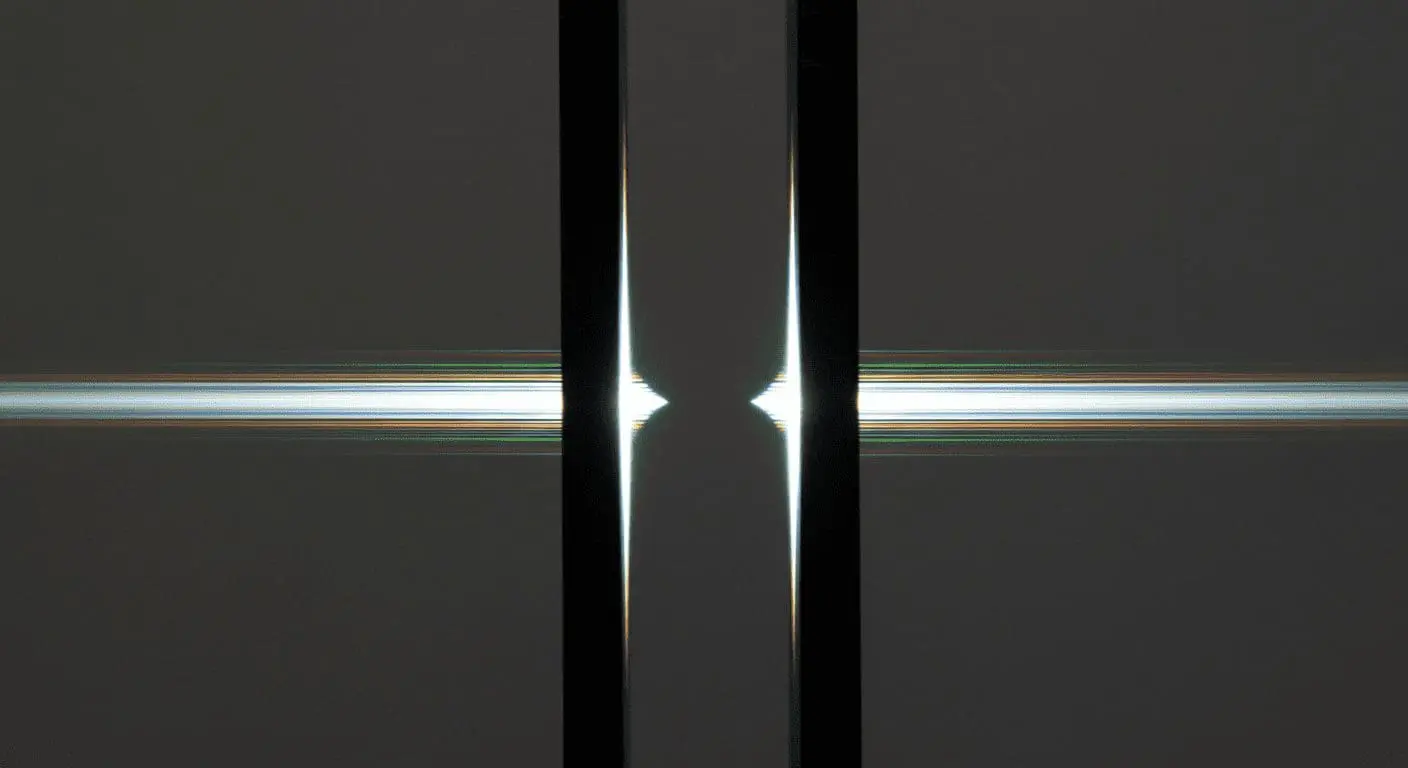
The genuine surprise of the experiment is that the interference pattern persists when the light intensity is turned down so low that only one photon at a time is in the apparatus. Each photon arrives at the detection screen as a single localised spot (the particle behaviour), but the accumulated pattern of many single-photon hits builds up the wave interference pattern (the wave behaviour). The only explanation consistent with the data is that each individual photon is in superposition of the two paths through the two slits, and the interference between those paths is what produces the striped pattern. The experiment has been repeated with electrons (Davisson and Germer, 1927), neutrons (Helmut Rauch, 1974), atoms (Olivier Carnal and Jurgen Mlynek, 1991), and large molecules including buckyballs (Anton Zeilinger‘s group, 1999) and protein-sized macromolecules (Markus Arndt’s group, 2019 onwards). Each repetition produces the same interference pattern, confirming that superposition is a universal feature of quantum mechanics rather than a peculiarity of photons.Schrodinger’s cat and the measurement problem
Quantum interference
Quantum interference is what makes superposition empirically observable and useful, the architectural primitive that turns the abstract Hilbert-space mathematics into a measurable physical effect. When a quantum state evolves under unitary dynamics, the probability amplitudes for different paths through the evolution add up as complex numbers, and the resulting amplitudes can be larger than the sum of the individual amplitudes (constructive interference) or smaller (destructive interference, including complete cancellation).The Mach-Zehnder interferometer
The textbook example is the Mach-Zehnder interferometer. A single photon enters at one input port, hits a 50/50 beam splitter that puts the photon in an equal superposition of the upper path and the lower path, travels along both paths, is recombined by a second 50/50 beam splitter, and exits through one of two output detectors. If the two paths have exactly the same length, the recombination interference is perfect and the photon always exits through one specific output port. Adjusting the path-length difference shifts the relative phase between the two amplitudes and continuously varies the output probabilities from 100% at one port to 100% at the other. Every quantum algorithm exploits the same interference principle. Shor’s factoring algorithm builds a superposition over all possible factors of a large integer, then arranges quantum interference so that the amplitudes corresponding to the correct factors add constructively and the incorrect amplitudes cancel destructively. Grover’s search algorithm uses an “amplitude amplification” subroutine that gradually concentrates probability amplitude onto the search target through repeated interference steps. The architectural primitive in every case is taking advantage of the fact that amplitudes can cancel, something classical probabilities cannot do.Decoherence and the end of superposition
The honest answer to how long superposition lasts in a real system is decoherence: the process by which a quantum system in superposition loses its quantum-coherent character through interaction with its environment, transitioning from a clean superposition to an effectively classical mixture. The mechanism is entanglement: a system that interacts with its surroundings becomes entangled with them, and tracing out the inaccessible environment leaves the system in a classical mixture of the original basis states.T1 and T2 timescales
The most-quoted experimental measure of how long superposition survives in a real system is the T2 dephasing time, the timescale over which the relative phase between the α and β amplitudes of a qubit superposition randomises through environmental coupling. Reported T2 times in 2026 quantum hardware span six orders of magnitude across modalities: superconducting transmons typically run at 100 microseconds to 1 millisecond, neutral-atom qubits at tens of seconds, trapped-ion qubits at minutes, and silicon-spin qubits at milliseconds. T1, the energy-relaxation time, is the related timescale over which a qubit excited to |1⟩ decays back to |0⟩. The relationship 1/T2 = 1/(2T1) + 1/Tφ (where Tφ is the pure dephasing time) ties the two together as the basic decoherence model used across every hardware modality. The canonical primary source for modern decoherence theory is the Schlosshauer survey on decoherence and the transition to classicality, freely available on arXiv. Decoherence is also why macroscopic objects (Schrodinger’s cat, a coffee cup, a baseball) never appear to be in superposition. The environmental coupling is so strong and the timescale so short that no human-scale measurement could ever catch the object mid-superposition. Quantum-error-correction codes (surface code, qLDPC code, bosonic codes) are the architectural response: they encode a logical qubit into many physical qubits in a way that lets the system detect and correct decoherence errors faster than they accumulate, preserving the logical superposition indefinitely if the physical-qubit error rate stays below a threshold.Superposition in quantum computing
Frequently asked questions
What is superposition in simple terms?
Superposition is the principle that a quantum system can exist in multiple states at the same time, with a single mathematical state that describes the combination. The simplest mental picture is a coin balanced exactly on its edge, spinning so fast that neither face is fully visible; the coin is not heads, the coin is not tails, the coin is genuinely in a layered state where both possibilities are part of the description. When the coin is measured (something forces it to land) it collapses to one face, and the probability of each face is set by exactly how the coin was spinning before measurement.Is superposition the same as quantum entanglement?
Superposition and entanglement are related but distinct concepts. Superposition is a property that any quantum system can have on its own; a single qubit can be in superposition of |0⟩ and |1⟩ without anything else in the universe being involved. Entanglement is a property of two or more quantum systems together: when two qubits are entangled their joint state cannot be written as a product of independent single-qubit states, and a measurement on one qubit instantaneously determines the result of a measurement on the other. Every entangled state is a superposition of the joint Hilbert space, but a single qubit cannot be entangled (you need at least two), and not every multi-qubit superposition is entangled. See our what is entanglement guide for the deeper picture.How does measurement collapse a superposition?
Measurement of a quantum system in superposition produces a single classical outcome chosen at random according to the Born rule, and after the measurement the system is in the basis state corresponding to that outcome. For a qubit in state α|0⟩ + β|1⟩, measuring in the {|0⟩, |1⟩} basis yields 0 with probability |α|² and 1 with probability |β|², and the system is left in |0⟩ or |1⟩ respectively. The pre-measurement amplitudes are lost; any information they carried (the relative phase, the interference structure) is unrecoverable. The measurement problem (the philosophical question of why measurement seems to violate unitarity and what counts as a measurement) is still debated among interpretations of quantum mechanics, but the empirical Born rule is one of the most-tested predictions in all of physics.What is the double-slit experiment, and why does it matter for superposition?
The double-slit experiment passes light (or electrons, atoms, or molecules) through two narrow parallel slits and records where it lands on a detection screen behind. The pattern that builds up is a striped interference pattern, the classic signature of wave behaviour, but the experiment works equally well when the source is turned down to emit one photon at a time. Each single photon arrives at the screen as a localised spot, but the accumulated pattern still shows the interference stripes, the proof that each individual photon was in superposition of the two paths through the two slits. The double-slit experiment is the cleanest experimental demonstration that superposition is a real physical phenomenon and not just a mathematical convenience.What is Schrodinger’s cat?
Schrodinger’s cat is a 1935 thought experiment by Erwin Schrodinger that scales quantum superposition to a macroscopic system. A cat is sealed in a box with a small amount of radioactive material, a Geiger counter, a hammer, and a sealed flask of poison; if a radioactive atom decays the Geiger counter triggers the hammer, the hammer breaks the flask, and the cat dies. The radioactive atom is a quantum system that can be in superposition of (decayed) and (not decayed), and if the rest of the apparatus is treated as a single coupled quantum system, the cat ends up in an entangled superposition of (alive) and (dead) until someone opens the box. Schrodinger meant the thought experiment as a rhetorical attack on the Copenhagen interpretation, but it became the most famous illustration of how strange superposition can be when scaled up. The modern resolution is decoherence: a cat interacts with its environment so strongly that the superposition collapses essentially instantaneously.What is quantum interference, and how is it related to superposition?
Quantum interference is the phenomenon that probability amplitudes for different paths through a quantum evolution add up as complex numbers, and can either reinforce each other (constructive interference) or cancel each other (destructive interference, including complete cancellation). Superposition is the necessary precondition: a system has to be in multiple states simultaneously for interference between those states to be possible. The architectural difference between classical probability and quantum superposition is precisely that quantum amplitudes can cancel; if you simply add classical probabilities you only ever get larger numbers, never zero. Every observable consequence of superposition (the double-slit fringes, the Mach-Zehnder interferometer output, the speedup of Shor’s algorithm) traces back to quantum interference.Can large objects be in superposition?
In principle quantum mechanics applies to objects of any size, and the wave-function evolution equation does not have a cutoff scale. In practice large objects interact strongly with their environments (air molecules, thermal radiation, vibrations), and these interactions cause decoherence essentially instantaneously, collapsing the superposition to a classical mixture before any human-scale measurement could detect it. Experiments by Markus Arndt’s group and others have demonstrated superposition for molecules of up to 25,000 atomic mass units (large biological molecules, including proteins) as of 2019, and the boundary continues to be pushed. The Schrodinger’s cat scenario remains experimentally unreachable for any object larger than a small protein because of decoherence, but theoretically there is no known size limit on quantum superposition.What is the difference between superposition and probability?
Classical probability and quantum superposition look superficially similar but are fundamentally different objects. A classical probability distribution is a list of non-negative real numbers that sum to one, describing the relative frequencies of different mutually exclusive outcomes. A quantum superposition is a unit-length complex vector in a Hilbert space, with amplitudes that are complex numbers whose squared magnitudes sum to one. The fundamental difference is that quantum amplitudes can interfere: if you have two paths from initial state to final state, the amplitudes for the two paths add as complex numbers and can cancel, which classical probabilities never can. The experimental signature of superposition (as opposed to classical uncertainty) is interference, which is why interferometers and double-slit experiments are the canonical tests for quantum behaviour.How does superposition power quantum computing?
Quantum computers run on registers of qubits in superposition, and the exponential parallelism is what makes them potentially powerful. A register of n qubits in superposition encodes 2-to-the-n complex amplitudes simultaneously, which is exponentially more than a classical register of n bits could hold. A quantum algorithm is a sequence of unitary gates that arrange constructive and destructive interference between these amplitudes so that the post-measurement sample concentrates onto useful outcomes. Shor’s factoring, Grover’s search, quantum approximate optimisation, variational quantum eigensolvers, and every other quantum algorithm rely on this superposition-plus-interference architecture, and each modality of qubit hardware (superconducting, trapped ion, neutral atom, photonic, silicon spin) implements superposition in slightly different physical hardware but with the same underlying mathematical structure.What is decoherence and why does it matter for superposition?
Decoherence is the process by which a quantum system in superposition becomes effectively classical through interaction with its environment. The mechanism is entanglement: the system’s superposition gets entangled with environmental degrees of freedom (air molecules, thermal radiation, magnetic-field fluctuations), and tracing those out leaves the system in a classical statistical mixture rather than a clean superposition. The T2 dephasing time is the most-quoted measure of how long a qubit’s superposition survives in a real system; superconducting transmons typically run at 100 microseconds to 1 millisecond T2, neutral atoms at tens of seconds, trapped ions at minutes, and silicon spins at milliseconds. Quantum error correction codes are the architectural response, encoding a logical qubit into many physical qubits in a way that lets the system detect and correct decoherence errors faster than they accumulate.Who discovered superposition?
Superposition arrived in physics through three parallel developments in the 1920s. Werner Heisenberg, Max Born, and Pascual Jordan introduced matrix mechanics in 1925, Erwin Schrodinger published the wave-mechanics formulation in 1926, and Paul Dirac unified the two in his 1930 textbook Principles of Quantum Mechanics, which formalised the superposition principle in modern bra-ket notation. The empirical scaffolding goes back further, including Thomas Young’s 1801 double-slit demonstration of light interference, the 1927 Davisson-Germer experiment showing electron diffraction, and Compton’s 1923 photon-scattering measurements. The conceptual leap from classical superposition of waves to the quantum superposition of matter particles is the defining content of quantum mechanics.What is the Born rule?
The Born rule, proposed by Max Born in 1926, says that when a quantum system in state |ψ⟩ is measured in some basis, the probability of obtaining a particular basis state |a⟩ is the squared magnitude of the inner product, P(a) = |⟨a|ψ⟩|². For a qubit in state α|0⟩ + β|1⟩ measured in the {|0⟩, |1⟩} basis, the Born rule gives P(0) = |α|² and P(1) = |β|². The rule converts the complex-amplitude wave function into observable real-valued probabilities, and it is one of the most-tested predictions in all of physics. Why exactly the Born rule holds (and whether it could be derived from more fundamental principles) is one of the open foundational questions in quantum mechanics.


See today’s quantum computing news on Quantum Zeitgeist for the latest breakthroughs in qubits, hardware, algorithms, and industry deals.