The first clean proof that a quantum computer can beat a classical one. A useless problem that became one of the founding moments of quantum computing.
By the early 1990s quantum computing had a theory but no trophy. Physicists could define a quantum computer and argue that it ought to be powerful, yet nobody had shown a clear case where it provably beat an ordinary machine. The Deutsch-Jozsa breakthrough was the moment that changed, the first clean demonstration that quantum can do something classical computing simply cannot match.
The problem it solved was deliberately artificial, a puzzle with no practical use, and that is exactly why it was so convincing. By stripping away every distraction, the Deutsch-Jozsa breakthrough isolated the pure advantage of quantum computation and proved it beyond argument. It is the quiet milestone that gave the field its confidence.
Before the breakthrough, a field without proof
In the years after David Deutsch defined the universal quantum computer in 1985, the idea sat in an awkward place. It was mathematically respectable and intuitively promising, but sceptics could fairly ask for evidence that a quantum machine offered any real speed advantage at all. Without a concrete example, the whole enterprise risked looking like elegant speculation.
What the field needed was not a useful application but a clean proof of principle, a problem where the quantum advantage was unarguable even if the problem itself was trivial. Deutsch had already found a tiny version of such a problem in 1985, and the task that remained was to sharpen it into something undeniable. That sharpening is what made the difference.
What the Deutsch-Jozsa problem asks
The puzzle is easy to state. You are given a function, a kind of black box that takes a string of bits and returns either zero or one, and you are promised it is one of two types, either constant, giving the same answer for every input, or balanced, giving zero for exactly half the inputs and one for the other half. Your only job is to decide which type it is.
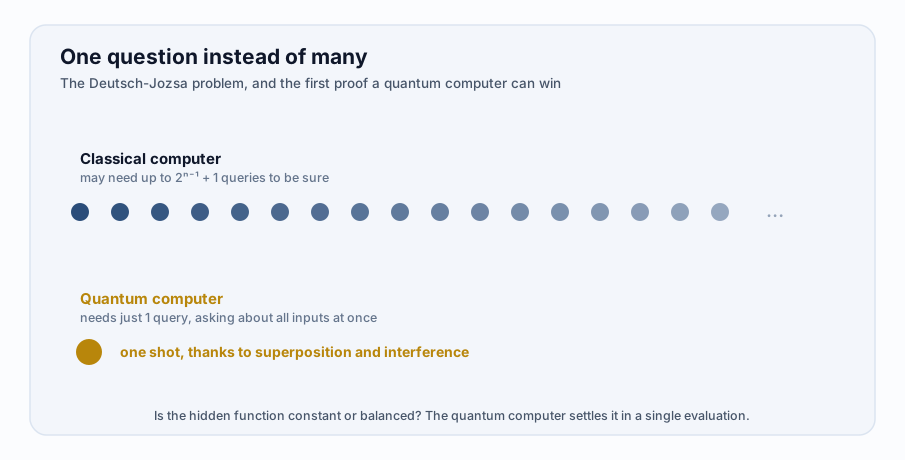
The diagram below shows why this is hard for an ordinary computer and easy for a quantum one. A classical machine, in the worst case, must test just over half of all the possible inputs before it can be certain, a number that grows exponentially with the size of the input. A quantum computer can answer with a single query, no matter how large the problem.
One query instead of many
The quantum trick is to feed the black box not one input at a time but a superposition of all inputs at once, then use interference to make the unwanted possibilities cancel out. After a single evaluation, a final operation leaves the answer sitting plainly in the measurement, distinguishing constant from balanced in one step. Where the classical method grinds through case after case, the quantum method asks one cleverly shaped question.
This is the heart of the result and the reason it landed so hard. The gap between one query and exponentially many is not a modest improvement but a difference in kind, the sort of separation that cannot be explained away as a better classical trick waiting to be found. For the precise mechanics of how the circuit achieves this, our explainer on the Deutsch-Jozsa algorithm walks through it step by step.
Why the Deutsch-Jozsa breakthrough mattered
It is tempting to dismiss the whole thing as a parlour trick, since no one actually needs to know whether a contrived function is constant or balanced. That misses the point entirely. The Deutsch-Jozsa breakthrough was never about the problem, it was about the proof, and it established for the first time that the quantum advantage was real rather than hoped for.
That proof gave researchers the confidence to look for advantages on problems people did care about. Within two years Peter Shor had found his factoring algorithm and Lov Grover his search algorithm, both descendants of the same idea that a quantum computer can interrogate many possibilities at once. The Deutsch-Jozsa breakthrough was the door through which those discoveries walked.
From Deutsch to Deutsch-Jozsa
The result carries two names for good reason. David Deutsch devised the original single-bit version in 1985, showing that one quantum query could sometimes do the work of two classical ones, a small but genuine separation. It was the first hint that the universal quantum computer he had defined was more than a curiosity.
In 1992 Deutsch joined with Richard Jozsa to generalise the idea to inputs of any size, turning a modest edge into the dramatic exponential gap that made the point unmistakable. The collaboration is why the field speaks of the Deutsch-Jozsa breakthrough rather than Deutsch alone, and it sits naturally in the larger story of who founded quantum computing.
The legacy of the first quantum advantage
As a piece of technology the Deutsch-Jozsa algorithm has had no direct use, and it never will, which is a strange fate for so celebrated a result. Its value was always conceptual, a clean landmark that every student of the field still learns as the first proof that quantum computation is genuinely more powerful than classical computation in some setting.
Seen that way, the Deutsch-Jozsa breakthrough belongs with the founding documents of the discipline, less an invention than a demonstration that the dream was real. Everything that followed, from Shor’s threat to encryption to today’s race for quantum advantage on useful tasks, rests on the confidence it provided. Sometimes a useless problem is the most useful thing of all.
Frequently asked questions
What was the Deutsch-Jozsa breakthrough?
What is the Deutsch-Jozsa problem?
Why does the Deutsch-Jozsa breakthrough matter if the problem is useless?
Who created the Deutsch-Jozsa algorithm?
Is the Deutsch-Jozsa algorithm used in practice?




See today’s quantum computing news on Quantum Zeitgeist for the latest breakthroughs in qubits, hardware, algorithms, and industry deals.