

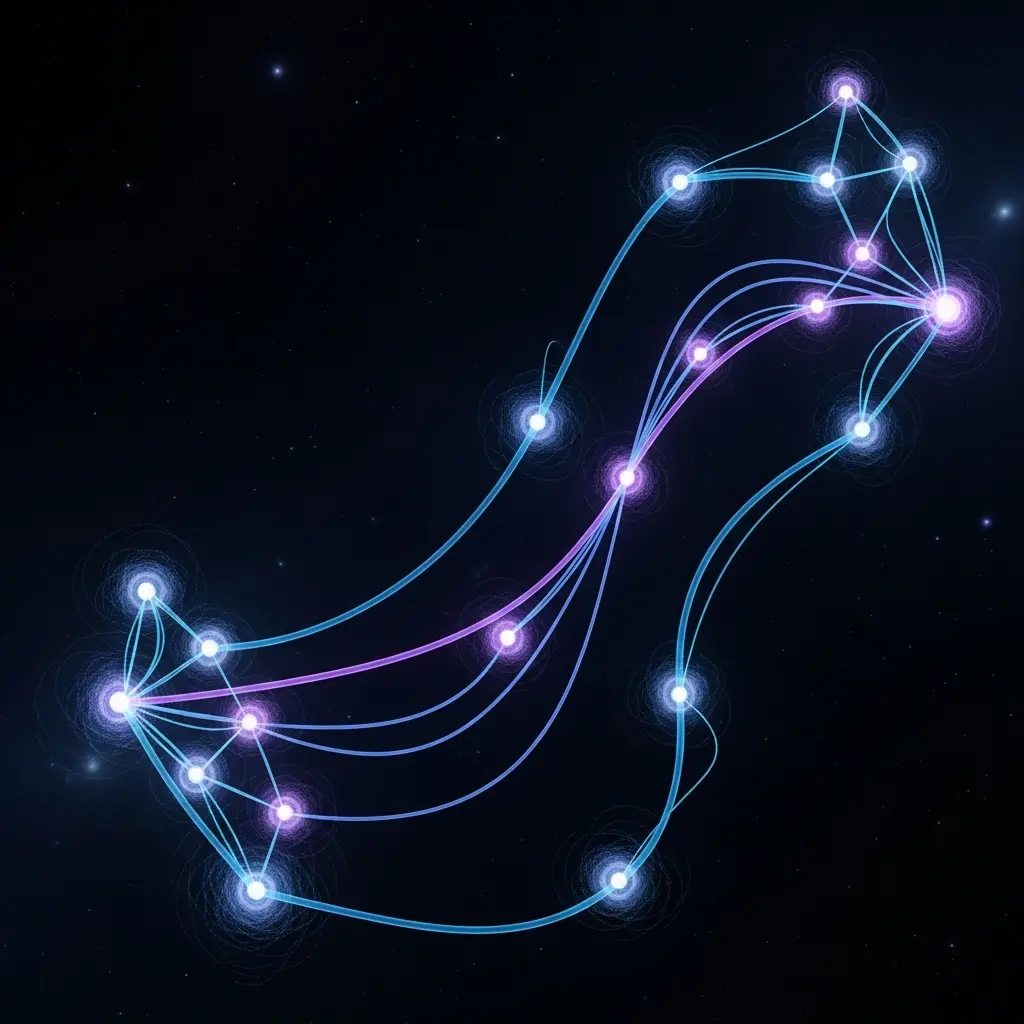
The architecture of growing networks, from the internet to social connections, remains a fundamental question in understanding complex systems, and researchers are now exploring how flexible connections shape these structures. Tingyu Zhao, Balázs Maga, and Pierfrancesco Dionigi, alongside Gergely Ódor, Kyle Soni, and Anastasiya Salova, investigate a new model of network growth where new nodes do not necessarily connect directly to their intended target, but instead link to nodes within the target’s vicinity. This approach, termed quantum preferential attachment, reveals that even limited flexibility in connection-building dramatically alters network behaviour, producing small-world networks that differ fundamentally from traditional scale-free models. The team’s findings, supported by detailed analytical work, establish a comprehensive framework for understanding network formation and suggest broader implications for any system where connections can be established indirectly, offering new insights into how complex networks evolve.
Local Flexibility Drives Small-World Networks
The study investigates network formation, introducing a preferential attachment model with local flexibility in connection establishment. Instead of direct connections to intended targets, nodes randomly connect to others within the target’s proximity, including the target itself. This approach generates small-world architectures that differ from traditional, scale-free network models, offering a nuanced understanding of network behavior. Researchers used computational simulations and analytical results to create a unified phase diagram encompassing both the new model and classical preferential attachment variants.
Experiments systematically varied connection preference and random connection probability to map resulting network topologies, meticulously tracking degree distributions and average path lengths. The work demonstrates that the model converges to the Barabási, Albert model when connection preference is set to 1, and that the highest-degree node stabilizes with a linear growth rate when connection preference approaches infinity and random connection probability is less than 1. Analysis of network diameter proved it remains finite under specific conditions, indicating a tightly connected structure, and the proportion of degree-k nodes reveals a predictable distribution, providing a comprehensive understanding of the model’s behavior.
Flexible Connections Yield Novel Network Structures
This research offers a new perspective on network development, moving beyond traditional growth models. Scientists demonstrate that flexible connections, where new nodes connect to nodes near their intended target, fundamentally alters network structure. The team’s model reveals two distinct classes of network architectures exhibiting small-world properties, but without the scale-free patterns common in many networks, establishing a framework that unifies existing preferential attachment models within a broader phase diagram. When new nodes disproportionately target high-degree nodes, a hierarchical structure emerges, potentially forming a “rich club” of highly connected hubs. Conversely, bias towards lower-degree nodes breaks scale-freeness, resulting in a universal large-degree tail in the network’s degree distribution. While the model simplifies real-world networks by assuming uniform connection choices, the principles of flexible connection establishment are expected to be relevant to future large-scale architectures, and the team has made their simulation code publicly available for further investigation.
👉 More information
🗞 Quantum preferential attachment
🧠 ArXiv: https://arxiv.org/abs/2512.22542




See today’s quantum computing news on Quantum Zeitgeist for the latest breakthroughs in qubits, hardware, algorithms, and industry deals.



