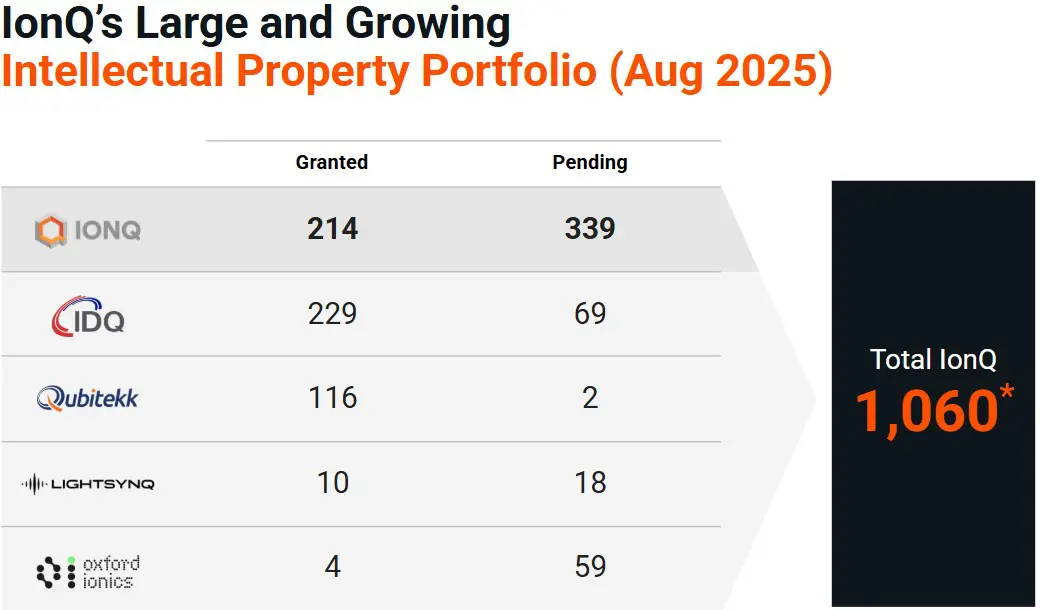
IonQ has expanded its intellectual property portfolio to over 1,000 patents and applications, aiming to accelerate the development of commercial quantum computing. Recent US patents issued in March and April 2025 detail advancements in trapped-ion quantum computing and networking, including a quantum repeater for secure long-distance communication utilising portable quantum memory packages and a self-aligning fabrication process for 3D photonic structures within quantum memory devices. These patents, alongside those from Lightsynq Technologies, IDQ, and a pending acquisition of Oxford Ionics, underpin IonQ’s current generation systems, IonQ Forte and IonQ Forte Enterprise, which have demonstrated 20x performance gains for partners such as Amazon Web Services and AstraZeneca, and contribute to the company’s stated goal of a 2 million qubit computer by 2030.
Expanding Intellectual Property Portfolio
IonQ’s intellectual property portfolio currently comprises over 1,000 licensed, owned, or controlled patents and patent applications, a figure representing a deliberate, long-term strategy focused on developing and owning quantum technologies across multiple industries and applications. The company anticipates this expanded portfolio will accelerate the timeline towards achieving commercial quantum advantage, enabling the development of scalable, high-performance, and cost-effective systems. This strategy is evidenced by recent patent grants building upon existing technical achievements, including improvements to quantum circuit optimization, gate operations, noise reduction, error mitigation techniques, and multi-beam technology.
Recent patents specifically underscore IonQ’s commitment to advancing the fundamental building blocks of quantum systems, encompassing both precision control and scalable architectures. One patent, US Patent 12,260,113, issued on March 25, 2025, details a quantum repeater designed for secure long-distance quantum networking, utilizing quantum memories configured to receive and store photons for use in large-scale optical fiber networks. Another patent, US Patent 12,265,254, issued on April 1, 2025, introduces a self-aligning fabrication process intended to improve the transport of light and coupling of photonic layers within quantum memory devices.
The company’s intellectual property extends beyond internally developed patents to include those from Lightsynq Technologies, IDQ – in which IonQ holds a majority stake – and Oxford Ionics, an acquisition currently pending. These patents contribute to IonQ’s progress in producing scalable, high-performance, enterprise-grade systems, and are expected to support advancements in areas such as trapped-ion quantum computing and the development of a quantum internet. Dean Kassmann, SVP of Engineering & Technology at IonQ, asserts these achievements demonstrate a strategic path towards commercial quantum advantage.
Advancements in Quantum Technologies
IonQ’s expanding patent portfolio now totals over 1,000 licensed, owned, or controlled patents and patent applications, a growth intended to accelerate the timeline towards achieving commercial quantum advantage. According to the company, this robust portfolio is a direct result of a long-term strategy focused on developing and owning quantum technologies across multiple industries and applications. These patents are expected to enable the development of scalable, high-performance, and cost-effective systems.
The company’s intellectual property now includes patents from Lightsynq Technologies, IDQ – in which IonQ owns a majority stake – and Oxford Ionics, an acquisition currently pending. These assets contribute to IonQ’s progress in producing scalable, high-performance, enterprise-grade systems, signalling strong technical innovation and a strategic path towards commercial quantum advantage, and support advancements in areas such as trapped-ion quantum computing and the development of a quantum internet.
IonQ intends to deliver a quantum computer with 2 million qubits by 2030, accelerating innovation in areas including drug discovery, materials science, financial modelling, logistics, cybersecurity, and defence. Advancements in quantum networking also position IonQ as a leader in building the quantum internet, further supported by its growing patent portfolio.
Future Outlook and Commercialisation
Recent patent grants build upon existing technical achievements, including quantum circuit optimisation, improved gate operations, reduced noise, error mitigation techniques, and multi-beam improvements. These advancements are expected to contribute to the development of scalable, high-performance, and cost-effective systems.
Two exemplary patents highlight innovation in trapped-ion quantum computing and quantum networking, demonstrating IonQ’s commitment to advancing the fundamental building blocks of quantum systems. US Patent 12,260,113, issued March 25, 2025, details a quantum repeater comprising quantum memories configured to receive and store photons, facilitating secure, long-distance communications via large-scale optical fibre networks.
Another patent, US Patent 12,265,254, issued April 1, 2025, introduces a self-aligning fabrication process to transport light and couple photonic layers inside quantum memory devices. This patent relates to a quantum memory device with a 3D photonic structure that enables accurate alignment of photonic materials without finely tuned alignment procedures.
IonQ’s current generation quantum computers, IonQ Forte and IonQ Forte Enterprise, have demonstrated 20x performance results for customers and partners such as Amazon Web Services, AstraZeneca, and NVIDIA. The company’s offerings are available through all major cloud providers, facilitating access to its quantum computing capabilities.
More information
External Link: Click Here For More
Disclaimer. This article is for informational purposes only and does not constitute investment, financial or professional advice. The quantum technology industry evolves rapidly and information may become outdated. Always conduct your own research and consult qualified advisers before making investment decisions. Investing in quantum computing companies involves significant risk, including the potential loss of your entire investment, and past performance is not indicative of future results.




See today’s quantum computing news on Quantum Zeitgeist for the latest breakthroughs in qubits, hardware, algorithms, and industry deals.