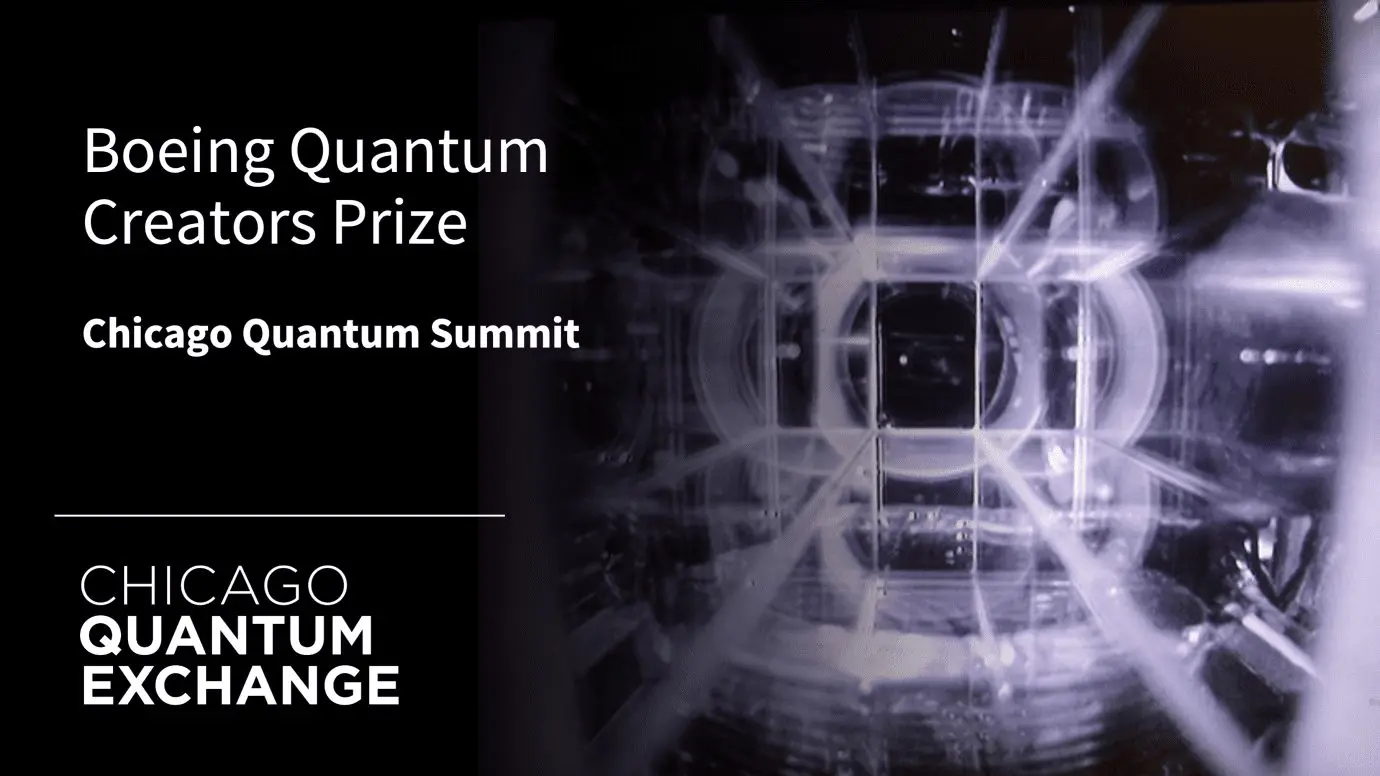
The 2025 Boeing Quantum Creators Prize recognizes twelve early-career researchers contributing to advancements in quantum information science and engineering, a field poised to revolutionize technology and society. Initiated in 2021 and expanded in 2023 with Boeing’s commitment, the program aims to identify promising talent and foster innovation within the rapidly evolving quantum landscape. This year’s recipients, announced in November 2025, will receive a monetary prize of $3,500 (where legally permissible) and the opportunity to present their work at the Chicago Quantum Summit on November 3 and 4.
Several awardees are directly addressing the critical challenge of quantum error correction and fault tolerance. Margarita Davydova, a Burke postdoctoral fellow at the California Institute of Technology (Caltech), focuses on physics-inspired approaches to these areas, alongside research into robust dynamical phases of matter. Her doctoral work was completed at the Massachusetts Institute of Technology (MIT). Similarly, Rhine Samajdar, a postdoctoral fellow at Princeton University, investigates the intersection of quantum information science and condensed matter physics, building upon his doctoral research at Harvard University concerning quantum simulation with neutral atom arrays. These efforts are crucial, as maintaining the delicate quantum states necessary for computation requires mitigating the effects of environmental noise and imperfections.
Further contributing to the development of robust quantum systems is Joseph Meyer, who recently earned a PhD in Physics Education Research from the University of Colorado Boulder. Meyer’s work specializes in the teaching and learning of quantum computing and quantum information science, advocating for responsible development and research-based pedagogies. This focus on education is vital for building a skilled workforce capable of advancing the field. Additionally, Mehmet Tuna Uysal, a postdoctoral researcher at MIT working with Professor Vladan Vuletic, explores photonic interfaces for atomic systems and entanglement generation with solid-state qubits, aiming to create the building blocks for future quantum networks. His doctoral work was completed at Princeton University in Professor Jeff Thompson’s group.
Beyond error correction, the prize also acknowledges research into the fundamental hardware required for quantum computation. Seokjin Bae, a postdoctoral researcher at the University of Illinois Urbana-Champaign (UIUC) working with Professor Vidya Madhavan, has developed an ultrafast scanning tunneling microscope to investigate light-matter interactions at the atomic scale in quantum materials. Guanhao Huang, a Swiss National Science Foundation Postdoc Mobility Fellow at Harvard University in Professor Marko Lončar’s group, is developing ultralow-loss diamond nanomechanical platforms for quantum sensing and tabletop tests of gravity, building on his doctoral work at École Polytechnique Fédérale de Lausanne. Chuankun Zhang, now an IQIM postdoc at Caltech with Andrei Faraon, demonstrated quantum-state-resolved thorium-229 nuclear spectroscopy to realize a solid-state optical clock, following his doctoral work at JILA/University of Colorado, Boulder. These advancements in materials science and quantum sensing are essential for building more stable and precise quantum devices.
See today’s quantum computing news on Quantum Zeitgeist for the latest breakthroughs in qubits, hardware, algorithms, and industry deals.