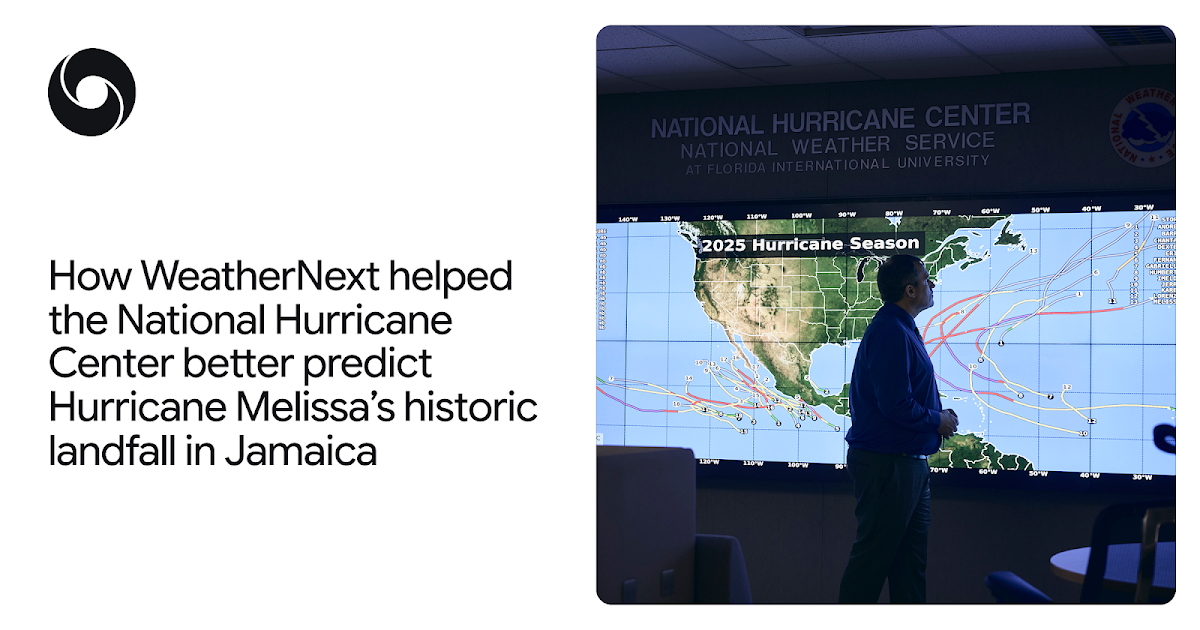
Forecasters achieved a historic milestone in predicting Hurricane Melissa’s landfall in Jamaica, accurately forecasting the storm would reach Category 5 intensity starting from Category 1 wind speed, a first for the National Hurricane Center. This improved prediction was aided by WeatherNext, an AI model developed by Google DeepMind and Google Research, which predicted the storm’s rapid intensification, defined as a wind speed increase of at least 35 mph in 24 hours, five days in advance. This early warning allowed authorities to mobilize resources and coordinate evacuations effectively as Melissa ultimately became the strongest hurricane on record to land in Jamaica. “Predicting dangerous storms earlier and more accurately helps teams on the ground to better mobilize resources and coordinate evacuations effectively,” noted the WeatherNext team, highlighting the model’s ability to excel at predicting both a storm’s track and its intensity, a capability that has historically challenged meteorologists.
WeatherNext Predicts Hurricane Melissa’s Category 5 Landfall in Jamaica
Hurricane Melissa’s intensification to a Category 5 storm was accurately forecast five days in advance by the AI model WeatherNext, a feat previously unattainable for meteorological prediction systems. This prediction proved historic, marking the first time a storm was successfully forecast to reach Category 5 intensity originating from such a low initial wind speed; identifying a top-tier hurricane from modest beginnings represents a turning point in anticipating extreme intensification events. The WeatherNext team explained the challenge overcome. Supported by WeatherNext’s predictions, alongside physics-based models like HAFS and real-time data, the National Hurricane Center (NHC) provided the Meteorological Service Jamaica with unprecedented lead time. The NHC’s annual verification report confirmed WeatherNext as the top-performing individual model for both track and intensity, supporting expert decision-making throughout the hurricane season; the collaboration between Google and the NHC is already expanding to regions including the Philippines, Taiwan, Indonesia, and Vietnam, with the goal of reducing the human and economic toll of natural disasters.
WeatherNext Resolves Track and Intensity Prediction Trade-offs
For decades, hurricane forecasting presented a fundamental challenge: models consistently excelled at predicting a storm’s path or its intensity, but rarely both simultaneously. Larger global models proved adept at tracking, yet lacked the granular detail to assess the small-scale atmospheric processes driving rapid intensification, while high-resolution local models, capable of capturing intensity changes, often struggled with broader contextual accuracy. The AI model bridged this historical gap by demonstrating proficiency in forecasting both track and intensity, achieved by training on decades of global weather patterns alongside specialized datasets of extreme tropical cyclones. Unlike traditional models offering a single prediction, WeatherNext generates ensembles of 50 “what-if” scenarios, providing forecasters with a range of possibilities to inform critical decisions. When Hurricane Melissa initially appeared as a weak tropical depression, WeatherNext confidently predicted a Category 5 landfall in Jamaica five days in advance, with an initial 80% confidence that rose to near 100% three days before impact.
For the first time, they predicted a storm would reach Category 5 intensity starting from Category 1 wind speed.
WeatherNext team
Google’s WeatherNext AI model demonstrated an unprecedented ability to forecast rapid intensification in hurricanes, a capability highlighted during Hurricane Melissa’s historic landfall in Jamaica. This approach proved critical when models initially wavered on whether Melissa would remain a weak system or intensify as it approached Jamaica. Striking late in the Atlantic hurricane season, Melissa arrived after NHC forecasters had already spent months validating and gaining confidence in WeatherNext.
WeatherNext was the top-performing individual model for track and intensity supporting expert decision-making.
NHC’s annual verification report
WeatherNext Collaboration Expands to Global Meteorological Agencies
The success of WeatherNext in forecasting Hurricane Melissa’s intensity is now extending beyond the Atlantic basin, with Google deepening collaborations with meteorological agencies worldwide. Following validation during the hurricane season when Melissa occurred, the National Hurricane Center’s (NHC) positive experience with WeatherNext is informing partnerships with the Philippines’ PAGASA, Taiwan’s CWA, Indonesia’s BMKG, and Vietnam’s VNMHA. This isn’t simply about sharing a tool; it’s about integrating AI-driven insights with local expertise. Google emphasizes that “all official weather alerts and warnings are issued solely by the respective national meteorological authorities,” underscoring the continued primacy of human forecasters. Future collaborations are planned with agencies in Japan, Australia, and India, reflecting a commitment to broadening the reach of this technology. This international expansion is driven by a core mission to improve disaster preparedness and response globally.
This allowed local officials to mobilize resources and coordinate evacuations effectively.




See today’s quantum computing news on Quantum Zeitgeist for the latest breakthroughs in qubits, hardware, algorithms, and industry deals.