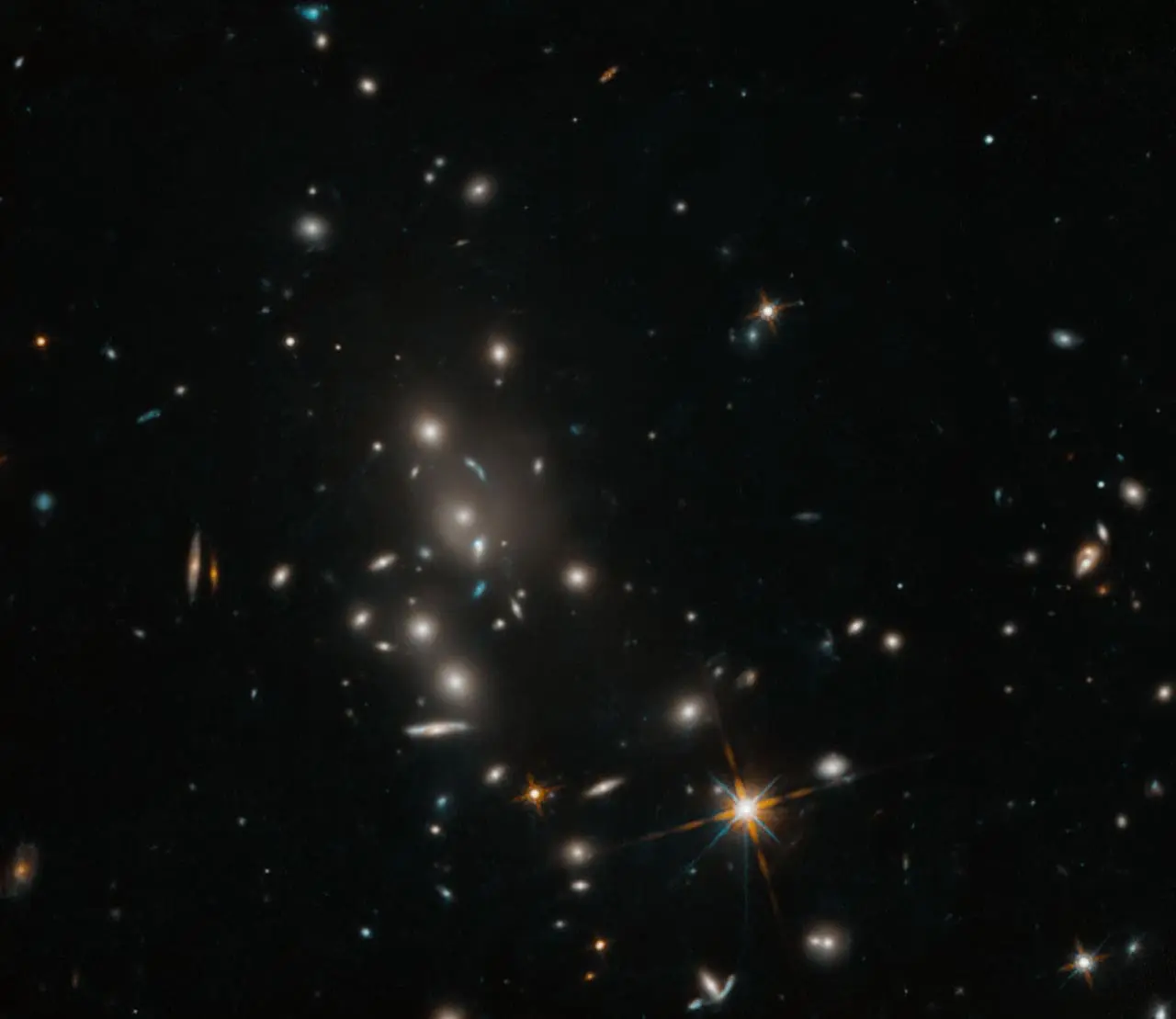
The diffraction spikes extending from bright stars in a new image of galaxy cluster MACS J1141 are not a property of the stars themselves, but a direct result of light bending around the supports holding Hubble’s secondary mirror. Captured in both visible and infrared light, the image reveals galaxies of various shapes and sizes clustered toward the center-left, approximately four billion light-years away in the constellation Crater. This scene is a composite of data from two Hubble observing programs specifically targeting massive galaxy clusters that also shine brightly in X-rays, allowing researchers to study these systems with a multi-wavelength approach. Hubble’s archive of over 1.7 million observations continues to be a valuable resource for astronomers seeking new discoveries.
Hubble Captures Galaxy Cluster MACS J1141
This subtle effect, a consequence of the telescope’s engineering, demonstrates how the tools used to observe the cosmos shape our perception of distant objects and is a consistent feature across Hubble’s extensive image catalog. These programs sought to identify distant galaxies undergoing gravitational lensing, where the cluster’s gravity bends and magnifies light from objects behind it, and to analyze the interactions occurring at the cluster’s core. The NASA Hubble Mission Team explains that both programs were looking for distant galaxies gravitationally lensed by the cluster, highlighting the multi-wavelength approach employed to gain a more complete understanding of these complex cosmic structures. This new data adds to Hubble’s substantial archive of over 1.7 million observations, a resource that continues to empower astronomers to make discoveries by re-examining existing data with advanced analytical tools. The archive’s longevity ensures its value for generations of researchers to come.
Hubble’s 36-Year Archive Enables New Discoveries
The enduring legacy of the Hubble Space Telescope extends far beyond its initial mission parameters; its accumulated data now forms a uniquely rich resource for astrophysical research. With over 1.7 million observations already cataloged and that number constantly increasing, Hubble’s archive is proving invaluable for investigations spanning decades and employing techniques unavailable at the time of the original observations. This wealth of data allows astronomers to revisit past targets with modern analytical tools, uncovering previously hidden details and confirming or refining existing theories. The recent image of galaxy cluster MACS J1141 exemplifies this archival power, created using data from two specific Hubble programs focused on massive galaxy clusters notable for their bright X-ray emissions. Researchers leveraged both visible and infrared light, alongside existing X-ray data, to gain a more comprehensive understanding of these complex structures and search for gravitationally lensed distant galaxies. The ability to mine 36 years of observations with evolving technology ensures that Hubble will continue to yield new insights for generations to come.
Hubble’s archive of 1.7 million observations, and counting, is a valuable tool for current and future astronomers.



See today’s quantum computing news on Quantum Zeitgeist for the latest breakthroughs in qubits, hardware, algorithms, and industry deals.