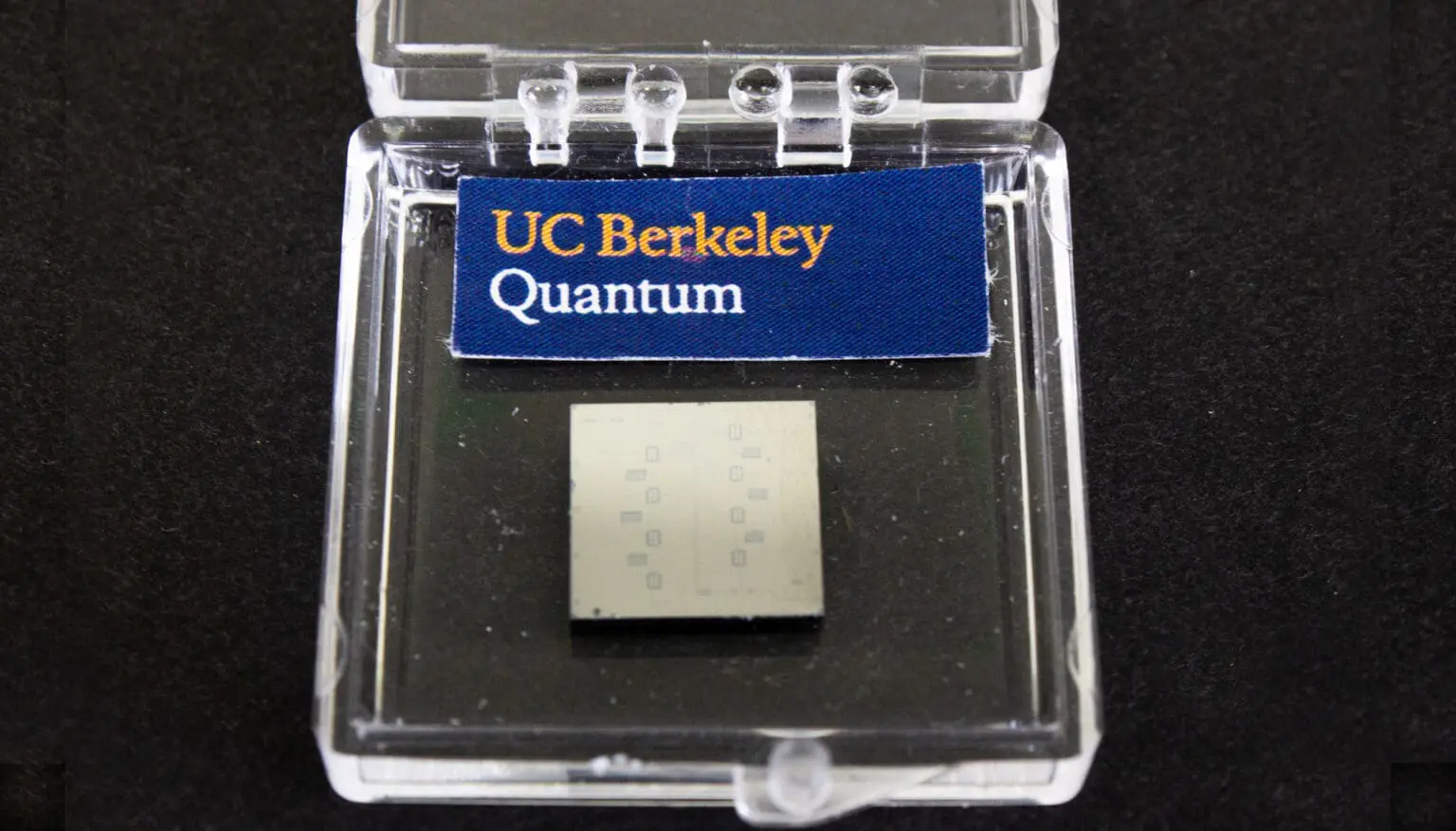
A superconducting quantum processing unit with eight qubits, fabricated at UC Berkeley, will be sealed within a national time capsule this July 4th, destined to remain unopened until America’s 500th birthday in 2276. Selected by California Governor Gavin Newsom as a representation of the state’s innovation, the 10 millimeter-square chip is the first widely distributed QPU of its kind, a key building block for future quantum computers that may solve problems currently impossible for existing machines. “It’s a fitting symbol of the indispensable role public higher education plays in driving American innovation,” said UC Berkeley Chancellor Rich Lyons, “and a reminder that the discoveries happening on our campus today will shape tomorrow.” Alongside the quantum chip and a component from an experimental nuclear fusion reactor, a prediction of California’s future generated by Anthropic’s AI agent, Claude, will also be preserved within the capsule, buried at Independence National Historical Park in Philadelphia.
UC Berkeley’s Eight-Qubit QPU Selected for Time Capsule
This superconducting QPU, comprising eight qubits constructed from niobium and aluminum on silicon, represents a foundational element for future quantum computers and a tangible snapshot of current technological capabilities. The governor’s office stated on June 15th, “These items represent the innovative technology California leads the nation and globe in, capturing the remarkable spirit and communities that make the Golden State one-of-a-kind.” Produced in collaboration with Berkeley Lab and led by Berkeley physics Professor Irfan Siddiqi, the eight-qubit QPU has already facilitated research into simulating neutrino interactions and nuclear structures through the Advanced Quantum Testbed.
UC Berkeley Chancellor Rich Lyons expressed enthusiasm, stating, “We’re thrilled that a qubit chip from UC Berkeley is among California’s distinguished contributions to the America250 time capsule.” Kan-Heng Lee, a research scientist at Berkeley Lab who oversaw production, highlighted the chip’s origins, noting, “It was designed at UC Berkeley, fabricated at UC Berkeley and provided to the scientific community by Berkeley Lab.” Lee envisions the QPU as a symbol of the quantum revolution’s origins, hoping it will remind future generations of the critical role played by Berkeley and California in the field.
It was designed at UC Berkeley, fabricated at UC Berkeley and provided to the scientific community by Berkeley Lab, so it reminds you of the ecosystem we have in California.
Niobium & Aluminum Chip Fabrication and Superconducting Operation
The fabrication of the UC Berkeley quantum processing unit, destined for the America250 time capsule, relies on a precise layering of materials; the eight qubits comprising the chip are constructed from niobium and aluminum deposited on silicon substrates. This specific material combination is not arbitrary; niobium and aluminum exhibit superconductivity at extremely low temperatures, a critical property for minimizing signal loss and maintaining quantum coherence within the qubits. The chip, measuring just 10 millimeters square, underwent a multi-stage fabrication process initially at the Marvel NanoLab in Sutardja Dai Hall, then completed in the Quantum Nanoelectronics Lab in Campbell Hall. At these cryogenic temperatures, electrical resistance vanishes, allowing current to flow without energy dissipation and dramatically reducing thermal noise that could disrupt delicate quantum states. This reliance on extreme cooling underscores a significant engineering challenge in scaling up quantum computing technology.
The resulting superconducting circuits enable the qubits to maintain their quantum properties long enough to perform calculations. The selection of this particular eight-qubit QPU for long-term preservation reflects its status as the first widely distributed quantum processing unit. Researchers have already utilized Berkeley Lab’s Advanced Quantum Testbed, powered by this chip, to explore complex quantum computations, including simulations of neutrino interactions and nuclear structure. Lee expressed optimism about the chip’s legacy, noting that it represents a significant step toward future quantum technologies.
The 10 millimeter-square chip is the first widely distributed quantum processing unit, or QPU.
Source: https://vcresearch.berkeley.edu/news/berkeley-quantum-computing-chip-be-buried-national-time-capsule

See today’s quantum computing news on Quantum Zeitgeist for the latest breakthroughs in qubits, hardware, algorithms, and industry deals.