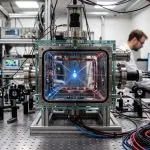
Researchers at the Karlsruhe Institute of Technology (KIT) have demonstrated a new method for controlling the spin of single magnetic molecules using electric voltage, a potentially significant shift from relying on magnetic fields for manipulating qubits. These single magnetic molecules are being investigated as building blocks for quantum computers due to their size and adaptability through chemical synthesis. The team, led by Professor Philip Willke of KIT’s Physikalisches Institut (PHI), combined electron spin resonance with scanning tunneling microscopy to achieve this targeted spin-electric control of iron phthalocyanine molecules on a surface. “For the future use of magnetic molecules, we must be able to control their quantum-mechanical state, i.e. their spin, precisely and locally,” Willke said; the findings, published in Nature Physics, open new avenues for faster, more compact quantum components and electrically controlled quantum operations.
Electric voltage now offers a pathway to controlling the spin of individual molecules, a development with significant implications for future quantum technologies. Single magnetic molecules are attractive candidates for qubits because of their diminutive size and the potential for tailored design through chemical synthesis, allowing researchers to adapt them for specific applications. This method relies on spin-electric coupling, a phenomenon where electric fields influence the spin state of the molecule. Using electric voltage instead of magnetic fields represents a substantial advancement; electric fields can be spatially defined with greater accuracy and switched at considerably faster rates. Willke explained, “Our findings show that molecular spins can be controlled efficiently and locally using electrical signals,” adding that this opens new prospects for the development of fast and compact quantum components. Researchers from Ewha Womans University in South Korea contributed theoretical principles that explain the observed spin-electric coupling, furthering understanding of the underlying physics. This electrical control method could ultimately offer a viable alternative to complex magnetic techniques, potentially accelerating progress in quantum computing, quantum-sensing technology, and spintronics.
Our findings show that molecular spins can be controlled efficiently and locally using electrical signals. This opens up new prospects for the development of fast and compact quantum components.
Professor Philip Willke, KIT
The pursuit of stable and scalable qubits currently favors superconducting circuits and trapped ions, but molecular quantum systems offer a compelling alternative due to their inherent miniaturization and potential for tailored properties. Researchers are actively investigating single magnetic molecules as building blocks for qubits, leveraging their discrete quantum states and the ability to refine these states through precise chemical synthesis. However, manipulating these molecular qubits has traditionally relied on external magnetic fields, a method hampered by limitations in localization and switching speed. This method ensures the molecules remain firmly anchored, facilitating accurate manipulation. The implications of this work, published in Nature Physics, extend beyond simply demonstrating a new control mechanism; unlike magnetic fields, electric fields offer greater spatial precision and significantly faster switching speeds, potentially overcoming key bottlenecks in quantum circuit design.
For the future use of magnetic molecules, we must be able to control their quantum-mechanical state, i.e. their spin, precisely and locally.
Professor Philip Willke, Physikalisches Institut (PHI) at KIT


See today’s quantum computing news on Quantum Zeitgeist for the latest breakthroughs in qubits, hardware, algorithms, and industry deals.