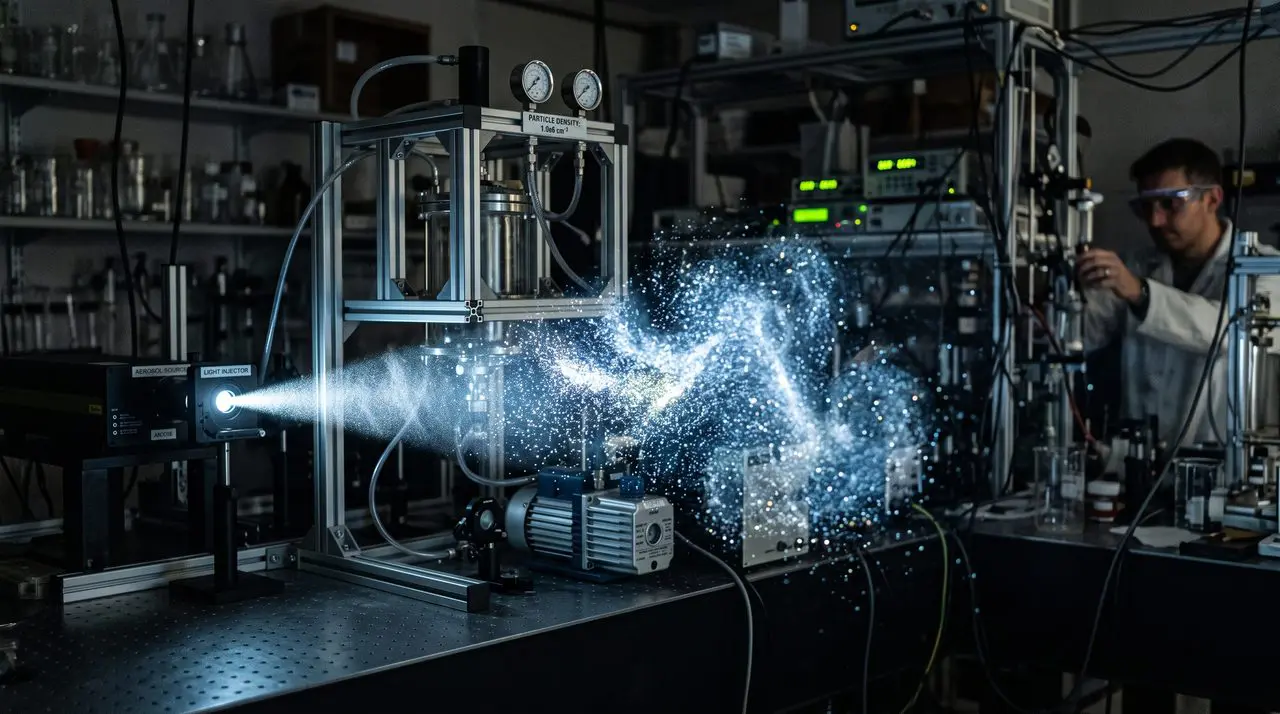
An international research team has demonstrated that artificial intelligence can design new physics experiments, potentially yielding more precise results than those conceived by human researchers. The team published its findings in the journal Nature, detailing how AI systematically explores experimental possibilities using existing laboratory components, lasers, lenses, mirrors, and detectors.
This capability originated from a personal challenge for Professor Mario Krenn, who, as a student in Vienna found his quantum experiment stalled until an algorithm proposed a successful configuration; “Programming it only took a few hours,” Krenn says, “Then I went home and left the computer running.” The approach differs from chatbot AI, focusing instead on optimization within defined physical constraints.
AI Algorithm Solves Quantum Experiment Design Challenges
The University of Tübingen’s machine learning algorithm successfully designed a quantum experiment that eluded a team of physicists, resolving a challenge originating from Professor Mario Krenn’s time as a student in Vienna. Krenn recounted the initial hurdle; his research group struggled to identify an experimental configuration capable of demonstrating specific quantum effects despite possessing a fully equipped laboratory. Rather than continuing manual attempts, Krenn tasked a computer with the problem, describing the available components mathematically and instructing an algorithm to search for viable combinations.
The resulting solution, delivered after an overnight run, proved unexpectedly effective. “When I came into the office the next day, the program had produced a file containing a proposed solution. Of course, that was extremely exciting. I immediately started analysing the proposal, and indeed: unlike all of us, the computer had found an experimental setup that satisfied the necessary criteria,” Krenn stated.
This success isn’t about replacing human ingenuity, but rather augmenting it with computational power capable of exploring a large design space. The system doesn’t propose entirely new physics; it optimizes existing components, lasers, lenses, mirrors, detectors, and electronic components, to achieve desired experimental outcomes. This approach differs significantly from the operation of large language models, which rely on statistical probabilities derived from vast datasets.
“There is an overwhelmingly large space of possible experiments that can be built from the available components. The computer has to search this space systematically in order to find the best possible solution.” The team published their findings in Nature, detailing how the AI systematically explores this complex landscape to identify optimal experimental designs.
Professor Philipp Haslinger, head for Electron Microscopy at TU Wien, noted the potential impact on fields like electron microscopy, where AI can propose designs humans might overlook, potentially yielding significantly improved images or novel measurement capabilities. The algorithm’s utility extends beyond quantum experiments; it has already been applied to improving fusion reactors, developing new particle detectors, and enhancing the sensitivity of gravitational-wave detector systems. However, the AI’s effectiveness hinges on the precision with which researchers define their objectives and constraints.
“That is precisely the challenge: defining as accurately as possible what you actually want, and which constraints have to be satisfied — for example, a maximum cost, or a maximum amount of energy the device can absorb without exploding,” Krenn explained. The system can calculate whether a proposed setup will function, but understanding why it works, and potentially improving upon it, still requires human expertise.
Sometimes, the AI’s proposals reveal unexpected insights. “Sometimes you look at these computer-generated experimental proposals and quickly understand the idea behind them—why the new concept works better than previous approaches,” Krenn said, “But sometimes it is also very difficult to understand. You can calculate that the new experimental setup works better, but you cannot really put into words why.” The underlying principle is the development of a universal physics simulator, using fundamental equations to predict experimental outcomes and optimize configurations.
Krenn envisions a future where computers handle complex calculations, freeing researchers to focus on higher-level scientific inquiry. “Human work is simply shifting to a higher level,” Krenn asserted.
“In the past, calculations had to be done by hand, and nobody wants to go back to that today. Now we have tools that can develop great experimental ideas for us, but using these tools will still require scientific expertise, creativity and a good intuition for physics.” This shift, he argues, isn’t a displacement of human intellect, but a re-allocation of effort towards more conceptual and creative aspects of scientific discovery.
Programming it only took a few hours. Then I went home and left the computer running.
Mario Krenn, Professor of Machine Learning in Science at the University of Tübingen

See today’s quantum computing news on Quantum Zeitgeist for the latest breakthroughs in qubits, hardware, algorithms, and industry deals.