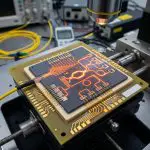
The U. S. Department of Commerce has proposed research and development funding for Quantinuum to address specific hurdles in building large-scale, fault-tolerant trapped-ion quantum computers, a move explicitly linked to bolstering the nation’s semiconductor supply chain. Quantinuum anticipates collaboration with onshore suppliers like GlobalFoundries and Monarch Quantum to optimize engineering pathways for future commercial systems, strengthening U. S. manufacturing capabilities in a critical technology area. “With today’s CHIPS Research and Development investments in quantum computing, the Trump administration is leading the world into a new era of American innovation,” said Secretary of Commerce Howard Lutnick. This initiative aims to advance quantum computing and cultivate a specialized workforce for these technologies.
CHIPS R&D Funding for Fault-Tolerant Trapped-Ion Systems
The U. S. initiative addresses hindering progress in this particular architecture, clarifying where federal resources are being allocated. This isn’t simply about bolstering quantum computing, but also about achieving U. S. technological goals. Dr. Rajeeb Hazra, President and CEO of Quantinuum, emphasized the potential long-term impact of this collaboration, stating that it is “designed to help Quantinuum’s path to large-scale, fault-tolerant trapped-ion systems.” Beyond technological advancements, the initiative is projected to foster a specialized workforce equipped to handle the complexities of quantum technologies, further solidifying the U. S.’s position in this rapidly evolving field.
Quantinuum Partners: GlobalFoundries & Monarch Quantum
Linking advancements in quantum computing with bolstering the United States’ semiconductor infrastructure, as signaled by a letter of intent with the U.S. Department of Commerce’s CHIPS Research and Development Office, is now Quantinuum’s strategic direction. The company intends to receive R&D funding specifically to address bottlenecks hindering the development of fault-tolerant trapped-ion quantum computers, a focused approach within the broader quantum investment landscape. This isn’t simply about building more powerful computers; it’s about securing the supply chain for critical components needed to realize them. GlobalFoundries, specializing in cryo-CMOS and advanced packaging, believes its platforms combined with Quantinuum’s ion-trap expertise will help Quantinuum accelerate their quantum system scale-up roadmap to utility-scale quantum computing, according to CEO Tim Breen.
Monarch Quantum will contribute advanced integrated photonics, aiming to establish a resilient domestic supply chain for the secure and scalable manufacturing of fault-tolerant quantum systems. Dr. Timothy Day, Chairman & CEO, stated that Monarch Quantum is proud to partner with Quantinuum to advance U.S. leadership in computing infrastructure. This initiative also anticipates the development of a specialized workforce to support these technologies.
Monarch Quantum is proud to partner with Quantinuum to advance U.S. leadership in next-generation computing infrastructure.
Dr. Timothy Day, Chairman & CEO of Monarch Quantum
QCCD Architecture & High-Fidelity Two-Qubit Gate Performance
Leveraging its established QCCD architecture, a platform for building trapped-ion quantum computers, Quantinuum is pursuing advancements in fault tolerance, a critical hurdle in realizing practical quantum computation. The company’s approach centers on achieving increasingly high fidelity in two-qubit gate operations, currently demonstrating the industry’s highest accuracy levels based on average two-qubit gate fidelity. This focus on gate fidelity directly addresses a need identified by the U.S. Department of Commerce as deserving of focused research and development funding. The Department of Commerce’s proposed funding, formalized in a letter of intent, intends to bolster Quantinuum’s efforts to scale up its systems. Key to this plan is collaboration with onshore suppliers, including GlobalFoundries for semiconductor components and Monarch Quantum for integrated photonics. This strategic alignment underscores a broader initiative to strengthen U.S. semiconductor supply chain and manufacturing capabilities, linking quantum computing progress to national economic and technological goals. Quantinuum’s workforce, comprised of approximately 700 employees, over 70% of whom hold advanced degrees, is positioned to capitalize on this momentum.
Quantum computing has the potential to unlock new possibilities across science, industry, and national priorities for decades to come.
Dr. Rajeeb Hazra, President and CEO of Quantinuum




See today’s quantum computing news on Quantum Zeitgeist for the latest breakthroughs in qubits, hardware, algorithms, and industry deals.