

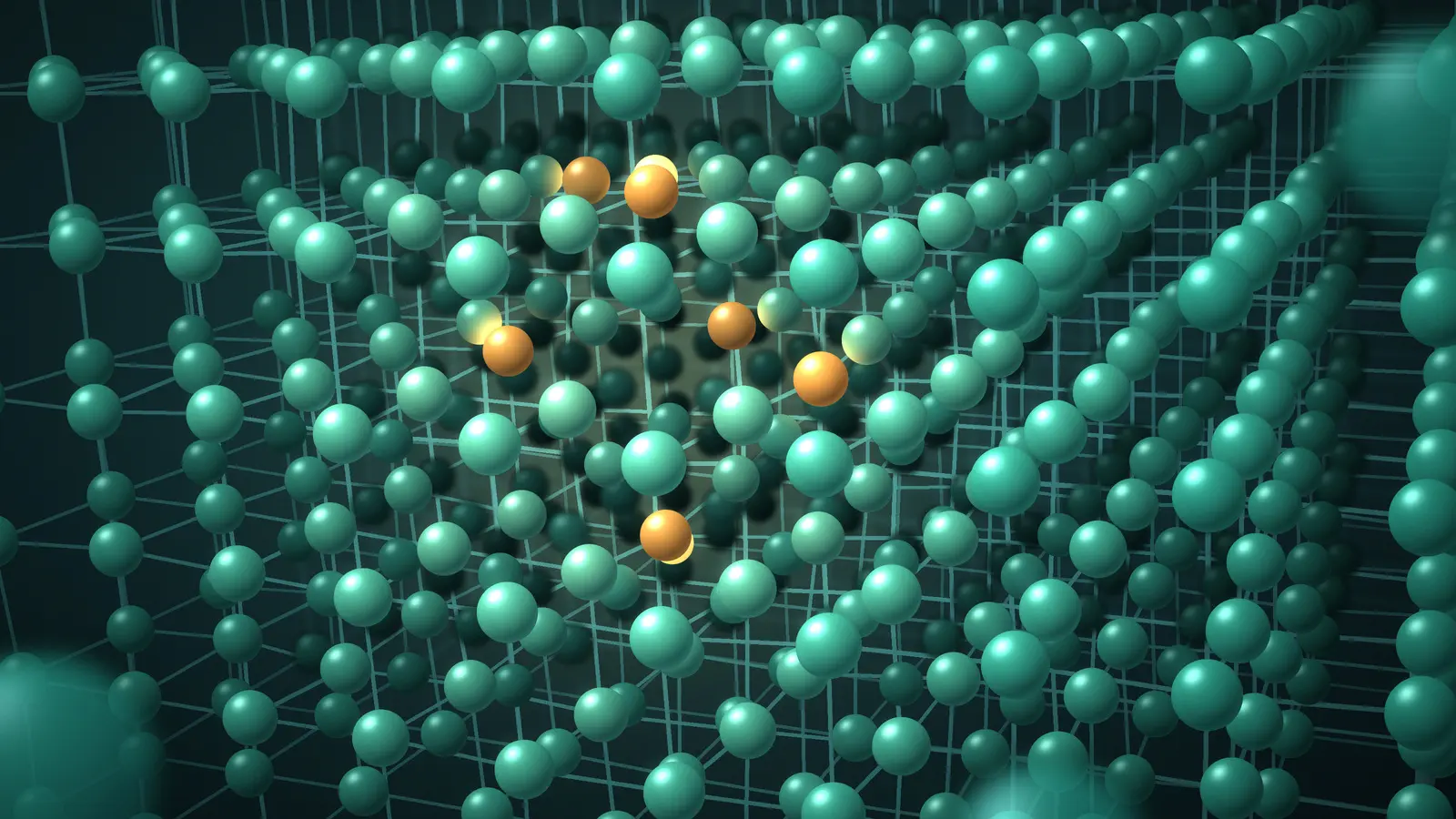
Manipulation of misfit layer compound composition, materials formed by interleaving layers of lanthanum selenide, lead selenide, and niobium diselenide, results in a transition between conventional and topological superconductivity. This doping-controlled phase shift enables observation of evolving superconductivity from one state to another; key orientation-selective in-gap modes are revealed at atomic step edges consistent with crystalline-topological ordering. Identification of a reliable method for transitioning materials between conventional and topological superconductivity represents an advance towards building more stable quantum computers.
Precise control over material properties allows observation of how superconductivity changes states; unique electrical signals appear at atomic edges consistent with crystalline-topological ordering, a specific arrangement within the material’s structure. These findings suggest similar compounds could be engineered for use in future advanced quantum technologies. Manipulation of superconductivity within layered materials is achieved through this level of control, which is vital for developing fault-tolerant quantum computers.
The focus lies on misfit layer compounds, structures built from interleaved layers of lanthanum selenide, lead selenide, and niobium diselenide, using ‘doping’ as a key tool; doping resembles adding impurities like boron or phosphorus to silicon to alter its electrical conductivity. Precise adjustment of these materials’ composition reveals a transition between conventional and topological superconductivity, showing how electron flow changes states. A topological superconductor acts as a special type of wire where electrons move without resistance along the surface, unaffected by imperfections that would normally disrupt current.
Localised electron mapping reveals subtle superconducting behaviour
Scanning tunneling microscopy and spectroscopy, or STM/STS, proved central to unlocking these findings. The technique charts where electrons are likely to be found at an atomic scale by mapping local density of states. This detailed probing was important because it enabled tracking changes in the superconducting gap as material composition altered, revealing shifts invisible to broader measurements such as SQUID magnetometry which measures overall magnetic fields.
Precise doping levels within each sample were verified independently via quasiparticle interference; accurate control over material properties was vital for observing transitions between superconductivity types. Measurements conducted at 350 millikelvins observed subtle shifts in superconducting behaviour not detectable by broader techniques. Quasiparticle interference confirmed the precise doping within each sample, ensuring accurate control over material properties during the investigation; this level of precision was crucial for reliable results.
Doping induced topological transition and unconventional superconductivity in layered LaxPb1−xSe compounds
Increasing doping levels within layered materials to approximately 0.6 e−/Nb achieved complete suppression of charge density wave order, previously impossible without disrupting key electronic properties. A transition between conventional and topological superconductivity occurred in (LaxPb1-xSe)1.14(NbSe2)2. This abrupt collapse of superconductivity is unexplained by standard theoretical models considering band structure or interactions with the charge density wave ordering; instead it suggests an evolution towards crystalline-topological order parameters supported by calculations.
Calculations also support these findings, alongside observed orientation-selective electrical signals appearing at atomic step edges. Specifically, ‘in-gap modes’, orientation-selective electrical signals, were detected at atomic step edges when doping levels are high, supporting the emergence of new spatial signatures consistent with time-reversal symmetry. While these results establish misfit layer compounds as promising platforms for engineering topological superconductivity, achieving practical quantum computation still requires overcoming challenges related to material sensitivity and disorder effects that require further investigation.
Doping-induced instability limits progress in topological superconductivity realisation
Identifying materials exhibiting strong topological superconductivity is vital for developing fault-tolerant quantum computers; this state allows electrons to flow without resistance even with imperfections present within the material itself. However, their carefully doped misfit layer compound becomes increasingly susceptible to disorder when pushed towards higher doping levels, challenging achievement of this ideal state. Identifying these limitations proves as valuable as demonstrating initial success because it directs future material engineering efforts toward greater stability.
Establishing this doping-controlled phase change confirms the potential of misfit layer compounds as flexible platforms for engineering tailored superconducting properties. Increased sensitivity to imperfections at higher doping levels suggests that future work must focus on improving material durability alongside further exploration into crystalline-topological order parameters. Understanding these characteristics will be vital in optimising performance and addressing current challenges hindering progress toward stable quantum computation.
The research demonstrated a transition from conventional to topological superconductivity within doped lanthanum lead selenide (LaxPb1-xSe)1.14(NbSe2)2, revealing two distinct superconducting states separated by a non-superconducting phase. Researchers used Bogoliubov, de Gennes calculations and observed orientation-selective signals at atomic edges to support these findings.
👉 More information
🗞 Doping-controlled topological superconducting transition in misfit layer compounds
✍️ Hugo Le Du, Robin Salvatore, Justine Cordiez, Ludovica Zullo, Arindam Mukherjee, Daniel Schmieg, Dominik Volavka, Francois Debontridder, Marie Herve, Tomas Samuely, Shunsuke Sasaki, Florent Pawula, Etienne Janod, Laurent Cario and Tristan Cren
🧠 ArXiv: https://arxiv.org/abs/2609.07545



See today’s quantum computing news on Quantum Zeitgeist for the latest breakthroughs in qubits, hardware, algorithms, and industry deals.



