It’s impossible to create an algorithm determining if a symmetric function with rational coefficients remains nonnegative regardless of how many dimensions are considered; this answers a long-standing question in the field. As a result, verifying dimension-free moment criteria, used to assess entanglement in quantum information, is also undecidable. Furthermore, there exists a specific degree eight homogeneous symmetric function which is positive definite but lacks a sum-of-squares multiplier applicable across any number of variables.
Determining whether certain mathematical expressions, symmetric functions, remain non-negative as their complexity increases across multiple dimensions is fundamentally impossible, this isn’t limited by computing power but represents an inherent limitation. The findings demonstrate that established methods for solving problems like Hilbert’s 17th cannot be universally applied, requiring mathematicians to seek new approaches.
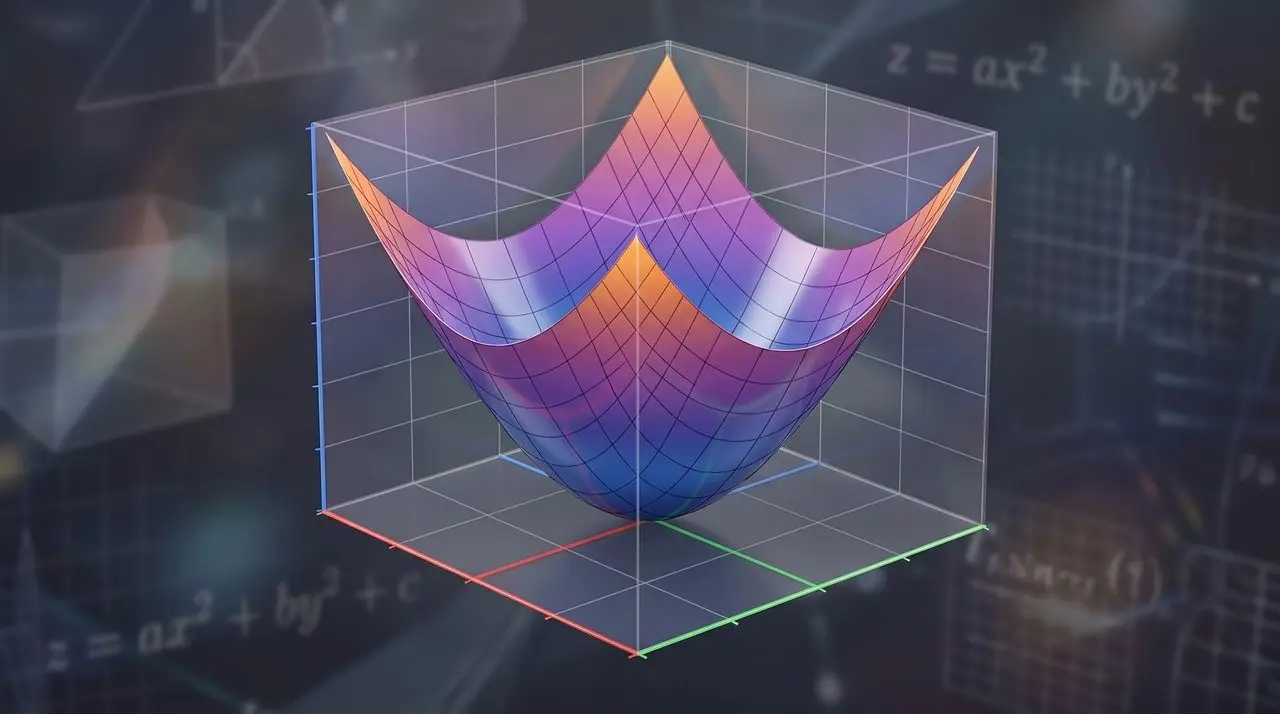
Determining whether a symmetric function remains non-negative as it grows more complex across different dimensions is fundamentally impossible with any algorithm; this resolves a long-standing open question in mathematics. A positive definite symmetric function can be imagined like a landscape where every point rises above sea level, consistently yielding positive results no matter what values are inputted.
This finding has key implications because it demonstrates limitations beyond mere computational power when solving problems such as Hilbert’s 17th problem, akin to seeking a universal recipe (Positivstellensatz) for building anything from basic ingredients but discovering the recipe fails under certain conditions.
Nonnegativity of Symmetric Functions Is Undecidable Across All Dimensions
Previous methods failed to definitively establish limitations when determining properties like non-negativity across any number of variables. The proof demonstrates it’s impossible to determine if a symmetric function with rational coefficients remains nonnegative regardless of dimension, a question posed by Acevedo, Blekherman, Debus and Riener at their respective institutions. Consequently, potential extensions of Artin’s solution to Hilbert’s 17th problem and the Krivine-Stengle Positivstellensatz into higher dimensional spaces are invalidated.
Specifically, researchers constructed a homogeneous symmetric function of degree 8 that is positive definite across all dimensions but lacks a ‘sum of squares multiplier,’ meaning its positivity cannot be established using standard algebraic techniques. This discovery extends beyond pure mathematics; while an example has been demonstrated, little is known about how frequently such functions appear or their distribution across different polynomial degrees and variable counts. The current results apply only to rational coefficients and do not yet extend to real or complex numbers.
Undecidability of Symmetric Function Positivity via Halting Problem Reduction
The team employed a sophisticated technique rooted in computational complexity theory by adapting methods from the study of Turing machines, theoretical models of computation, to demonstrate undecidability within symmetric functions. A reduction was constructed from determining if a program will halt to whether a given symmetric function remains non-negative across all possible dimensions; this shows that solving the latter would imply being able to solve the former, which is impossible. They encoded information about these halting problems *within* their carefully crafted symmetric functions, creating expressions where positivity or negativity directly reflected an intractable algorithmic challenge.
It has been proven impossible to determine whether a symmetric function with rational coefficients will be non-negative for any number of dimensions, a problem previously posed by Acevedo, Blekherman, Debus and Riener. This approach superseded traditional methods because they failed to resolve this question; techniques from studying Turing machines were adapted to demonstrate its inherent unsolvability. The team’s demonstration provides concrete evidence against long-held assumptions in algebraic structures and challenges established results like Artin’s solution to Hilbert’s 17th problem and the Krivine-Stengle Positivstellensatz.
Undecidability of Symmetric Function Positivity and Prevalence of Counterexamples
This work definitively establishes an impossibility result regarding symmetric functions, that we cannot universally determine if they remain non-negative as complexity increases, but simultaneously highlights how little is known about *how often* such failures occur. A failure was demonstrated for a specific degree eight polynomial, but this field remains largely uncharted territory. This raises a critical question: are these undecidable cases rare anomalies or do they represent a widespread phenomenon lurking within seemingly well-behaved algebraic structures?
Despite the inherent undecidability concerning their non-negativity with increasing variables, this research is far from inconsequential; it isn’t merely about computational limits but rather an intrinsic mathematical barrier to finding a universal solution for assessing positivity in symmetric functions. The team definitively showed that determining whether one remains non-negative across any number of dimensions is fundamentally impossible using algorithms and resolves a longstanding question initially posed by Acevedo, Blekherman, Debus and Riener. Consequently, verifying criteria used to confirm entanglement within quantum information theory now also lacks such a definitive algorithmic approach, a discovery which will begin new avenues for exploring these mathematical fields further.
This research demonstrates that there is no algorithm to determine if a symmetric function with rational coefficients remains non-negative as the number of variables increases. This finding answers a question raised by Acevedo, Blekherman, Debus and Riener and has implications for areas like quantum information theory where similar moment criteria are used; validating those criteria is now known to be an undecidable problem.
The authors demonstrated this unsolvability using techniques adapted from Turing machine studies on a specific degree eight polynomial. They note that while they’ve shown such determinations are impossible, understanding how frequently these failures occur requires further investigation.
👉 More information
🗞 Hilbert’s 17th problem for symmetric functions: undecidability and a counterexample
✍️ Sebastian Debus and Robin Schabert
🧠 ArXiv: https://arxiv.org/abs/2611.16690



See today’s quantum computing news on Quantum Zeitgeist for the latest breakthroughs in qubits, hardware, algorithms, and industry deals.