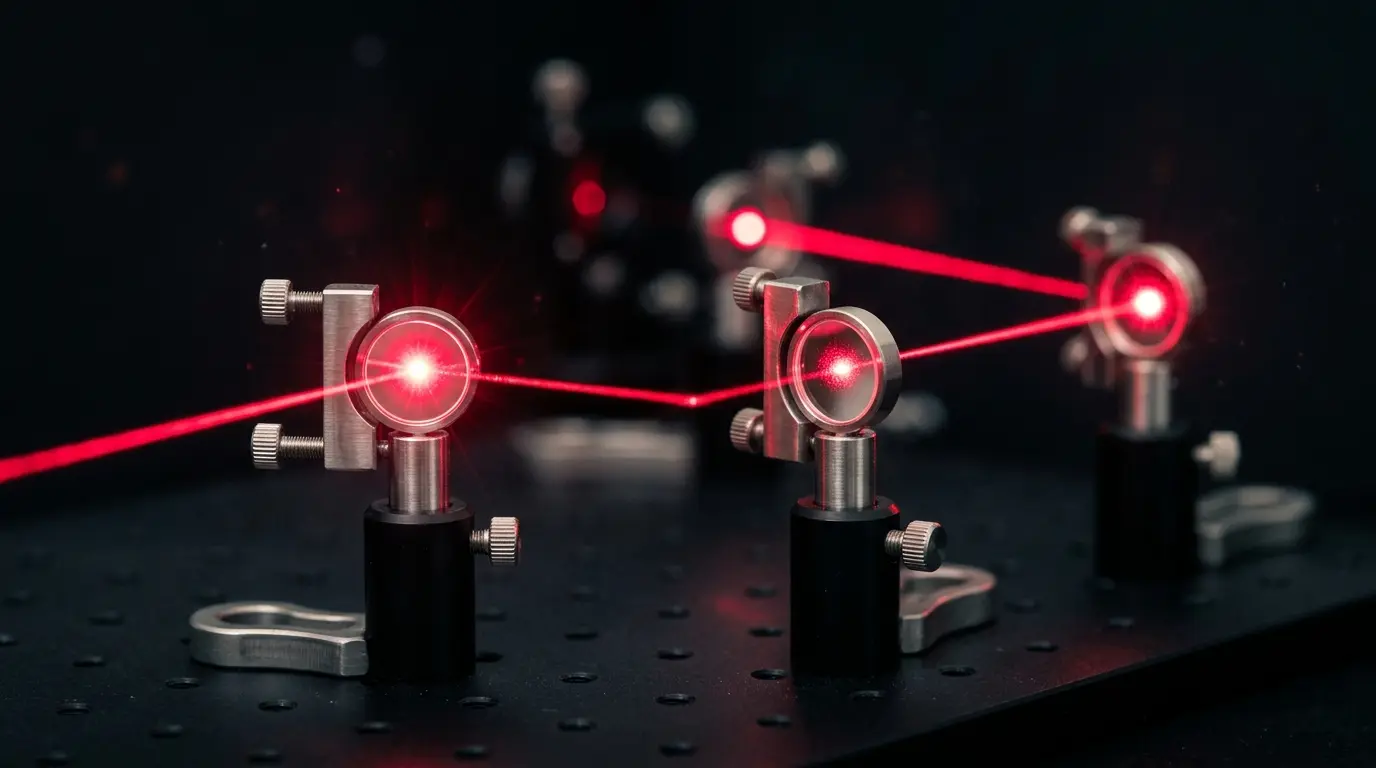
Macroscopic objects can now be reliably linked through quantum entanglement via a specially designed optomechanical system combining a ‘Fano-mirror’ cavity, which boosts light-matter interactions, with coherent feedback control. This approach uses light and mirrors within the device called a ‘Fano-mirror’ optomechanical system; it builds on existing work exploring interactions between light and mechanical vibrations at a tiny scale. A trained neural network accurately predicts the strength of this entanglement by analysing only easily measurable optical signals, removing the need for complex full state measurements.
Researchers from Zhengzhou University of Light Industry have detailed a new approach to reliably link macroscopic objects via quantum entanglement; it is key for both fundamental physics research and developing future technologies like ultra-secure communication networks. The team proposes using an ‘optomechanical system’, imagine a miniature swing set where photons (light particles) push on the swings (mechanical oscillators), creating interactions between light and movement, combined with precise control over its operation.
This design incorporates a ‘Fano-mirror cavity which boosts these light-matter interactions, alongside what they term coherent feedback: similar to adjusting the volume knob on an amplifier, some output signal is fed back into the input to modify it.
Neural networks enable threefold enhancement of sustained macroscopic optomechanical entanglement
Entanglement now peaks at 0.64, a threefold increase over schemes lacking Fano-mirror cavities, achieved through coherent feedback control in their optomechanical system. Previously sustaining such high levels of entanglement between macroscopic objects proved exceptionally difficult due to rapid decoherence. Combining this design with optical frequency mismatch allows for substantial amplification and bypasses complex quantum state tomography; a neural network predicts entanglement strength from readily measurable optical signals instead.
This all-optical approach establishes an experimentally feasible method for generating and characterising macroscopic optomechanical entanglement, opening avenues for advancements in quantum information processing as the closed loop interaction enhances both cavity-mechanical and Fano-mechanical entanglement. Further refinement through coherent feedback reveals maximum values reaching approximately 0.36 for one type of entanglement; these figures represent logarithmic negativity calculations under specific parameters.
These measurements do not yet demonstrate sustained macroscopic entanglement in noisy real-world environments or scalability beyond this carefully controlled laboratory setup, but researchers are now investigating how gains hold up when subjected to realistic noise conditions. Exploring methods to extend their approach to more complex systems with multiple entangled objects represents key steps toward practical quantum technologies.
Optical Fano Mirrors Advance Macroscopic Entanglement Toward Quantum Computing
This work demonstrates an all-optical route towards macroscopic entanglement, a key step for future quantum technologies, but the current scheme remains theoretical and lacks experimental validation, vital given that real devices inevitably deviate from idealised models. The team acknowledges imperfections could degrade performance or even eliminate predicted benefits entirely; however, despite needing proof through experimentation, this research offers a fully optical method to create entanglement between large objects important for building future quantum computers. Their use of ‘Fano mirrors’, structures manipulating light behaviour, combined with feedback loops and machine learning prediction tools simplifies verifying these delicate entangled states without complex measurements. A specifically designed cavity paired with feedback control, akin to adjusting amplifier volume, enhances interactions within an optomechanical system.
This research successfully demonstrates how to generate and predict macroscopic entanglement using a Fano-mirror cavity optomechanical system alongside coherent feedback. This approach allows researchers to entangle the motion of relatively large mechanical components through manipulation of light, potentially simplifying the creation of this nonclassical state needed for certain quantum technologies.
The team showed that enhancing interaction via the Fano mirror improved entanglement up to approximately 0.36 as measured by logarithmic negativity; they also used a neural network to estimate entanglement from observable optical signals. Researchers are now working to test these findings under more realistic conditions with added noise.
👉 More information
🗞 Feedback Control and Neural-Network-Based Prediction of Quantum Entanglement in Fano-mirror cavity optomechanics
✍️ Ya-Feng Jiao, Ze-Yu Zhu and Wen-Qiang Fang (Zhengzhou University of Light Industry); Jie Wang (Affiliation: College of Science); Qing-Shou Tan (Hunan Institute of Science and Technology); Le-Man Kuang and Hui Jing (Hunan Normal University)
🧠 ArXiv: https://arxiv.org/abs/2611.15516



See today’s quantum computing news on Quantum Zeitgeist for the latest breakthroughs in qubits, hardware, algorithms, and industry deals.