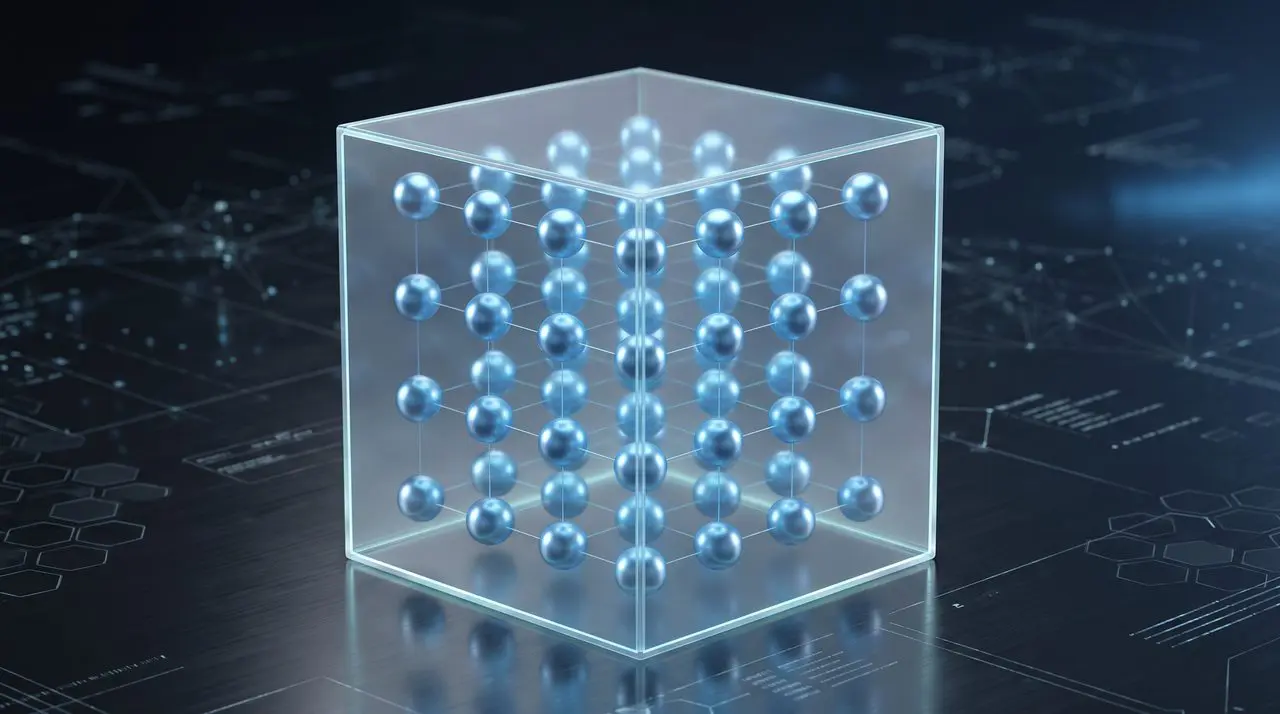
An algorithm identifies arbitrary multi-qubit states known as stabilizer states using fewer resources than previously thought possible. It learns these complex states, key for applications including quantum error correction and simulation, from only a linear number of individual measurements on each qubit. An improved method exists for identifying complex quantum states called stabilizer states which are fundamental to several areas of quantum computing including error correction and simulation.
The new algorithm requires fewer measurement ‘copies’ of these states than previously possible; crucially achieving results using only a number of measurements that grows linearly with the number of qubits involved. Researchers at Freie Universität Berlin and affiliated institutions have achieved a breakthrough in identifying complex quantum states known as stabiliser states, central to advancements in areas like error correction and simulation within quantum computing.
A stabiliser state can be thought of as a specific type of quantum state relatively easy for conventional computers to simulate yet still valuable for certain advanced algorithms. The team’s new algorithm sharply reduces the resources needed to learn these states, requiring only a number of measurements which grows linearly with the number of qubits involved, an improvement over previous methods needing far more copies of the state. This was accomplished using Clifford measurements, basic operations on qubits designed to minimise errors, akin to asking both qubits the same question simultaneously rather than separately via Bell measurements.
Adaptive algorithms optimise quantum stabiliser state learning efficiency
A new adaptive algorithm sharply reduces the number of quantum states needed for learning stabiliser states; achieving a reduction from needing Ω(n²) measurement ‘copies’ to just Θ(n). This closes a longstanding gap between methods employing Bell sampling, which efficiently uses two copies of a quantum state, and those relying on individual, non-adaptive assessments that previously demanded quadratically more resources. The approach utilises Clifford measurements, basic operations minimising errors during qubit assessment, and intelligently sequences these evaluations based on previous results.
Effectively refining understanding with each step without requiring multiple identical states is achieved. Furthermore, utilising quantum memory of only ‘k qubits allows optimal testing tradeoffs of Θ(n−k+1/ε) at a specified level of inaccuracy ε. Adaptivity fully bridges this gap in quantum learning techniques.
In particular, the method’s applicability extends beyond perfect stabiliser states; it successfully learns those with a “nullity” of up to ‘r’, requiring O(n² r ) measurements and improving upon existing techniques for complex states containing some imperfections. The team also explored learning states with a limited number of ‘T gates’, achieving efficiency gains proportional to the quantity of these gates, they used four times the number of qubits plus a small correction factor for their tests.
Adaptive Clifford Measurements Enable Efficient Quantum State Tomography
The breakthrough hinged on employing Clifford measurements, basic operations performed on qubits designed to minimise errors compared with more complex measurement types. This algorithm strategically sequences single qubit assessments, unlike previous methods reliant on simultaneously comparing two qubits via Bell measurements. Each subsequent measurement is informed by prior results; this adaptive approach allows understanding of the quantum state to be refined incrementally and focuses efforts where information gain is highest while discarding unproductive lines of inquiry.
Intelligent selection of which properties to measure next circumvented the need for multiple copies of the quantum state previously considered essential for efficient learning. Harvard University and Freie Universität Berlin researchers have devised an algorithm capable of characterising an n-qubit stabiliser state using only Θ(n) copies of data from single qubit measurements alongside an adaptive approach achieving optimal scaling for stabiliser state learning. This demonstrates a significant advancement in reducing resource demands during characterisation.
Efficiently mapping quantum states via reduced measurement requirements
Accurately characterising quantum states remains a key challenge in realising practical quantum technologies. Current methods for ‘learning’ these states face inherent trade-offs between accuracy and resource demands. The new work offers a compelling alternative, addressing a longstanding inconsistency where identifying an n-qubit stabiliser state previously required either numerous copies using complex Bell sampling or sharply more individual assessments without adaptivity.
Nevertheless, acknowledging that achieving truly scalable quantum computation remains distant despite this advance is important. This addresses a specific bottleneck in efficiently characterising these complex states, determining their properties with fewer resources, but doesn’t resolve all hurdles facing practical devices. While the algorithm identifies quantum stabilizer states using only single assessments of individual qubits bypassing previous limitations requiring numerous copies or complex measurements for accurate characterisation, further research will be needed to address remaining challenges.
The researchers demonstrated an adaptive algorithm capable of learning an n-qubit stabiliser state from Θ(n) single-copy Clifford measurements, matching the efficiency of Bell sampling without needing multiple copies of the quantum state. The team also developed a sample-optimal single-copy tolerant tester and showed their method extends to states with limited ‘stabilizer nullity’, including those created by certain types of quantum circuits. They suggest this approach offers improved scaling for stabilizer state learning and reduces resource demands during characterisation.
👉 More information
🗞 Adaptivity is all you need: Optimal stabilizer learning using just single-copy measurements
✍️ L. Bittel, J. Eisert, W. Gong, A. A. Mele and L. Schatzki
🧠 ArXiv: https://arxiv.org/abs/2610.02031


See today’s quantum computing news on Quantum Zeitgeist for the latest breakthroughs in qubits, hardware, algorithms, and industry deals.