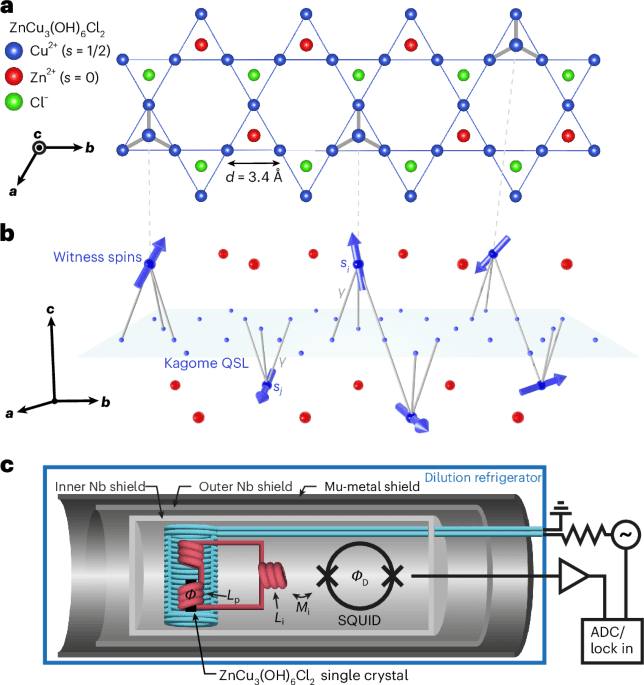
Researchers have observed a sharp transition in the magnetic behavior of herbertsmithite at around 260 mK, a temperature at which impurity atoms within the material coalesce into a spin glass phase. These impurities, created by approximately 33% substituted copper atoms on zinc sites, were reconsidered as a tool to probe the material’s elusive quantum spin liquid state, a state theorized to host quasiparticles called spinons. Instead, the team utilized spin noise spectroscopy to measure the dynamics of these witness spins, revealing interactions mediated by these spinons and establishing a direct link between theoretical particles and observable dynamics. The researchers explain that in the theory of such materials, strongly interacting spins do not undergo spontaneous magnetic ordering, but enter a ground state with extensive long-range quantum entanglement, suggesting a new approach to studying quantum spin liquid physics through the reconsideration of controlled impurities.
Impurity Atoms as Witness Spins in Herbertsmithite
This approach seeks to leverage these impurity atoms as a direct probe of the elusive quantum phenomena occurring within the kagome lattice structure. The herbertsmithite crystal structure reveals kagome planes of copper atoms theorized to sustain a quantum spin liquid, with some copper atoms randomly substituting zinc sites, a phenomenon previously considered a hindrance. The team aimed to reconsider these impurity atoms as ‘witness spins’ to provide an exceptional probe of the conjectured QSL state, employing spin noise spectroscopy to measure the frequency and temperature dependence of their dynamics. A sharp transition was observed at around 260 mK, below which the properties of both spin noise and magnetic susceptibility suggest that the witness spins form a spin glass phase, a disordered magnetic state.
The observed behavior is consistent with extensive interactions between witness spins mediated by propagation of spinons through the quantum spin liquid, demonstrating a direct link between these theoretical quasiparticles and observable dynamics. The researchers state that viewed as quantum mechanical witness spins, they may be used for exploration of the QSL state itself, suggesting a broadly applicable technique for studying quantum spin liquid physics.
Kagome Lattice and Quantum Spin Liquid Theory
Researchers are now reconsidering seemingly detrimental impurities within herbertsmithite, a material believed to host a quantum spin liquid (QSL) state, as probes of this exotic phenomenon. This approach offers a novel pathway to understanding a state of matter where strongly interacting spins avoid conventional magnetic ordering, instead entering a ground state with extensive quantum entanglement and fractionalized spinon quasiparticles. Detailed measurements using spin noise spectroscopy revealed a transition at around 260 mK. Analysis of the data suggests that the observed interactions are consistent with either a Z 2 or U(1) quantum spin liquid, with the Z 2 model providing a closer match to the experimental results. This work establishes the potential for utilizing quantum mechanical witness spins as a broadly applicable method for investigating QSL physics in other materials, opening new avenues for exploring these enigmatic states of matter.
Herbertsmithite Crystal Structure & Magnetic Susceptibility
The herbertsmithite crystal structure, with lattice parameters a = b = 6.84 Å and c = Å, features kagome planes of copper ions theorized to sustain the QSL state. These witness spins, copper atoms substituting zinc within the structure, offer a unique window into the material’s quantum properties. Detailed measurements reveal that the contribution of these spins to the kagome-specific magnetic susceptibility, χK(ω, T), exhibits a downturn at temperatures below 30 K, hypothetically due to spin-singlet formation. Takahashi explains, “here we reconsider them as an innovative resource.” This innovative use of impurity atoms as probes may prove widely applicable to the study of quantum spin liquid physics, offering a new avenue for exploring these complex materials.
Antiferromagnetic Interactions and Curie-Weiss Temperature
The unconventional approach of utilizing impurity atoms to understand quantum materials is yielding new insights into herbertsmithite, a leading candidate for hosting a quantum spin liquid (QSL) state. This shift in perspective allows for a novel method of probing the QSL, reconsidering these impurity atoms rather than dismissing them as disruptive elements. Detailed analysis of herbertsmithite reveals a Curie, Weiss temperature of -300 Kelvin, indicating strong antiferromagnetic interactions between the kagome lattice spins. However, the material notably avoids conventional magnetic ordering even at extremely low temperatures. This behavior is consistent with the theoretical expectation that strongly interacting spins in a QSL do not spontaneously order, but instead enter a ground state characterized by quantum entanglement and fractionalized quasiparticles called spinons.
Conflicting Evidence for Gapped vs. Gapless QSL States
The search for a definitive signature of quantum spin liquid (QSL) behavior in herbertsmithite has yielded surprisingly contradictory results, challenging conventional interpretations of experimental data. While some studies suggest a gapped spinon spectrum, indicating a finite energy required to excite quasiparticles, others point towards a gapless state where excitations can occur at arbitrarily low energies. Nuclear magnetic resonance studies have contributed to this debate, with reports both supporting and refuting the presence of an energy gap within the kagome planes of the material. Specifically, experiments have yielded conflicting results regarding the kagome plane susceptibility at the lowest temperatures, with some indicating a non-zero value suggestive of a gapless state. Detailed measurements of herbertsmithite’s magnetic properties reveal a complex interplay between the kagome lattice spins and the impurity atoms substituting onto the zinc sites. These randomly substituted copper atoms, previously considered imperfections, are now being reconsidered as probes of the QSL state. Ultimately, this work suggests that witness spins may now be used as a widely applicable probe of quantum spin liquid physics.
A custom-built SQUID (Superconducting Quantum Interference Device) spin noise spectrometer was central to this work, designed to measure This technique allowed for precise observation of how the witness spins respond to fluctuations, offering insights into the underlying quantum spin liquid state.
Witness Spin Concentration in Interplanar Zinc Sites
Researchers are now reconsidering imperfections within herbertsmithite crystals, specifically, copper atoms substituting for zinc, not as hindrances, but as a probe of the elusive quantum spin liquid (QSL) state. This innovative approach, spearheaded by Hiroto Takahashi and colleagues, shifts the conventional view of impurities from detrimental defects to valuable analytical tools. The team’s work centers on understanding the dynamics of these witness spins, which reside on the planes separating the kagome lattices believed to host the QSL.
Transition to Spin Glass Phase at 260 mK
Detailed measurements using spin noise spectroscopy exposed this transition, demonstrating that the witness spins transition into a disordered state at this low temperature. The team’s analysis indicates that the observed interactions are mediated by spinons, the quasiparticles theorized to be fundamental to the quantum spin liquid. These spinons propagate through the material, directly linking their behavior to the dynamics of the witness spins within a specific temperature range. This connection provides further evidence supporting the existence of these elusive particles and their role in the exotic properties of herbertsmithite. However, a sharp transition at around 260 mK complicates the picture, as the observed magnetic susceptibility and spin noise characteristics strongly suggest the formation of a spin glass phase, prompting a re-evaluation of the witness spins’ role.
See today’s quantum computing news on Quantum Zeitgeist for the latest breakthroughs in qubits, hardware, algorithms, and industry deals.