Researchers have developed a new approach to detecting low-frequency electric signals using Rydberg atoms, addressing a critical limitation in current quantum sensing technology. Existing low-frequency Rydberg receivers depend on a constant bias field, typically achieved through methods like intra-cell electrodes or Rydberg plasmas, but these methods present challenges in calibration, long-term stability, and robustness, hindering practical deployment. The team, including Xiayang Fan and Shenchao Jin of the Chinese Academy of Sciences and Qianyuan Laboratory, now introduces an AC-field modulation strategy, effectively sidestepping the need for a static field and improving sensor performance. This work demonstrates a sensitivity at 5 kHz and a minimal detectable field with a 1000-second integration time, establishing a framework for more robust and stable low-frequency electric field sensing with Rydberg atoms.
Rydberg Atom Sensitivity to Low-Frequency Electric Fields
Rydberg atom-based sensors are now achieving sensitivities previously unattainable for detecting low-frequency electric fields, but practical implementation has been hampered by persistent stability issues. The core of this advancement lies in shifting away from static electric fields, which are susceptible to calibration drift and environmental sensitivity. Instead, the team introduced an AC-field modulation strategy, a departure from conventional methods. “Unlike conventional methods that employ external DC electric fields that are often fully shielded by adsorbed atom layers on the cell walls, we introduce an AC-field modulation strategy,” explain the researchers in their recent publication. This incoming low-frequency signal mixes with the auxiliary field, inducing Stark shifts in the Rydberg level and mapping these shifts onto a probe laser via electromagnetically induced transparency (EIT), analogous to heterodyne detection.
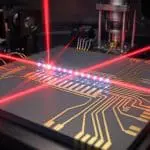
This research addresses a critical bottleneck in the field; while Rydberg atoms have proven remarkably sensitive across a broad spectrum of frequencies, from DC to terahertz, deploying these sensors outside controlled settings has remained difficult. By employing quantum frequency mixing (QFM), the modulated auxiliary field amplifies the weak low-frequency signal and shifts it to sidebands, improving noise resilience and eliminating the need for internal electrodes. The experimental setup utilizes a glass vapor cell, driven by frequency-stabilized lasers and a pair of copper plates generating a uniform electric field. The implications of this work extend to several fields, including space science, geophysical surveys, and communication in complex environments, where detecting subtle low-frequency electric signals is crucial. By establishing a robust and systematic framework for quantum sensing, this research offers a pathway toward deployable LF electric-field sensors with improved stability and immunity to environmental drifts, potentially unlocking a new era of precision measurement in diverse applications.
Modulated Auxiliary Fields Enable Quantum Frequency Mixing
These methods have demonstrated success, but they introduce practical limitations that impede wider adoption. The team’s recent work details a departure from these static field implementations, introducing a novel strategy centered around modulated auxiliary fields. This new technique leverages the principles of quantum frequency mixing (QFM) to amplify weak signals and improve detection fidelity. This process, analogous to heterodyne detection, shifts the signal to sidebands of the auxiliary field, enhancing its detectability and resilience against noise. “This technique requires no internal electrodes and is intrinsically stable, calibration-friendly, and robust against environmental drifts, offering a practical route toward deployable LF electric-field sensors,” the researchers state. The researchers extended their analysis to explore the performance of generalized auxiliary fields containing multiple frequency components, establishing a framework for systematically optimizing sensor performance.
The experimental setup, detailed in their publication, features a configuration where the auxiliary and signal fields are applied via copper plates, simulating real-world application scenarios. This electrode-free design, coupled with the QFM-based amplification, promises to overcome the limitations of previous Rydberg atom-based sensors and unlock new possibilities for low-frequency electric field detection in diverse environments.
Electromagnetically Induced Transparency Maps Stark Shifts
Researchers at Qianyuan Laboratory are developing a new approach to mapping subtle electric field variations using the quantum properties of Rydberg atoms, moving beyond limitations inherent in current low-frequency receivers. The core innovation lies in utilizing electromagnetically induced transparency (EIT) to map Stark shifts induced by both a modulated auxiliary field and the target low-frequency signal. This allows for a quantum frequency mixing effect, where the incoming low-frequency signal combines with the auxiliary field, amplifying the signal and shifting it to a frequency more easily detected. This technique, detailed in their recent publication, avoids the need for internal electrodes, addressing a key source of instability in previous designs. They demonstrate a sensitivity at 5 kHz and a minimal detectable field with an integration time of 1000 seconds.
This performance was realized through a combination of the modulated auxiliary field and a weak-measurement-enhanced readout, a technique used to suppress technical fluctuations during signal detection. This advancement promises to unlock wider applications for Rydberg atom-based sensors in fields like space science, geophysical surveys, and specialized communication systems, where detecting weak, low-frequency electromagnetic signals is crucial.
The ability to accurately detect subtle shifts in low-frequency electric fields is becoming increasingly vital across diverse fields, from monitoring space weather patterns to improving geophysical surveys and enabling robust communication in challenging environments. This mixing process amplifies the weak signal and shifts it to a higher frequency, improving resilience against noise and technical fluctuations. The team meticulously designed and built a system where “a locally generated AC auxiliary field is superimposed with the incoming LF signal field,” inducing a Stark shift on the Rydberg states. This level of performance, coupled with the inherent stability and robustness of the AC-field modulation approach, positions this technology as a viable candidate for deployment outside controlled settings. The team believes this work establishes a foundation for a new generation of practical, high-performance electric field sensors.
This shift addresses persistent issues of calibration drift, limited long-term stability, and environmental sensitivity, factors that have previously restricted deployment beyond controlled laboratory settings. This technique doesn’t simply improve sensitivity; it fundamentally alters the stability and practicality of Rydberg-based LF sensors. Crucially, the system requires no internal electrodes, eliminating a significant source of calibration errors and long-term drift.
👉 More information
🗞 Quantum sensing of low-frequency electric signal enabled by modulated auxiliary field in Rydberg atoms
✍️ Xiayang Fan, Shenchao Jin, Jiatian Liu, Jialiang Zhang, Qichao Qi and Yuan Sun
🧠 ArXiv: https://arxiv.org/abs/2607.18740


See today’s quantum computing news on Quantum Zeitgeist for the latest breakthroughs in qubits, hardware, algorithms, and industry deals.