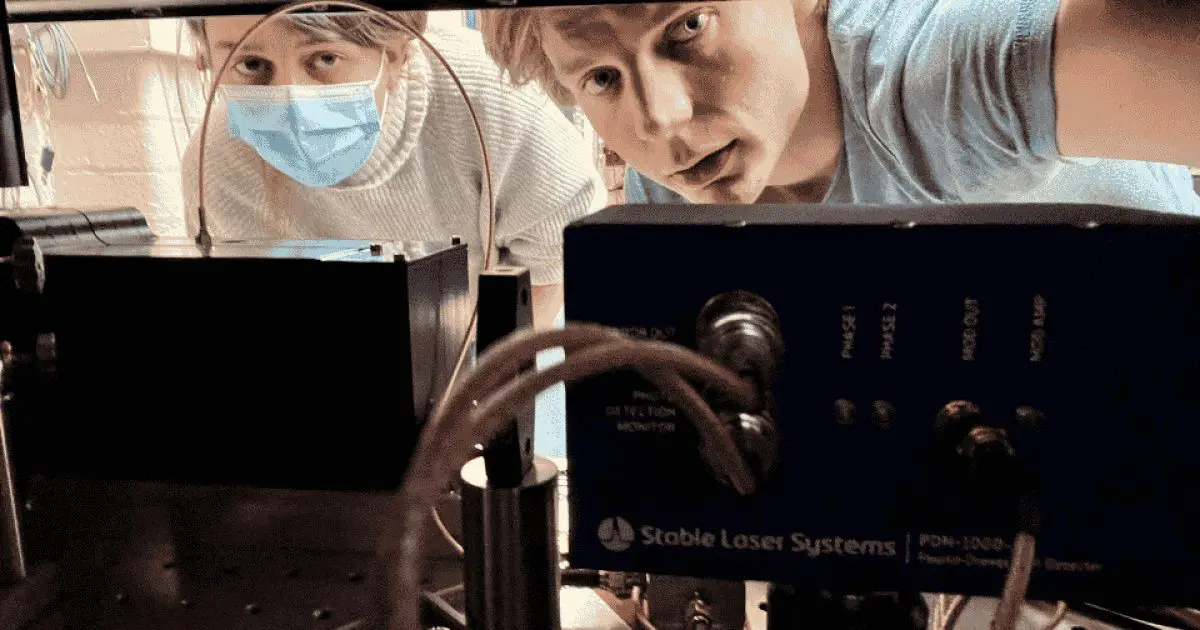
Researchers at the University of Oxford have expanded the possibilities for quantum technologies by creating a new family of Schrödinger’s cat states, extending the toolkit available for quantum computing, sensing, and error correction. Unlike traditional “cat states” which rely on nearly identical quantum wave packets displaced in opposite directions, the team demonstrated superpositions built from a broad range of highly non-classical components differing in how their uncertainty is distributed or how they are oriented in phase space. These components, including squeezed, trisqueezed, and quadsqueezed states, were combined coherently within a single trapped ion of strontium-88, allowing for programmable control over the resulting superposition. “This approach gave us a tool to sculpt quantum superpositions into almost any shape,” explains lead author Dr. Sebastian Saner, and the resulting states exhibit striking geometric interference patterns and rotational symmetries.
Non-Classical State Synthesis via Trapped Strontium-88 Ions
A single strontium-88 ion is at the heart of a new method for crafting complex quantum states, extending the possibilities for quantum technologies beyond conventional approaches. These components, including squeezed, trisqueezed, and quadsqueezed states, were previously synthesized within the same trapped-ion platform; the innovation lies in coherently combining them into programmable superpositions, allowing precise control over size, orientation, and separation. The experiment leveraged a single ion confined in an ion trap, exploiting the dual nature of trapped ions where the internal electronic state functions as a qubit and the ion’s motion acts as a quantum harmonic oscillator. By coupling these, the researchers used the qubit to sculpt the motional state, first entangling the internal state with different possible states of motion, then projecting the ion’s motion into the desired superposition via a mid-circuit quantum measurement. Sebastian Saner confirmed these findings. The resulting states, confirmed through state tomography and exhibiting negative values in the Wigner function, demonstrated greater quantum resourcefulness than standard cat states or Fock states for a given energy level, suggesting potential benefits for quantum computation and bosonic quantum error correction.
Programmable Superpositions of Squeezed and Trisqueezed States
The experiment, conducted with a single strontium-88 ion trapped within an ion trap, successfully combined previously synthesized squeezed, trisqueezed, and quadsqueezed states into coherent superpositions. This achievement is not simply about adding more components, but about maintaining control over their characteristics; the researchers demonstrated the ability to tune the size, orientation, and separation of each part within the superposition. The underlying interactions used are unitary, meaning they can be repeated without disrupting the quantum state, a crucial element for building complex superpositions. State tomography confirmed the genuinely quantum nature of the created states, revealing interference patterns and negative values in the Wigner function, indicators that these states cannot be explained by classical physics. Dr. Raghavendra Srinivas adds that “We were really encouraged by our colleagues’ reaction when we showed them what we had made,” suggesting a significant impact within the quantum physics community and hinting at further exploration of these states’ fundamental properties and practical applications. Crucially, the technique is unitary, allowing for repeated application of interactions within a single experimental sequence without state degradation.
This approach gave us a tool to sculpt quantum superpositions into almost any shape.
Source: https://www.physics.ox.ac.uk/news/oxford-physicists-create-new-family-schrodingers-cat-states



See today’s quantum computing news on Quantum Zeitgeist for the latest breakthroughs in qubits, hardware, algorithms, and industry deals.