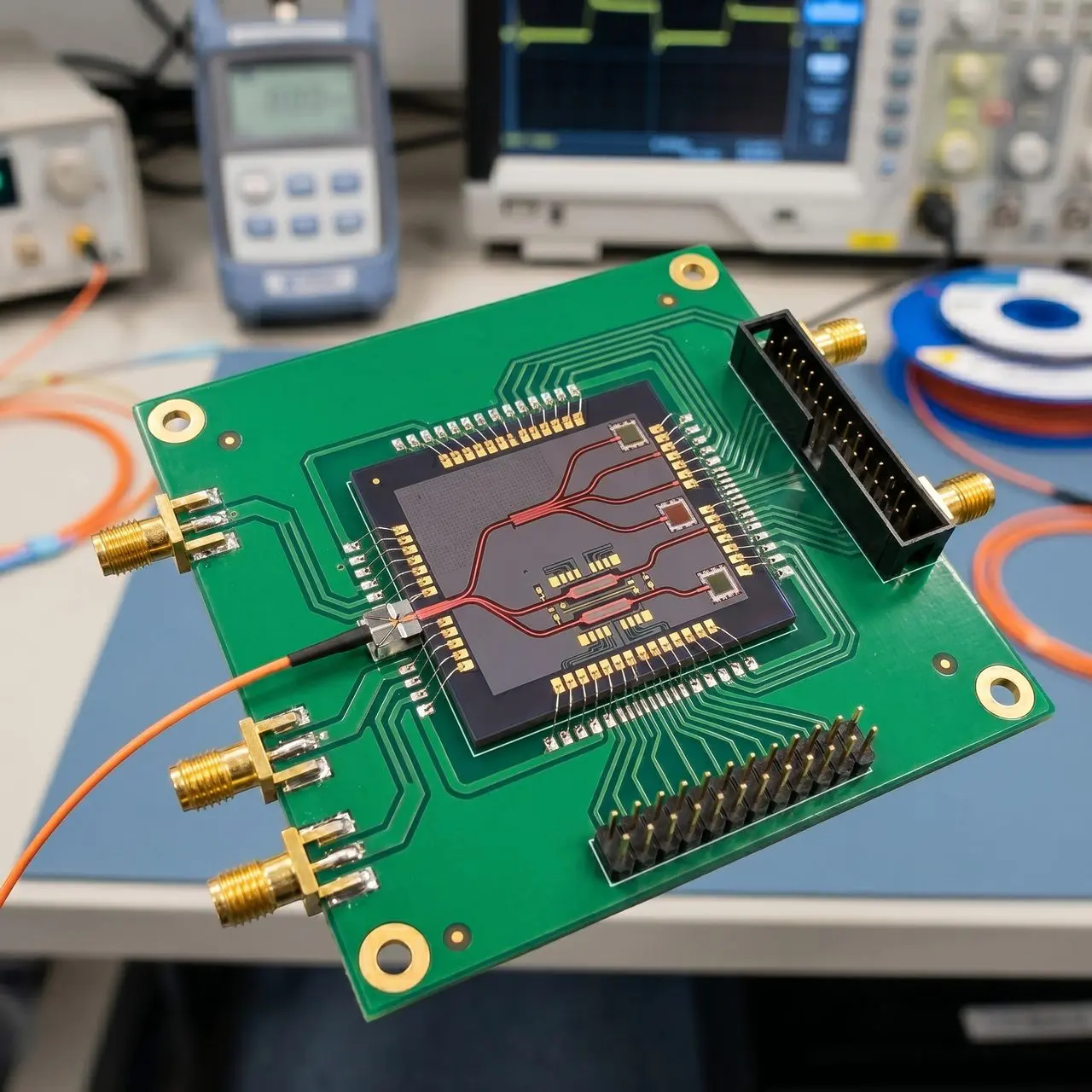
Researchers at Zhejiang University have demonstrated a new approach to generating single photons, achieving 2.58 times greater output than previous methods that lack multiplexing. The team built a two-port multiplexing system using four integrated heralded single-photon sources and a novel switching network, allowing them to harness combinatorial photon events. This strategy yields a 1.60 times higher generation probability compared to conventional multiplexing.
Combinatorial Heralding Boosts Multi-Port Single-Photon Generation
Quantum technologies stand to gain significantly from a newly demonstrated method of generating single photons, achieving 2.58 times more photons compared to implementations lacking multiplexing. Researchers detailed a novel approach to building multi-port single-photon sources, moving beyond simple replication of units seen in conventional designs to a system leveraging combinatorial heralding. This architecture, detailed in npj Quantum Information, utilizes a multi-input/multi-output switching network to harness photon events in a more efficient manner, theoretically revealing a super-exponential enhancement in single-photon creation.
This configuration departs from traditional methods by intelligently combining photon signals, rather than simply increasing the number of independent sources. Theoretical analysis predicted this approach would reduce the number of heralded single-photon sources needed for a given output probability, a prediction now validated by experimental results.
The team’s strategy achieves a generation probability 1.60 times higher than conventional multiplexing techniques, demonstrating a substantial improvement in capturing these typically low-probability events. This improvement in generation probability is not merely incremental; it addresses a fundamental challenge in scaling quantum photonic technologies. Scalable systems demand the simultaneous production of highly indistinguishable multi-photon states, and the ability to do so with high probability is crucial.
The researchers propose that their combinatorial heralding method offers a pathway to meet this need. Baojie Hou, Haoran Ma, and Zichao Zhao of Zhejiang University, along with researchers from The Zhejiang Lab and the National University of Singapore, write that this multi-port multiplexed method opens a new avenue for establishing a solid foundation for advanced multi-photon quantum interference and large-scale quantum information processing.
Funding for the project came from the National Key Research and Development Program of China, the National Natural Science Foundation of China, and several provincial science and technology programs within Zhejiang and Ningbo. Beyond the immediate gains in photon generation, the integrated nature of the heralded single-photon sources is a key feature of this design. Integration allows for more compact and potentially more stable systems, crucial for practical applications.
The demonstrated two-port system serves as a proof-of-principle, but the underlying architecture is designed to be scalable to multiple output modes without the inefficiencies of simply replicating existing units. This scalability is a critical step towards building complex quantum networks and processors, with implications for quantum key distribution, quantum sensing, and ultimately, fault-tolerant quantum computation.
By increasing the efficiency of single-photon generation and multiplexing, the researchers have addressed a bottleneck that has long hindered the progress of these fields. The ability to create and manipulate multi-photon states with greater control and probability is essential for realizing the full potential of quantum information science, and this new approach offers a promising path forward.




See today’s quantum computing news on Quantum Zeitgeist for the latest breakthroughs in qubits, hardware, algorithms, and industry deals.