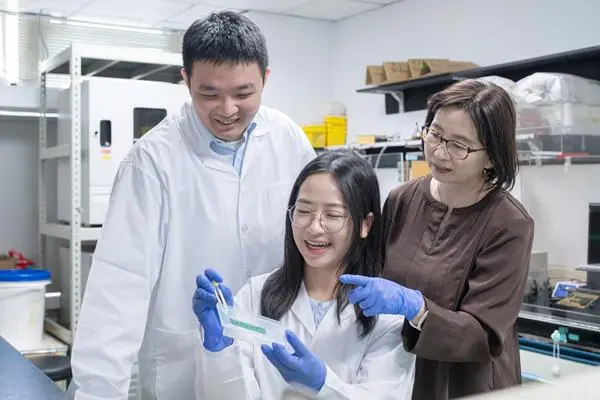
National Tsing Hua University researchers have provided the first definitive evidence of a quantum critical point (QCP) in high-temperature cuprate superconductors, potentially resolving a mystery that has challenged physicists for nearly 40 years. The international team, including Dean Chung-Yu Mou at NTHU, clarified how the material’s quantum states change on either side of this critical point using resonant inelastic X-ray scattering. The results published in Nature Communications pinpoint a landmark previously obscured by the superconducting state itself.
Quantum Critical Point Discovery in Cuprate Superconductors
Lanthanum strontium copper oxide (LSCO) revealed a hidden quantum critical point (QCP) through high-resolution resonant inelastic X-ray scattering (RIXS) performed at the Taiwan Photon Source, operated by the National Synchrotron Radiation Research Center. This discovery, made by an international team including researchers at National Tsing Hua University (NTHU), confirms a long-suspected landmark in the phase diagram of high-temperature cuprate superconductors, a point previously obscured by the materials’ superconducting state. The team tracked changes in charge density wave (CDW) behavior to pinpoint the QCP’s location, addressing a 40-year-old challenge in condensed matter physics.
The newly identified QCP represents a boundary where the material undergoes a transition between distinct quantum states as conditions like doping or pressure change at zero temperature, according to Dean Chung-Yu Mou of NTHU’s College of Science. “A quantum critical point is the boundary point at which the material makes the transition from one quantum state to another as conditions such as doping or pressure changes at zero temperature,” Mou explained, clarifying the fundamental nature of this critical juncture.
The team’s success depended on their ability to observe quantum critical scaling, a phenomenon where experimental data collected under varying conditions collapses onto a single underlying law, providing evidence for the QCP’s existence. Analysis of the data revealed a distinct shift in the material’s quantum states on either side of the critical point; on one side, charge density waves, superconductivity and a pair density wave coexist and intertwine.
Beyond the critical point, the material simplifies to a pure superconducting state, marking a clear demarcation in its electronic behavior. Dean Mou described this as creating distinct “topographies” on either side of the quantum critical point, clarifying their distinct “landscapes,” and providing a detailed map of the material’s quantum properties. This detailed understanding will be essential for refining theoretical models attempting to explain high-temperature superconductivity.
Charge density waves, a key element in the team’s analysis, manifest as an uneven distribution of electric charge, creating a periodic fluctuation in charge density. The team’s ability to track these fluctuations, even as temperature and doping levels were altered, was critical to identifying the underlying quantum critical law.
Di-Jing Huang, Distinguished Research Fellow at the National Synchrotron Radiation Research Center (NSRRC) and adjunct professor at NTHU, coordinated the research and data analysis, while Hsiao-Yu Huang, Assistant Research Fellow at NSRRC, performed the experiment and data acquisition. Atsushi Fujimori, Honorary Chair Professor at NTHU, was responsible for acquiring the samples used in the experiments, and Academician Ting-Kuo Lee contributed important ideas for data analysis.
Dean Mou emphasized the importance of this international effort, stating that the findings offer “a clearer picture of the complicated phase diagram of high-temperature superconductors and provide an important benchmark for testing theoretical models.” The team’s work published in Nature Communications provides a key foundation for future investigations into the elusive mechanisms driving high-temperature superconductivity.
A quantum critical point is the boundary point at which the material makes the transition from one quantum state to another as conditions such as doping or pressure changes at zero temperature.
See today’s quantum computing news on Quantum Zeitgeist for the latest breakthroughs in qubits, hardware, algorithms, and industry deals.