An MIT-trained entrepreneur turned author, he asks whether quantum reality behaves less like a stage and more like a vast running computation.
He trained at MIT and founded games companies. Rizwan Virk now writes about simulation theory, and the books are argument rather than research. His readership comes from software and games rather than from a laboratory.
The Simulation Hypothesis is his central work. It collects the case that reality behaves like a running computation. The sequel extends it into physics and religion.
Quantum mechanics is recruited to the argument. Measurement, superposition and the observer effect are read as evidence of rendering on demand. Physicists generally do not accept that reading.
The idea is famous because of a philosopher, not a technologist. Nick Bostrom’s 2003 argument gave the hypothesis academic respectability. Everything popular since builds on that.
Testability is the hard problem. No one has proposed an experiment that would distinguish a simulated universe from an unsimulated one. Without that, it is philosophy rather than physics.
It is still useful as a thinking tool. The hypothesis forces clear questions about what computation is and what physics assumes. That is worth something even if the answer is no.
- An entrepreneur who wrote The Simulation Hypothesis
- A games founder who came at physics from the engineering side
- Two books argue that reality behaves like a running computation
- The rendering analogy rests on measurement and superposition
- A writer assembling results rather than making them
- Investing, games and doctoral work at ASU still feed the argument
- A translator rather than a scientist
- Frequently asked questions
An entrepreneur who wrote The Simulation Hypothesis
Rizwan Virk is a technology entrepreneur, investor and author who founded the Play Labs @ MIT accelerator and now writes about whether the universe is a running computation. He is best known for the 2019 book The Simulation Hypothesis, which argues that our universe may be something closer to a vast computer simulation than a fixed physical stage. A sequel, The Simulated Multiverse, followed, and between them the two books brought the strange behaviour of quantum physics to a wide general audience. Virk reached that question not as a working physicist but as a computer scientist and builder who spent years in software and video games.
The training was computer science and business, not physics
Virk took a bachelor’s degree in computer science and electrical engineering at the Massachusetts Institute of Technology, and later a master’s in management at Stanford’s Graduate School of Business. That combination of deep technical training and business instinct shaped a career that moved easily between writing code, founding companies, and investing in startups.
The books turn on one comparison. Video games render convincing worlds out of pure information, and The Simulation Hypothesis asks whether our own world is doing something similar, a question that leads straight into the puzzles of quantum mechanics. That is how a writer trained in software ended up writing about physics at all.
A games founder who came at physics from the engineering side
Before he became associated with simulation theory, Rizwan Virk earned a reputation in the technology world as a founder and investor. He built and backed companies in software and gaming, where a small amount of code can conjure an entire interactive universe.
Virk founded Play Labs @ MIT, a startup accelerator that ran on the MIT campus, where he worked with founders building games, virtual reality, and other interactive media. Running an accelerator at a leading technical institution kept him close to the newest work on how digital worlds are constructed.
The engineering angle is what makes the books distinctive
Game developers use practical tricks to make worlds feel real without computing every detail at once. His books draw their angle from those tricks, or their apparent echoes, in descriptions of the quantum world.
This builder’s perspective is both the strength and the limit of his work. It produces fresh analogies that general readers find gripping, yet it does not amount to a physical theory that scientists can test. He presents the work as connecting ideas across disciplines rather than as new physics.
Two books argue that reality behaves like a running computation
The book that made Rizwan Virk widely known is The Simulation Hypothesis, published in 2019. Its subtitle argues that artificial intelligence, quantum physics, and Eastern mystics all agree we are in a video game. The book gathers ideas from computing, gaming, and physics into a single accessible argument, and it remains the anchor of his public profile.
He followed it with The Simulated Multiverse, whose subtitle promises an exploration of parallel universes, the simulation hypothesis, quantum computing and the so-called Mandela effect. The word exploration is doing real work there, because the sequel extends the argument rather than testing it.
The earlier books were about founding companies, not physics
Virk’s writing did not begin with simulation theory. Earlier titles such as Zen Entrepreneurship and Treasure Hunt drew on his own path as a founder, and Startup Myths and Models distilled lessons from years of building and investing. These books show that his core craft is explaining hard or abstract ideas to general readers.
When he turned that craft towards quantum physics, the result was a body of work that treats deep scientific puzzles as a source of wonder for everyone. The books invite curiosity rather than demanding a physics background. That accessibility is why his name now appears in popular discussions of quantum reality.
The rendering analogy rests on measurement and superposition
Quantum mechanics plays the central role in Rizwan Virk’s case for simulation. He focuses on the features of quantum physics that puzzle even physicists, and he asks whether they look like the signatures of a computed world. To follow him, it helps to know what those features actually are.
Quantum mechanics is the framework describing how matter and energy behave at the smallest scales. In that framework a particle can exist in a blend of possibilities at once, a condition known as superposition, until it interacts with a measurement. His argument turns on the way the outcome seems to depend on observation.
The rendering analogy treats the observer as a trigger for computation
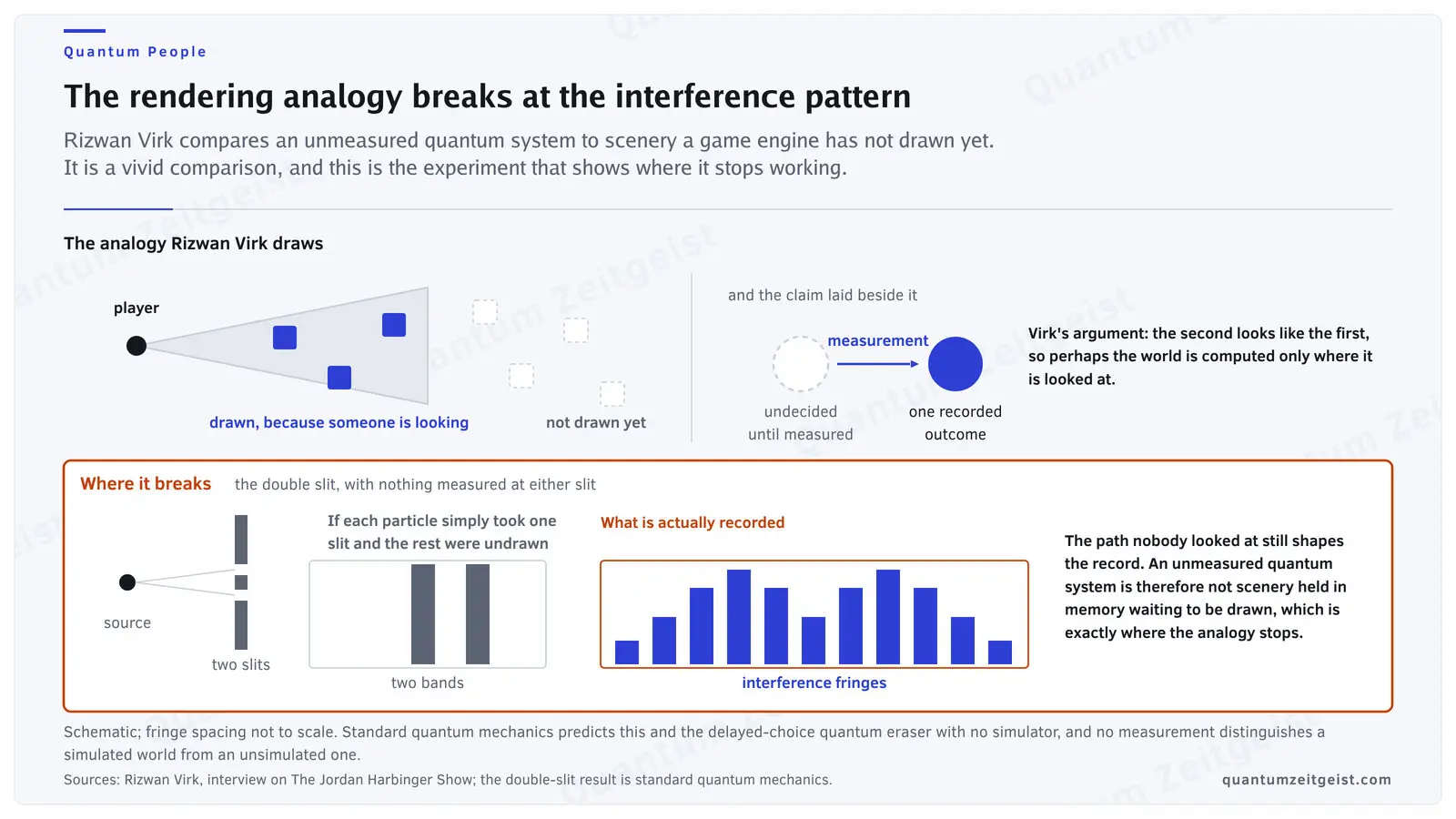
He compares the quantum world to a video game that renders only what a player is looking at. In a game the unseen scenery does not need to be fully computed until someone turns to face it, which saves enormous resources. He suggests that the way unmeasured quantum systems remain undecided until observed may echo this kind of on-demand rendering.
He often points to modern versions of the double-slit experiment and to the delayed-choice quantum eraser, where the act and timing of measurement appear to shape what is recorded. Those are offered as suggestive clues rather than as proof. Physicists, by contrast, explain the same experiments through standard quantum theory without invoking any simulation, and that disagreement matters.
The resource question is where quantum mechanics genuinely bites. Simulating a quantum system on a classical computer costs an amount of memory that doubles with every particle added. That is why classical machines cannot simulate more than a few dozen qubits, and why quantum computers are interesting at all.
A universe containing an enormous number of particles in superposition would therefore be impossibly expensive to simulate classically, by a margin no future technology addresses. The usual reply is that a simulator need only compute what is being observed and render the rest approximately, in the way a video game draws only what is in view. That reply moves the argument somewhere specific, because a simulation cutting corners where nobody looks would have to decide what counts as looking. That is uncomfortably close to the measurement problem that has troubled quantum mechanics for a century.
A writer assembling results rather than making them
The genuine value he provides is motivational and educational. Many readers first encounter the measurement problem and superposition through his books, and they come away curious enough to learn the real science. For a topic as forbidding as quantum mechanics, that on-ramp has real worth.
No experiment yet separates a simulated universe from a real one
The simulation hypothesis itself remains a philosophical conjecture with no experimental confirmation. Virk presents striking parallels, but a parallel is not evidence, and the quantum phenomena he cites are fully accounted for by mainstream physics without any simulator. His framing is best read as a thought experiment rather than a finding.
What decides whether Virk’s case belongs in physics or philosophy is whether any observation could tell a simulated universe from an unsimulated one. He does not offer such a test himself. The most cited suggestion from others looks for evidence that space is discrete rather than continuous, on the reasoning that a simulation would run on a grid and a grid leaves traces. One version predicted a signature in the highest-energy cosmic rays, and a search of data already in hand has found nothing.
The deeper problem is one Virk’s version shares with every other. A simulation sophisticated enough to run a universe is sophisticated enough to hide its grid, correct its own errors or adjust what an observer sees. Once a hypothesis can accommodate every possible observation it has stopped making predictions, and neither Virk nor anyone else has answered that objection.
The reason serious people discuss the idea at all is a philosophical argument published in 2003 by Nick Bostrom, and it is more careful than the popular version suggests. It does not claim we are in a simulation. It claims that at least one of three statements must be true, and invites you to say which.
The first is that civilisations almost always go extinct before they can run detailed ancestor simulations, meaning simulations of their own evolutionary history. The second is that civilisations which acquire the ability almost never use it. The third is that we are almost certainly living in one, since simulated observers would then vastly outnumber unsimulated ones. The argument also assumes consciousness can be produced by computation, which is contested.
The title of his best-known book carries the word hypothesis, and the argument inside it is presented as a question rather than a result. The responsible reading keeps the colourful analogies separate from the tested results of quantum theory, and enjoying the story does not require believing the conclusion.
Investing, games and doctoral work at ASU still feed the argument
Virk’s work outside writing still runs through investing and games. He has remained active as an investor in technology startups and has worked in and around the video game industry, the same world that supplies so many of his analogies.
He has also pursued academic work at Arizona State University. His ASU faculty page lists him as a faculty associate teaching at the Ira A. Fulton Schools of Engineering, and he has carried out doctoral research at the College of Global Futures. He has additionally been a visiting researcher at the Leverhulme Centre for the Future of Intelligence at the University of Cambridge. Teaching and doctoral research gave him a setting to develop these ideas with more structure than a popular book allows.
Talks and podcasts carry the argument past the science audience
Through talks, interviews, and podcasts, Virk has become one of the more visible public voices on the simulation question. That presence has amplified the reach of the quantum puzzles he discusses far beyond the usual science readership.
His role, in the end, is that of a bridge. He connects the laboratory results of physics, the engineering culture of games and software, and the age-old human question of whether reality is what it seems. Bridges of that kind are how difficult science reaches the general public.
A translator rather than a scientist
Rizwan Virk is a translator rather than a scientist, and he brings hard physics to a vast audience. Through his books and talks, ideas like superposition and measurement reach readers who would never open a textbook. That popularising function has real cultural value even though it produces no new physics.
His work also illustrates how quantum computing and quantum theory now shape the broader imagination, not just the laboratory. By tying quantum puzzles to questions about simulated worlds, Virk helps explain why so many people outside science find the field gripping. The interest he stirs can feed into genuine curiosity about real quantum technology.
He widens the door without rewriting the physics
He widens the door to quantum ideas without pretending to have rewritten the physics behind them. That is a narrower claim than his critics sometimes answer, and a fairer one.
An idea that cannot be tested can still sharpen questions that can be. Asking whether a universe could be computed forces a precise account of how much information a region of space can hold. That is a real question in physics, with answers involving black holes and thermodynamics. Asking what a simulator would have to render forces precision about what measurement is, the open problem at the centre of quantum foundations.
The pattern has precedent, and it is the strongest defence of what Virk is doing. Maxwell’s demon was a thought experiment about an impossible creature, and it produced the link between information and thermodynamics that underlies computing today. Einstein’s objections to quantum mechanics were meant to show it was incomplete and instead produced the analysis of entanglement that quantum cryptography now rests on.
For readers who arrive through his books, the natural next step is to learn the actual science of qubits, gates, and algorithms. Quantum computing is being built today in real laboratories, and its story stands on firmer ground than any simulation argument. Virk’s lasting service may simply be sending more curious minds towards the field itself.
Frequently asked questions
Who is Rizwan Virk?
What is The Simulation Hypothesis about?
Is Rizwan Virk a quantum physicist?
How does Virk connect quantum mechanics to simulation theory?
Is the simulation hypothesis established science?
What other books has Rizwan Virk written?
What is Play Labs @ MIT?
What is Rizwan Virk’s connection to Arizona State University?
Why does Rizwan Virk matter to the quantum field?




See today’s quantum computing news on Quantum Zeitgeist for the latest breakthroughs in qubits, hardware, algorithms, and industry deals.