
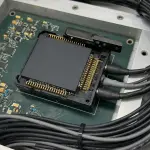
QuiX Quantum has installed its first Feed-Forward Control Unit (FFCU), a hardware component designed to rapidly interpret quantum measurements for its universal photonic quantum computer. Unlike many approaches, QuiX Quantum encodes and processes information using single photons moving through optical circuits, demanding exceptionally precise and swift control systems. The FFCU converts signals from single-photon detectors into control actions, a critical step toward achieving universality in measurement-based quantum computing where each measurement outcome dictates subsequent operations. “Universal photonic quantum computing requires more than high-quality photonic chips; it requires a complete system stack that can generate, route, measure and control photons in real time,” said Stefan Hengesbach, CEO of QuiX Quantum. This installation signifies progress toward a system capable of supporting a wider range of scientific and commercial applications.
Feed-Forward Control Unit Enables Real-Time Photonic Quantum Computing
The pursuit of practical quantum computation took a significant step forward with the installation of QuiX Quantum’s Feed-Forward Control Unit (FFCU). This hardware component addresses a critical bottleneck in building a universal photonic quantum computer. This approach necessitates a system capable of not only generating and routing photons, but also responding to measurement outcomes in real time, a capability the FFCU is designed to deliver. In this paradigm, the result of each measurement dictates the subsequent operations, requiring a system that can detect, decide and reconfigure the optical path in real time, according to Andrew Roos, vice president of R&D for QuiX Quantum.
The installed unit achieves a reported latency of approximately 150 nanoseconds between detecting a photon and settling the output voltage, a timeframe dictated by the speed of light itself. Roos explained that “to put that timing in perspective, in 150 nanoseconds light travels only about 30 meters in telecom fibre.” This speed is not merely an improvement, but a necessity for operating at the physical limits of information transfer. This installation signifies progress beyond simply creating high-quality photonic chips; QuiX Quantum is focused on building a complete system encompassing photon generation, multiplexing, and control. The company’s ambition is to create adaptive, programmable platforms, and the FFCU represents a critical component in realizing that goal as the broader quantum computing market gains commercial traction, with estimates suggesting a potential $2.7 trillion in economic value.
QuiX Quantum’s System Stack Integrates Photonic Components & Control
This emphasis on speed stems from the nature of measurement-based quantum computing, a universality target for the company, where each measurement’s outcome dictates subsequent operations, requiring immediate adjustments to the photonic pathways. This is the window in which the system has to make a decision and adapt the photonic circuit. This isn’t merely an improvement in control electronics; it represents operation near the physical limits of information transfer. The company anticipates this integrated approach will support adaptive, programmable photonic quantum operations, moving beyond theoretical potential toward scalable, reliable quantum systems capable of delivering on the projected $2.7 trillion in economic value quantum computing could generate worldwide.
Universal photonic quantum computing requires more than high-quality photonic chips. It requires a complete system stack that can generate, route, measure and control photons in real time.
Stefan Hengesbach, CEO of QuiX Quantum


See today’s quantum computing news on Quantum Zeitgeist for the latest breakthroughs in qubits, hardware, algorithms, and industry deals.