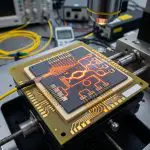
Connecticut is among twelve regions nationally selected to receive a highly competitive National Science Foundation Regional Innovation Engines award, positioning the state as a key player in the growing field of quantum technology. The University of Connecticut leads the QuantumCT Engine, a public-private initiative forged in partnership with Yale University, Southern Connecticut State University, ConnCORP, and CT Innovations, and will initially receive $15 million from the NSF, with the potential to grow to $160 million over the next decade if progress is made. This funding will support technology translation, workforce development, and incubator operations aimed at commercializing quantum technologies for sectors including national defense, biotechnology, and financial services. “With this award, NSF has recognized the scale of QuantumCT’s ambition and its potential to accelerate quantum technology for our state, region, and the United States,” said Yale University President Maurie McInnis.
NSF Engines Award Fuels Connecticut Quantum Technology
This funding is designed to accelerate the translation of quantum research into practical applications, cultivate a skilled workforce, and establish a robust quantum ecosystem within the state. These benefits are projected to include economic opportunities, specialized training programs, and the advancement of innovative technologies that bolster national competitiveness, security, and economic growth. The collaborative structure of QuantumCT is particularly noteworthy, uniting diverse institutions and organizations to pursue a unified vision for quantum innovation. Michael Crair, Yale’s vice provost for research, emphasized that “The award recognizes QuantumCT’s years of collaboration between institutes of higher education, industry, government, and community partners.” QuantumCT is the only initiative focused specifically on quantum technology, a sector projected to reach a $200 billion valuation by 2040 and reshape critical industries like aerospace, defense, biotechnology, manufacturing, and finance.
Connecticut already boasts a significant base of companies adopting quantum technologies, supporting over 270,000 jobs, representing 38% of the state’s total wages, and contributing over $28.7 billion to the national GDP. This existing foundation, coupled with sustained investments from UConn and Yale, positions the state as a leader in quantum technology adoption, according to Pamir Alpay, UConn’s provost and principal investigator on the NSF-funded proposal. “Connecticut is positioned to lead in quantum technology due to our deep pool of researchers, our entrepreneurial spirit, and the tight collaboration across the public, private, and non-profit organizations in the state,” added Josh Geballe, senior associate provost for entrepreneurship and innovation and managing director of Yale Ventures.
The initiative builds upon a $1 million NSF Engines Development Award received in 2023, which established the operational framework and partnerships driving the ecosystem, and will be based in New Haven, leveraging the city’s growing quantum workforce and tradition of innovation. Quantum Circuits plans to double its workforce in New Haven.
Connecticut is positioned to lead in the quantum era due to our deep pool of brilliant researchers, our entrepreneurial spirit, and the tight collaboration across the public, private, and non-profit organizations in the state.
Josh Geballe, senior associate provost for entrepreneurship and innovation and managing director of Yale Ventures
QuantumCT Partnership: UConn, Yale, and State Collaboration
Connecticut has rapidly emerged as a focal point for quantum technology development, distinguished by a convergence of academic prowess, private investment, and state-level support; this momentum is now poised for significant acceleration through the newly awarded NSF Regional Innovation Engines grant. Initial investment totals $15 million, but the potential for growth is substantial, with QuantumCT potentially receiving $160 million from the NSF over the next decade based on demonstrated progress. This collaborative structure extends into the economic sphere, leveraging existing strengths within the state. The initiative intends to focus on advancing quantum sensing, secured communications, computing, and materials, utilizing a shared testbed and deep-tech incubator to transform research insights into practical applications for national defense, biotechnology, and financial services.
The partnership between UConn and Yale is particularly noteworthy, combining the strengths of both institutions to foster a robust quantum ecosystem. Yale’s contributions include startups like Quantum Circuits, recently acquired by D-Wave and planning to double its New Haven workforce, demonstrating the university’s work in quantum computing, work that earned Robert Schoelkopf the 2025 Nobel Prize in Physics. The ERASE project, a Yale-led initiative, will complement QuantumCT’s efforts by providing a resource to facilitate research and innovation.
With this transformative award, NSF has recognized the scale of QuantumCT’s ambition and its potential to accelerate the quantum revolution for our state, region, and the United States as a whole.
Maurie McInnis, Yale University President
This funding model incentivizes sustained innovation and tangible outcomes within the state’s growing quantum ecosystem. The scale of the potential investment positions Connecticut uniquely within the national landscape of quantum technology development. Unlike many states focusing on isolated research efforts, QuantumCT represents a holistic approach, integrating research translation, workforce development, and incubator operations. Connecticut companies already contribute significantly to the national economy, supporting over 270,000 jobs and generating $28.7 billion in GDP, and QuantumCT aims to amplify this impact. The NSF’s decision to award QuantumCT this funding underscores the state’s existing strengths and potential for future growth. QuantumCT is the only one among the newly awarded NSF Engines focused specifically on advancing quantum technology.
Southern Connecticut State University is more than ready to take the lead on workforce development in Connecticut’s quantum ecosystem.
Sandra Bulmer, interim president of the university
Quantum Technology Applications in Defense, Finance, Biotech
Quantum technologies, poised to reshape industries from aerospace to pharmaceuticals, are now receiving focused investment to accelerate their translation into practical applications, particularly within defense, finance, and biotechnology. This concentrated funding model is designed to drive economic impact through targeted research and workforce development. These efforts directly address national security concerns, with applications in advanced encryption and secure data transmission vital for defense systems. Beyond defense, the financial sector stands to benefit from quantum computing’s potential to optimize complex algorithms for portfolio management, risk assessment, and fraud detection, where even marginal improvements can yield substantial gains. Biotechnology represents another significant area of impact, with quantum simulations promising to accelerate drug discovery and materials science. The ability to model molecular interactions with unprecedented accuracy could dramatically reduce the time and cost associated with developing new pharmaceuticals and therapies.
Connecticut companies currently employing quantum technologies are already responsible for millions of jobs and over $28.7 billion in GDP nationwide, demonstrating the existing economic foundation upon which QuantumCT will build. This is not merely a research initiative; it’s a concerted effort to generate technology ventures and train a skilled workforce capable of driving innovation in this rapidly evolving field. The success of QuantumCT, and the realization of its potential $160 million investment, will depend on its ability to translate fundamental research into tangible economic and societal benefits, solidifying Connecticut’s role in the quantum revolution.
Yale faculty have long been pioneers in quantum research, advancing application areas from computing to communication and even navigation.
Jeffrey Brock, dean of the Yale School of Engineering & Applied Science
ERASE Project & NQVL Advance Quantum Computing Hardware
Beyond the potential $160 million investment, Connecticut’s QuantumCT Engine is fostering specific advancements in quantum computing hardware through projects like ERASE, Erasure Qubits and Dynamic Circuits for Quantum Advantage, and leveraging the resources of the National Quantum Virtual Laboratory (NQVL). While much attention focuses on the overall economic impact, these initiatives represent concrete steps toward overcoming fundamental challenges in building practical quantum computers. The ERASE project received a $4 million NSF grant, specifically to develop a foundational blueprint for hardware and software supporting its novel approach to quantum computation. This isn’t simply about scaling up existing qubit technologies; ERASE aims to fundamentally alter how quantum information is stored and manipulated. The project draws heavily on the capabilities of NQVL, a national resource designed to broaden access to quantum research tools and expertise.
Michael Hatridge, a co-principal investigator for ERASE and an associate professor of applied physics at Yale Engineering, explains that “the complementary strengths of NQVL, ERASE, and QuantumCT create exciting opportunities to expand access to quantum research, education, and innovation while fostering collaboration across institutions and sectors.” This synergy is crucial, as ERASE’s hardware development can benefit from QuantumCT’s planned infrastructure for convening and collaboration, while NQVL provides a wider network for testing and validation. The focus on erasure qubits, a relatively new approach to quantum information storage, is driven by the need to improve qubit stability and reduce error rates, persistent obstacles in the field.
Steven Girvin, the Sterling Professor of Physics in Yale’s Faculty of Arts and Sciences, emphasizes that this investment will “help Connecticut expand its economic strengths in key industry sectors including defense, finance, insurance, and pharmaceutical/biomedicine as we transition into the quantum technology era of the 21st century.” Alongside hardware development, ERASE is also tackling the complex software challenges associated with controlling and interpreting data from these advanced qubits.
Connecticut is widely recognized as a leader in the intellectual development of quantum science and engineering.
Robert Schoelkopf, the Sterling Professor of Applied Physics at Yale Engineering




See today’s quantum computing news on Quantum Zeitgeist for the latest breakthroughs in qubits, hardware, algorithms, and industry deals.