Researchers at the U.S. Department of Energy’s Brookhaven National Laboratory and Stony Brook University successfully transmitted quantum information via light between their institutions, marking the first such demonstration in the United States. The team used facilities at Stony Brook to generate quantum states of light containing a few photons, sending them 13 miles through open air to Brookhaven’s Quantum Lighthouse.
This achievement extends a quantum network currently spanning 161 miles and connecting eight nodes, and moves beyond the limitations of fiber-optic cables, as DOE Under Secretary for Science Darío Gil stated, “The future of quantum information science will depend not only on what individual quantum computers and devices can do but on our ability to connect them.”
Free-Space Optical Link Bridges Stony Brook and Brookhaven
A laser beam carrying quantum information traveled 13 miles through open air, successfully bridging Stony Brook University and Brookhaven National Laboratory. This transmission, accomplished without fiber-optic cables, extends an existing quantum network spanning 161 miles and connecting eight nodes across multiple institutions, and introduces a wireless capability. Justine Haupt, Brookhaven Lab’s lead scientist on the project, explained that technologies used to collect and control light from distant stars were essential for maintaining the integrity of the quantum signals over the 21-kilometer distance.
Both institutions constructed specialized rooftop facilities, integrating optics, controls, communications, quantum sources, and detectors to function as a single experiment. Haupt emphasized, “We needed to integrate the optics, controls, communications, quantum sources, and detectors so equipment 21 kilometers apart could operate as one experiment. Bringing all those pieces together—and then adding the quantum layer—is what makes this capability unique.” The successful daytime demonstration involved transmitting photons through an optical fiber about 5 microns in diameter, less than one-tenth the width of a human hair, before their journey across Long Island.
Beyond the initial transmission of single photons, the team progressed to sending entangled photons during nighttime tests, achieving sustained wireless exchange of quantum information. Entangled photons, intrinsically linked by quantum mechanics, allow for instantaneous correlation even across vast distances, a property crucial for future applications in secure communication, advanced sensing, and networked quantum computing.
Eden Figueroa, director of Stony Brook’s Quantum Institute, noted that this FSO link will enable the use of infrared wavelengths native to quantum processors, offering a direct route to create entangled atomic systems across long distances. “In our long-distance fiber network, we routinely transmit entangled pairs of photons.
Gil said, “This free-space link is a key milestone, but it is also part of a much larger roadmap leading to distributed quantum systems. We will continue advancing the network’s capabilities so that researchers can connect increasingly sophisticated quantum systems together to address a range of problems, from computation to communication to sensing, in ways that just aren’t possible today.”
People think of telescopes as tools for looking up into space, but the same technologies that allow astronomers to precisely collect and control light are essential for these quantum experiments.
Justine Haupt, Brookhaven Lab’s lead scientist on the cross-institutional FSO link project
Quantum Watchtower & Lighthouse Enable Photon Transmission
The transmission relied on a free-space optical link, bypassing the limitations of wired connections and opening possibilities for a more versatile quantum internet. These photons, exiting a fiber about 5 microns in diameter, traveled 13 miles to Brookhaven’s Quantum Lighthouse, a purpose-built structure providing a clear line of sight between the two institutions. The precision of this link was highlighted during the daytime demonstration, where researchers transmitted photons between optical fibers measuring fractions of a millimeter in diameter.
Entangled Photons Demonstrate “Wireless” Quantum Exchange
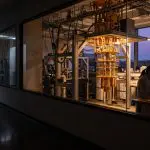
The demonstration involved generating quantum states of light containing a few photons within Stony Brook University’s Quantum Watchtower. Establishing this wireless component necessitated more than quantum physics expertise; it required a complex integration of multiple technologies. These entangled photons, originating from a Stony Brook physics laboratory, were distributed via fiber to the Quantum Watchtower, then transmitted across the new free-space link, and ultimately received and measured at the Quantum Lighthouse.
Infrared Wavelengths Expand Quantum Network Capabilities
This achievement builds upon an existing network already connecting eight nodes, demonstrating a crucial step toward a more versatile and interconnected quantum infrastructure. This expansion isn’t simply about increasing the network’s reach; it’s about broadening the types of quantum devices that can connect. The shift to infrared wavelengths circumvents limitations imposed by standard telecommunications fibers, opening pathways for seamless integration with a wider range of quantum hardware.
Establishing this wireless capability required a convergence of expertise beyond quantum physics, demanding precision in optics, controls, and communications systems. The delicate nature of quantum information necessitated an unprecedented level of atmospheric stability and precision in light collection and transmission.
In our long-distance fiber network, we routinely transmit entangled pairs of photons. However, such fiber networks are limited to the use of telecom wavelengths. In our new quantum wireless links, we are exploring the use of infrared wavelengths that are native to quantum processors and related technologies.
Eden Figueroa, director of Stony Brook’s Quantum Institute, endowed presidential professor of physics in the Department of Physics and Astronomy in the College of Arts and Sciences, and a joint appointee at Brookhaven Lab
Extending our quantum communication network to include a wireless link is a major leap forward in our development of the Quantum Internet of Things.
Andrea Goldsmith, State University of New York at Stony Brook President
The future of quantum information science will depend not only on what individual quantum computers and devices can do but on our ability to connect them.
Darío Gil, DOE Under Secretary for Science



See today’s quantum computing news on Quantum Zeitgeist for the latest breakthroughs in qubits, hardware, algorithms, and industry deals.