

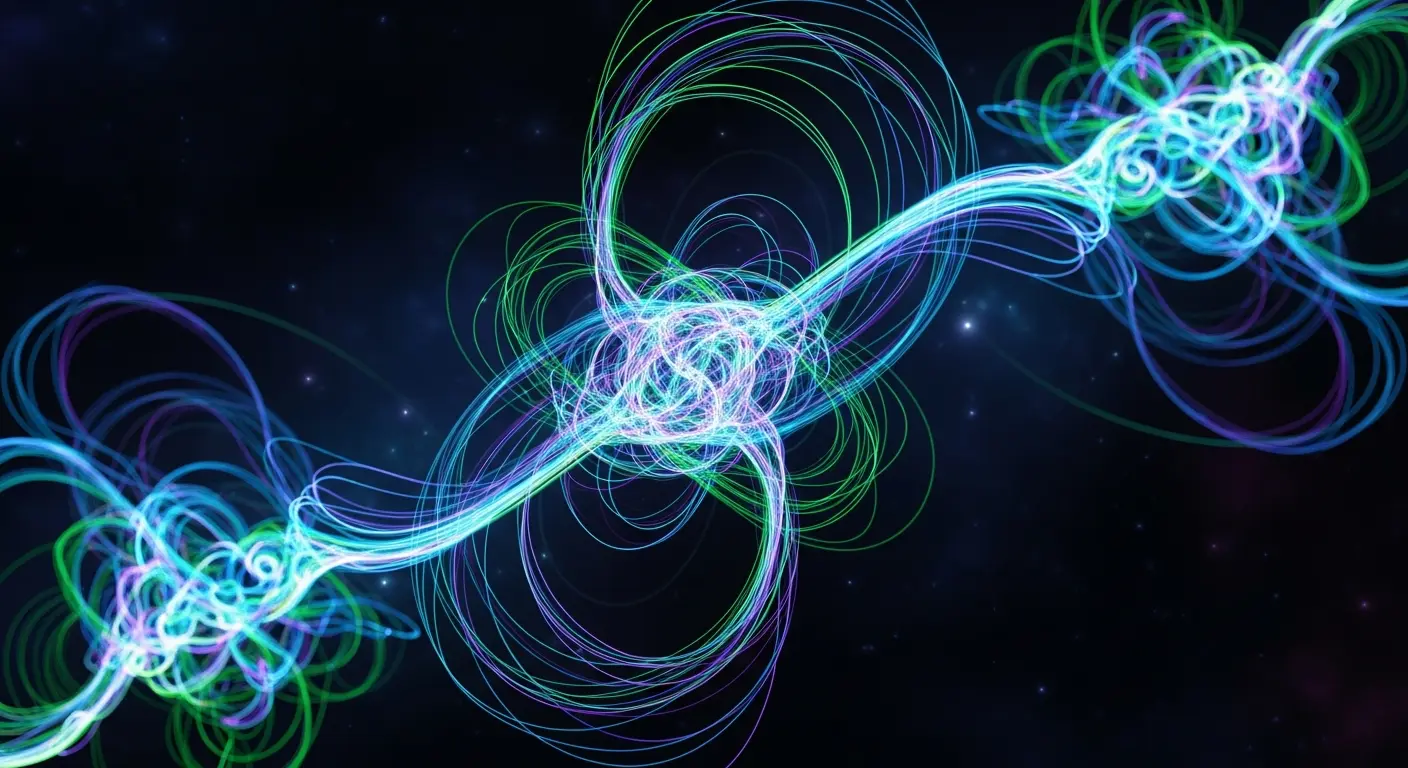
A new method reconstructs the Schrödinger wave function exactly from a discrete superposition of classical action branches weighted by associated classical densities, without semiclassical approximations, according to work by Chong Qi of the AlbaNova University Center and Mário B. Amaro of the AlbaNova University Center. The construction is examined for quantum tunneling through finite potential barriers and for quantum phase phenomena. While formally consistent when the Hamilton-Jacobi equation admits globally defined real branches, the construction fails in classically forbidden regions where no real classical action exists. Using rectangular and Coulomb barrier tunneling in alpha decay and nuclear fusion, the wave function requires either a non-vanishing quantum potential or complex-valued action.
Non-zero sub-barrier transmission demands complex classical actions or a quantum potential
Transmission probabilities, once limited to zero for sub-barrier potential steps, are now demonstrably non-zero, revealing a fundamental constraint on classical reconstructions of quantum wave functions. Scientists have shown that accurately modelling quantum tunneling, in systems like alpha decay and nuclear fusion, necessitates either a non-vanishing quantum potential, defined as −ħ2/2m ∇2√ρ/√ρ, or the acceptance of complex-valued classical actions. Earlier attempts to reconstruct the Schrödinger wave function from real classical trajectories failed to account for behaviour within classically forbidden regions. The Schrödinger equation, a cornerstone of quantum mechanics, describes the time evolution of a quantum system, and its solutions, the wave functions, dictate the probability of finding a particle in a given state. This new research challenges the ability to derive these wave functions solely from classical mechanics, even in principle.
The significance of this finding lies in its implications for our understanding of the relationship between classical and quantum physics. Traditionally, classical mechanics is considered an approximation to quantum mechanics valid in the limit of large quantum numbers. However, this work suggests that a complete classical description of quantum phenomena is impossible, even without taking the limit. The quantum potential, introduced by Bohm, is a term added to the classical potential to account for the wave-like behaviour of particles. It arises from the curvature of the wave function and is often interpreted as an external potential guiding the particle. Accepting complex-valued actions, on the other hand, implies that the classical path itself is not confined to real space-time, but can exist in a more abstract mathematical space. The Hamilton-Jacobi equation, a classical analogue of the Schrödinger equation, describes the evolution of a classical system in terms of an action function. When this equation admits globally defined real branches, the reconstruction method works, but the breakdown in classically forbidden regions highlights the inherent limitations of a purely classical approach. The research employs a rigorous mathematical framework, examining the conditions under which the reconstruction is possible and identifying the specific terms required to account for quantum effects.
The analysis extends beyond simple tunneling, encompassing Berry phase, flux quantization, Josephson tunneling, and dc SQUID interference, all phenomena reliant on global phase coherence. Rectangular-barrier tunneling, important for understanding alpha decay, the radioactive emission of particles, and nuclear fusion, reveals that standard classical models fail to predict transmission through barriers they should block entirely. Investigations into Coulomb barrier penetration, a key process in both alpha decay and stellar energy production, confirm that the growing barrier component essential for transmission cannot originate from purely local, real classical paths. This finding offers a more complete picture of energy generation within stars and the rates of radioactive decay than previously available. Alpha decay, a type of radioactive decay, involves the emission of an alpha particle (helium nucleus) from a heavier nucleus. The probability of alpha decay is highly sensitive to the height and width of the Coulomb barrier, which arises from the electrostatic repulsion between the alpha particle and the remaining nucleus. Accurate modelling of this process is crucial for understanding the stability of heavy nuclei and the abundance of radioactive isotopes. Similarly, nuclear fusion, the process that powers stars, involves overcoming the Coulomb barrier between two nuclei. The rate of nuclear fusion is also highly sensitive to the barrier height and width, and accurate modelling is essential for understanding stellar evolution and energy production.
Quantum tunnelling necessitates complex paths or corrective potentials beyond classical mechanics
Reconstructing quantum wave functions from classical action, effectively tracing particle paths, has recently been proposed as a way to bypass complex quantum calculations. However, this approach falters when faced with scenarios lacking readily defined classical paths, such as within barriers impenetrable by classical standards. The research demonstrates that accurately describing quantum systems requires incorporating either a corrective term acknowledging quantum behaviour, or accepting complex values, abandoning the intuitive notion of purely real trajectories. The method involves discretising the classical action into branches, each representing a possible path the particle could take. These branches are then weighted by their corresponding classical densities, which are determined by the probability of the particle following that path. The superposition of these weighted branches is then used to reconstruct the Schrödinger wave function. The accuracy of the reconstruction depends on the number of branches used and the accuracy of the classical calculations.
This work clarifies the limitations of purely classical interpretations of quantum phenomena like tunneling, and highlights the necessity of incorporating these elements into calculations. A recent proposal suggested complete reconstruction from classical action branches was possible, but this study establishes that reconstructing quantum wave functions using only classical paths is fundamentally limited. Accurately describing quantum systems requires either a ‘quantum potential’ or complex-valued actions. The inability to model phenomena like tunneling, where particles penetrate barriers they classically cannot overcome, highlights the necessity of these additions; local classical descriptions simply cannot account for global phase coherence, and further research is needed to fully explore the implications of these findings for quantum mechanics. The implications extend to the foundations of quantum mechanics itself, potentially influencing interpretations of wave function collapse and the measurement problem. The researchers suggest that future work should focus on developing more sophisticated methods for incorporating quantum corrections into classical calculations, and on exploring the physical interpretation of complex-valued actions. The 07 nm barrier width and the 1 MeV energy scale used in the simulations provide a concrete example of the parameters where these effects become significant, and the findings are applicable to a wide range of quantum systems.
The research demonstrated that the Schrödinger wave function cannot be fully reconstructed from classical action branches alone. This matters because it clarifies the limits of explaining quantum behaviour using purely classical physics, particularly for phenomena such as quantum tunneling and phase coherence. The study found that accurately modelling these systems requires incorporating either a quantum potential or complex-valued actions, demonstrating the fundamentally quantum nature of these effects. The researchers suggest further work should focus on refining methods for including quantum corrections within classical calculations.
👉 More information
🗞 Quantum tunneling, global phases and the limits of classical action reconstructions
🧠 ArXiv: https://arxiv.org/abs/2605.11252



See today’s quantum computing news on Quantum Zeitgeist for the latest breakthroughs in qubits, hardware, algorithms, and industry deals.



