

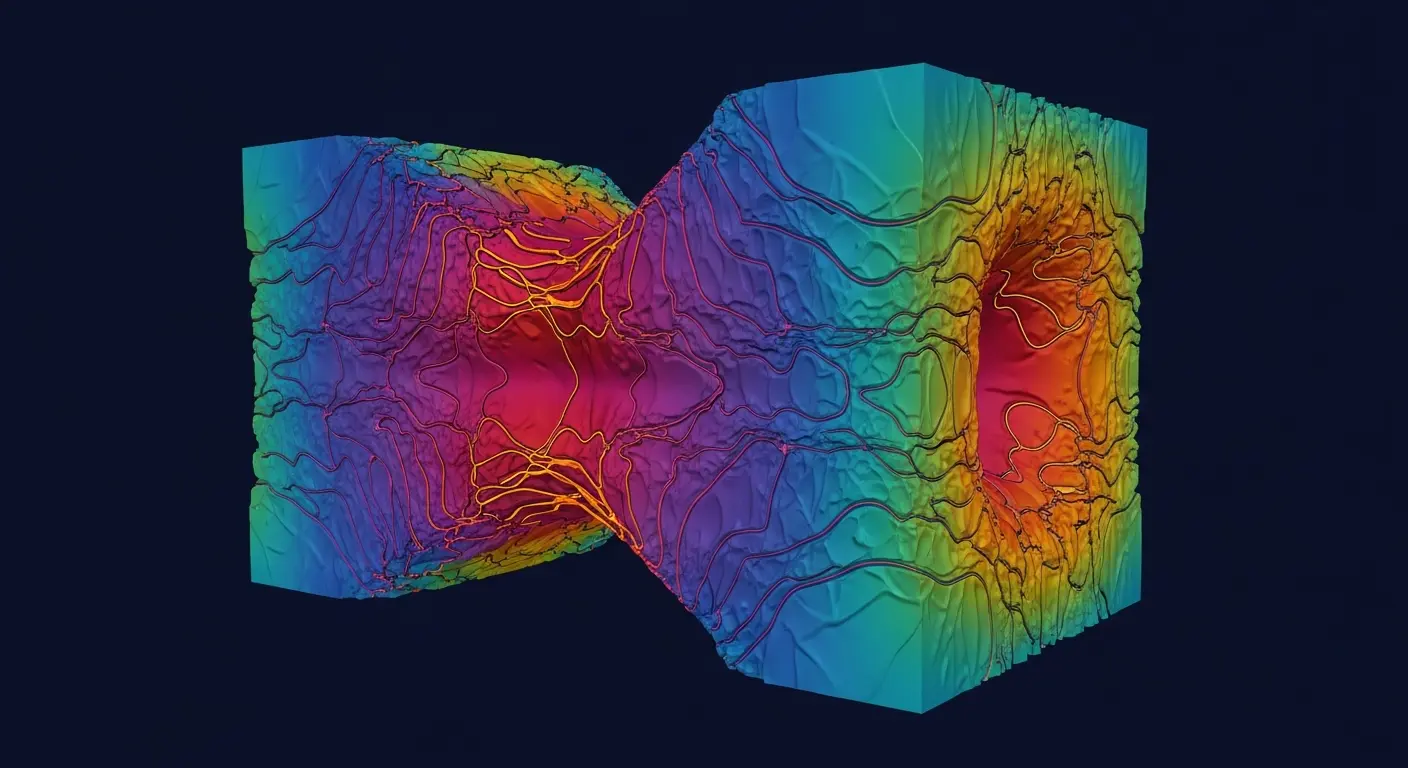
Xhek Turkeshi, and colleagues from University of Cologne detail a method using replica tensor networks to investigate random quantum circuits and understand their complex behaviour. The tutorial explains how the method reformulates calculations on multiple copies of a quantum system into a classical tensor network, transforming the problem into a statistical-mechanics model. This framework enables flexible analysis, adapting to different observables, initial states, and circuit ensembles, including unitary, orthogonal, and Clifford circuits. The work provides a key theoretical advance and a practical set of tools, the ReplicaTN library, for exploring quantum-information diagnostics such as wavefunction spread and entanglement.
Mapping quantum circuit complexity using replicated tensor networks
Replica tensor-network techniques represent complex quantum calculations as a network of interconnected nodes, similar to how diagrams of logic gates depict a computer circuit. This approach tackles random quantum circuits by creating multiple copies of the quantum system, known as ‘replicas’, and linking them together via tensors; these tensors mathematically describe information flow between the replicas during the quantum circuit’s operation. The core principle relies on the mathematical equivalence between calculating the average of observables over many identical quantum systems (replicas) and evaluating a partition function in a classical statistical mechanics model. This is achieved by exploiting the commutant of the gate ensemble, effectively mapping the quantum problem onto a classical one. Specifically, the replica approach allows one to compute circuit-averaged observables by contracting a tensor network, a process involving summing over all possible connections within the network. This contraction is analogous to calculating total electrical resistance in a circuit by combining individual component resistances, but operates on multidimensional tensors representing quantum amplitudes. The number of replicas used directly impacts the computational cost and accuracy of the simulation; typically, a few replicas, such as 2 or 4, are employed to balance these factors. Understanding the behaviour of these random circuits is crucial for benchmarking quantum computers and developing robust quantum algorithms, as they provide a challenging testbed for assessing performance and identifying potential errors.
Replica tensor networks enable scalable simulation of quantum circuits exceeding sixty gates
Using replica tensor networks and the ReplicaTN 0.1 library, simulations extended from approximately ten gates to over sixty gates, representing a six-fold increase in tractable circuit depth. This leap resulted from recasting the problem of analysing quantum circuits as a classical statistical mechanics model, circumventing limitations previously imposed by exponential growth in computational complexity. Traditional methods for simulating quantum circuits suffer from an exponential increase in computational resources required with increasing circuit depth, due to the need to store and manipulate the exponentially growing state vector. Replica tensor networks mitigate this by representing the quantum state as a network of tensors, allowing for efficient contraction and reducing the memory footprint. The framework efficiently calculates quantum information diagnostics, including wavefunction spread and entanglement, across diverse circuit types such as unitary, orthogonal, and Clifford circuits; adjustments to observables or ensembles are achieved by modifying boundary conditions or bulk tensors within the tensor network. Wavefunction spread, a measure of how much the quantum state delocalises during the circuit’s evolution, provides insights into the circuit’s scrambling capabilities. Entanglement, a key resource for quantum computation, is quantified to assess the circuit’s ability to create and maintain quantum correlations.
Circuits with a depth of ten gates were successfully simulated with this framework, a considerable improvement over prior limitations of approximately six gates. The method’s flexibility stems from its ability to modify boundary conditions to represent different initial states or observables, and adjust bulk tensors to reflect varied quantum gate ensembles. For instance, changing the initial state can be achieved by altering the tensors at the input layer of the network, while different observables are incorporated by modifying the tensors at the output layer. The ReplicaTN 0.1 library, a combined C++ and Python tool, provides a practical implementation of these techniques, enabling calculations of wavefunction spread and entanglement, and also serves as an educational resource. The C++ backend provides performance critical tensor operations, while the Python interface allows for easy scripting and data analysis. Recasting quantum circuit analysis as a classical statistical mechanics model enables efficient computation via tensor network contraction, analogous to evolving a matrix product state. Matrix product states (MPS) are another tensor network technique commonly used in condensed matter physics, and the analogy highlights the broader applicability of tensor networks to problems involving many-body quantum systems. The ability to simulate circuits with up to sixty gates opens up new avenues for exploring the dynamics of complex quantum systems and testing the limits of quantum computation.
Replica tensor-networks and limitations with orthogonal and Clifford quantum circuits
Computational techniques are increasingly used to model complex quantum systems, but fully capturing their behaviour remains a formidable challenge. This method offers a promising route to analyse these circuits by translating quantum calculations into classical statistical mechanics; however, the research acknowledges limited exploration of its application to orthogonal and Clifford circuits, suggesting potential restrictions. Orthogonal and Clifford circuits possess specific properties that may introduce challenges for the replica tensor network approach. For example, Clifford circuits have a limited ability to create entanglement, which could affect the efficiency of the tensor network contraction. Furthermore, the commutant structure, which is crucial for mapping the quantum problem to a classical one, may be less well-defined or more complex for these specific circuit types. Sensibly, acknowledging these limitations is important given the novelty of applying replica tensor-networks to this field. Future work will need to investigate these circuits in more detail to determine the extent of these limitations and potentially develop modifications to the method to address them.
The accompanying open-source software library, ReplicaTN, further accelerates adoption and experimentation, enabling wider testing across diverse quantum circuit designs. A new, accessible method for simulating random quantum circuits using replica tensor networks is now available. Representing multiple copies of a quantum system and their interactions as a network of interconnected tensors bypasses computational bottlenecks previously limiting circuit depth. This enables further investigation into the behaviour of complex quantum systems and the development of more efficient quantum algorithms. The availability of the ReplicaTN library, coupled with the detailed tutorial, is expected to foster a broader understanding and application of replica tensor networks within the quantum information science community, facilitating further research and innovation in this rapidly evolving field.
A new method for simulating random quantum circuits using replica tensor networks has been demonstrated. By representing multiple copies of a quantum system as a classical tensor network, researchers overcame computational limitations previously hindering the analysis of deeper circuits. This approach allows for the investigation of wavefunction behaviour and entanglement using both clean and noisy unitary circuits, and the accompanying open-source software library, ReplicaTN, facilitates wider experimentation. The authors note that future work will focus on extending the methodology to orthogonal and Clifford circuits to fully characterise its limitations.
👉 More information
🗞 Lecture Notes on Replica Tensor Networks for Random Quantum Circuits
🧠 ArXiv: https://arxiv.org/abs/2605.11150




See today’s quantum computing news on Quantum Zeitgeist for the latest breakthroughs in qubits, hardware, algorithms, and industry deals.



