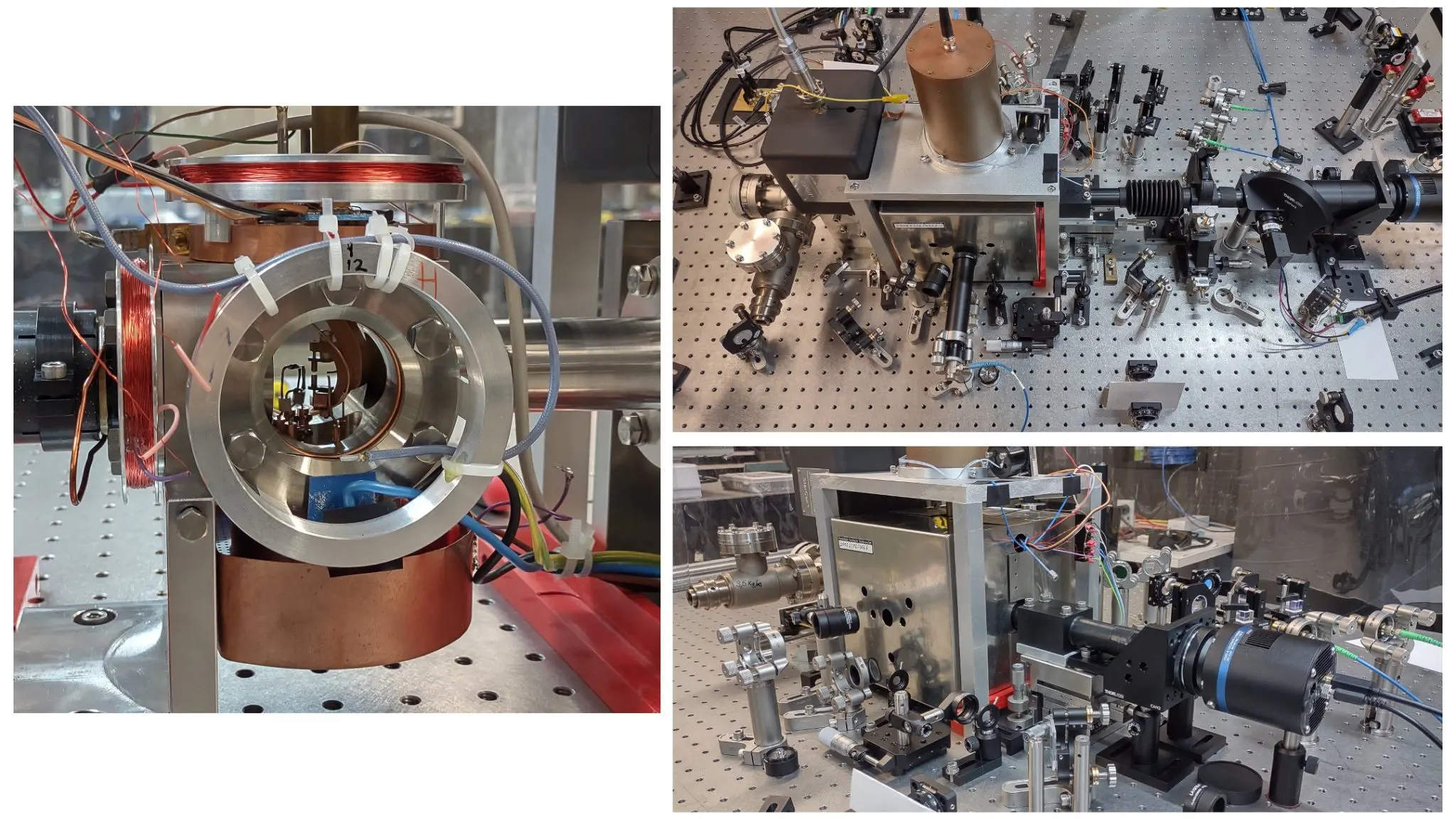
Researchers from Kyushu University, working with five other institutions including the Stevens Institute of Technology and the National Institute of Standards and Technology, have established a theoretical framework demonstrating that existing trapped-ion atomic clocks can be used to observe “quantum superposition of times.” This builds on Einstein’s theory of relativity, where time’s flow is relative, and extends it to the quantum level, where a clock’s motion can exist in multiple states simultaneously, a phenomenon never before experimentally confirmed. The precision of these atomic clocks is now so refined they can detect time dilation resulting from a height difference of just a few millimeters. “It’s the precision that led us to develop our theoretical model,” explains Associate Professor Joshua Foo of Kyushu University’s Institute for Advanced Studies. This work opens a new experimental frontier in fundamental physics and allows for the development of even more precise timekeeping technologies.
Trapped-Ion Atomic Clocks Reveal Quantum Time Superposition
Researchers are extending the capabilities of these devices into the quantum realm, proposing a method to observe a phenomenon previously confined to theoretical physics: the superposition of time itself. This challenges our classical understanding of time as a linear progression and explores the complex interplay between quantum mechanics and relativity. The signature of this effect is that the clock itself loses some of its quantum properties, which can be detected using modern techniques. The team’s innovation lies in a new technique for controlling the atomic clock’s motion, which they claim improves sensitivity to this effect by a factor of 100. This research establishes trapped-ion atomic clocks not merely as timekeeping devices, but as platforms for exploring fundamental physics, potentially opening avenues for more precise clocks. The experimental setup involves trapping ions and using laser apparatus to measure the clock’s frequency, a process refined to detect minute changes indicative of quantum superposition. While the theoretical groundwork is now established, Foo acknowledges the challenges ahead, stating, “Naturally, bringing our theoretical model to reality is the big next step, and developing a detailed experiment that accounts for real-world unpredictability will give us further insight into our model.” The team also hopes to investigate whether these clocks could eventually be used to probe the quantum nature of gravity, another enduring mystery in physics.
Entanglement Technique Enhances Clock Sensitivity by 100x
Current atomic clocks, already capable of discerning time dilation over mere millimeters in elevation, are undergoing a refinement that promises to unlock observation of quantum phenomena previously confined to theory. Researchers are now leveraging entanglement, a quantum link between particles, to dramatically enhance the sensitivity of these timekeeping devices, pushing the boundaries of precision measurement. This isn’t simply about building a more accurate clock; it’s about creating a tool to probe the fundamental nature of time itself, bridging the gap between Einstein’s relativity and the perplexing world of quantum mechanics. The research reveals that the clock’s motion becomes entangled with its internal energy, a connection that manifests as a detectable loss of quantum properties within the clock itself. This entanglement isn’t merely a technical hurdle, but the very signature researchers are seeking, a confirmation that the clock is experiencing a superposition of temporal states. This development transforms atomic clocks from precise timekeepers into potential platforms for exploring quantum physics, opening avenues for investigating the elusive quantum realm of gravity.
It’s the precision that led us to develop our theoretical model. We found that the atomic clock’s motion becomes “entangled” with its internal energy. The signature of this entanglement is that the clock itself loses some of its quantum properties, which can be detected using modern techniques,” explains Associate Professor Joshua Foo of Kyushu University’s Institute for Advanced Studies and one of the lead authors of the paper.
Associate Professor Joshua Foo of Kyushu University’s Institute for Advanced Studies



See today’s quantum computing news on Quantum Zeitgeist for the latest breakthroughs in qubits, hardware, algorithms, and industry deals.