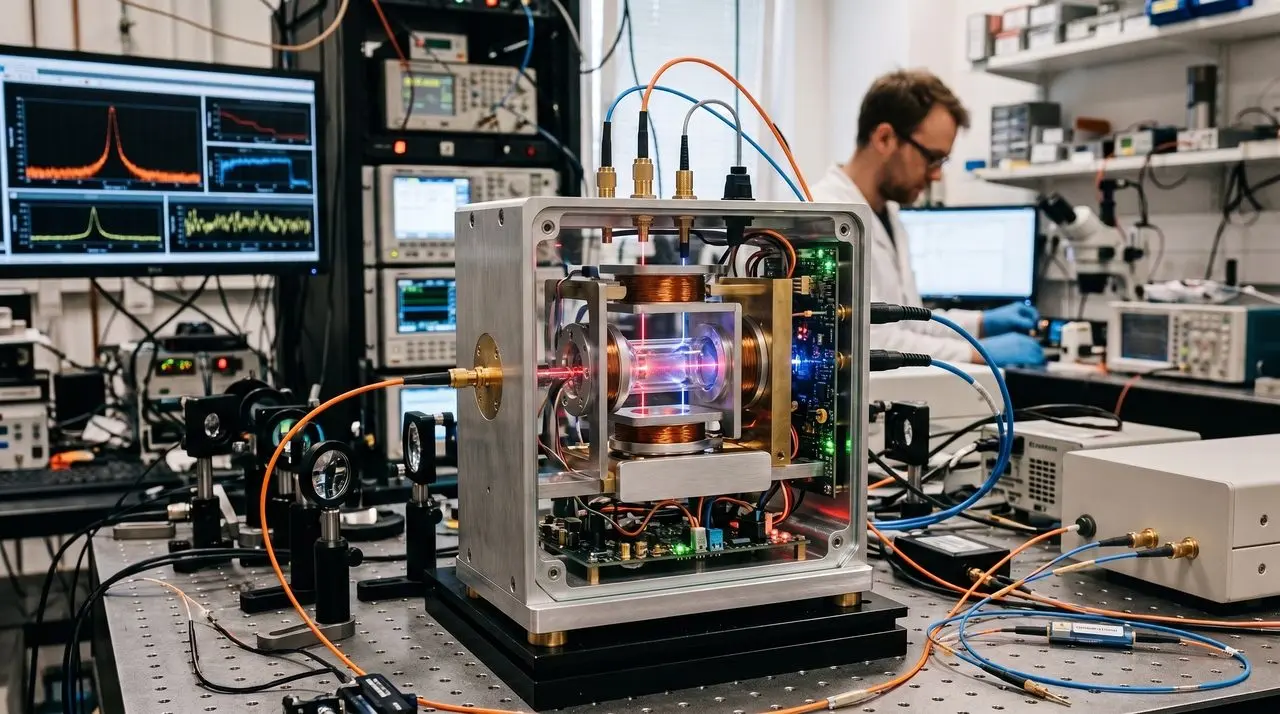
What limits the sensitivity of quantum sensors based on spin ensembles. A new dynamical decoupling technique, using carefully shaped microwave pulses alongside phase adjustments, sharply extends coherence protection within these systems operating at room temperature. The optimised protocol boosts signal clarity and provides an order-of-magnitude improvement in memory time compared with existing methods; it’s applicable not only to negatively charged NV centres in diamond, but also other similar materials experiencing significant variations in properties.
Protecting quantum information within materials is vital for advancing sensor technology; however, maintaining this delicate state has proven challenging. An improved technique using precisely shaped microwave pulses extends how long these fragile states last by over ten times compared with existing methods. This new approach works effectively even when properties vary across a material, enhancing both signal clarity and potential applications in diverse systems like diamond or boron nitride.
Spin ensembles, groups of tiny defects within materials like diamond that behave as microscopic compass needles governed by quantum mechanics, are pushing the boundaries of quantum sensing. Protecting these delicate quantum states from disturbance is key; however, maintaining coherence has proven difficult due to variations across materials and imperfections in control signals. The team developed a new technique employing precisely shaped microwave pulses, akin to gently “steering” a system between energy levels rather than abruptly changing them, alongside adjustments to their timing.
This optimised approach extends how long these fragile states last by an order-of-magnitude compared with existing methods, improving signal clarity and opening up possibilities for more sensitive sensors. But what are the limits of this improved protection when dealing with increasingly complex systems.
Rapid Adiabatic Passage Extends Quantum Memory Times ins
Coherence protection within nitrogen-vacancy centres in diamond enabled an order-of-magnitude increase in memory time, from approximately 49 microseconds using standard methods to 565 microseconds. Conventional dynamical decoupling techniques struggle when faced with amplitude or frequency inconsistencies that quickly degrade signal quality; this breakthrough surpasses previous limits imposed by imperfections and variations inherent in spin ensembles. Utilising rapid adiabatic passage pulses alongside phase adjustments, the optimised protocol enables strong quantum information storage previously unattainable under ambient conditions and opens avenues for more sensitive sensors capable of detecting weak oscillating fields.
The optimised protocol achieved a memory time of 565 microseconds through combining the KDD16 sequence with rapid adiabatic passage pulses, representing an order-of-magnitude improvement over standard XY8 methods employing rectangular pulses which yielded just 49 microseconds under identical ambient conditions. Sine- and parabola-shaped pulses refined coherence to 117 and 131 microseconds respectively within the XY16 or KDD16 protocols.
Detailed analysis revealed optimal performance at approximately 1 microsecond pulse separation, balancing error reduction against fidelity loss from repeated applications; T 1 relaxation was measured as 6.2 milliseconds while Hahn echo produced a T 2 time of 15.5 microseconds.
Rapid Adiabatic Passage Enhances Quantum Memory Despite Harmonic Signal Artifacts
Extending coherence times represents a clear win for quantum sensors, paving the way for more sensitive detection of faint signals, but limitations were acknowledged in their current approach. Specifically, unexpected “spurious peaks” appeared alongside desired readings when employing rapid adiabatic passage pulses with certain dynamical decoupling protocols like KDD16. These unwanted responses proved resistant to standard noise reduction techniques such as randomizing pulse timings and suggest that these harmonics are inherent in how gently “steering” quantum states affects signal clarity. Utilising carefully shaped microwave pulses alongside phase adjustments sharply improves coherence protection under ambient conditions.
This refined dynamical decoupling technique extends quantum information storage within spin ensembles by an order-of-magnitude. While conventional methods falter with material imperfections and control errors, rapid adiabatic passage, gently “steering” a system between energy levels, proves durable against these disturbances, enhancing both signal clarity and sensing capabilities. Further refinements will begin to address the unwanted responses observed and broaden applicability across diverse spin systems here.
The researchers found that using rapidly applied, smoothly changing pulses, called rapid adiabatic passage, in combination with adjusted phases significantly improved the performance of dynamical decoupling sequences in an ensemble of negatively charged nitrogen-vacancy (NV) centers. This approach extended quantum information storage time by ten times compared to standard pulse shapes under ambient conditions, reaching 131 microseconds.
The optimized protocol demonstrates resilience to imperfections common in real materials and control processes, which currently limit coherence protection. These findings suggest a pathway toward more sensitive quantum sensing utilizing spin ensembles like NV centers in diamond, while acknowledging ongoing work to address harmonic artifacts observed during signal detection.
👉 More information
🗞 Optimized Dynamical Decoupling for Spin Ensembles with Large Inhomogeneities
✍️ Rajan Paul, Genko Genov, Oliver Schmid and Fedor Jelezko (Ulm University); Shinobu Onoda (National Institutes for Quantum Science and Technology); Yutaka Kobayashi (Affiliation: Advanced Materials Laboratory, Sumitomo Electric Industries); Junichi Isoya (University of Tsukuba)
🧠 ArXiv: https://arxiv.org/abs/2610.39693



See today’s quantum computing news on Quantum Zeitgeist for the latest breakthroughs in qubits, hardware, algorithms, and industry deals.